Spinning sustainable food packaging
Elif Peker is finding new uses for sorghum waste as electrospun food films

By Elif Peker
Graduate School
Wednesday, July 8, 2026
Editor's note: "Driven to Discover" spotlights Kansas State University graduate students who are turning research ideas into real-world impact. Through their own voices, they share how their time at K-State is shaping discoveries that strengthen Kansas and serve the world.
Most packaging is plastic-based. It's cheap, but it creates waste that takes years, even millennia, to decompose, and its production leaves behind a large carbon footprint.
At the same time, the biofuel industry is steadily growing, and it also produces large amounts of by-products, such as sorghum Distillers Dried Grains with Solubles, or sorghum DDGS for short. These are mostly used as low-value, animal feed products.
But what if we could convert these by-products into something a lot more useful: a high-value, biodegradable food packaging film?
Electrospinning food films from nanofibers
Through my research, we extract functional compounds from sorghum DDGS and convert and upgrade them into a food packaging film. To do that, we use a technology called electrospinning.
Electrospinning uses an electric field to draw a liquid solution into ultra-thin nanofibers that are approximately 100 times thinner but significantly stronger than a human hair.
Compared to other technologies, electrospinning can produce nanofibers with higher surface area and porosity. This leads to better films that are more functional and interact better with oxygen, moisture and antimicrobial compounds.
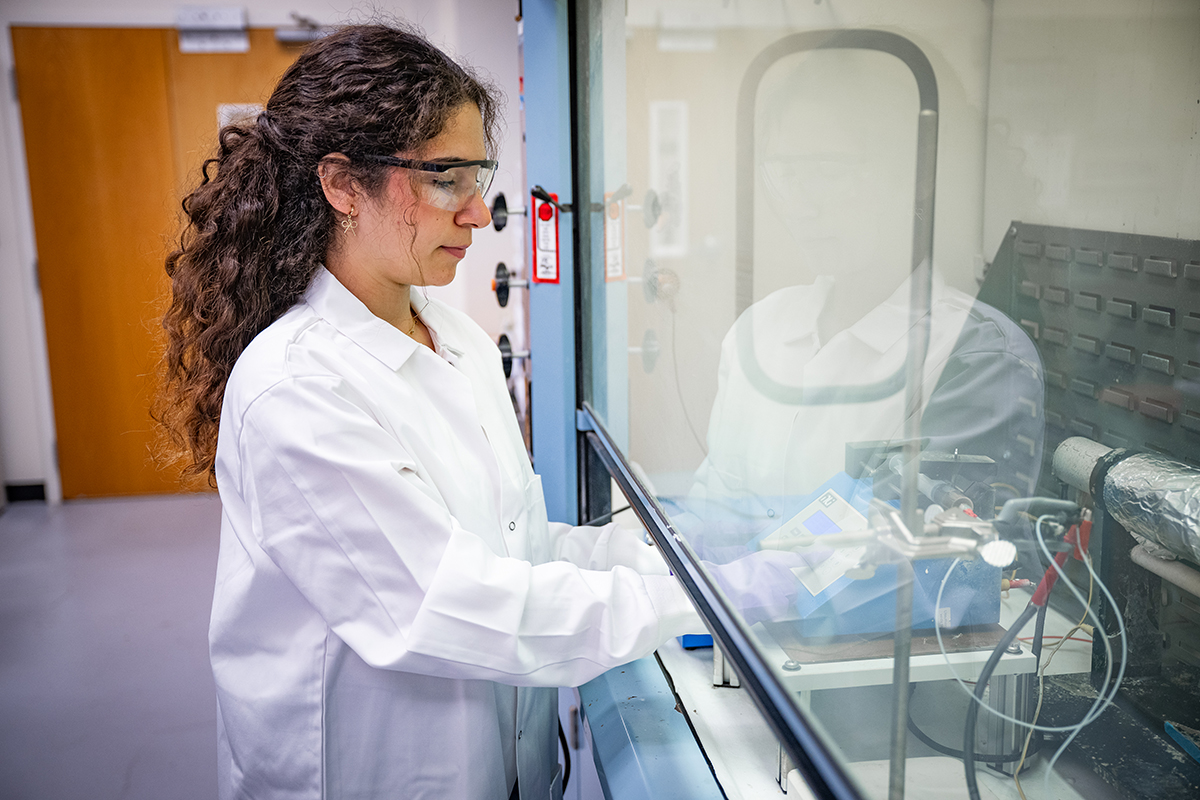
But our research goes further: we use an advanced form of electrospinning called coaxial electrospinning, which produces fibers with a double-layer structure — a core and a shell— in a single step. You can think of it like microscopic filled straw.
This method is more powerful because, with coaxial electrospinning, we can protect these functional compounds within the inner core. With the outer layer, the shell structure, you can control the release of these functional compounds over time. That makes the film more stable, more controlled and more functional.
Smarter packaging, longer freshness
The final impact is twofold. First, we can produce biodegradable packaging films that extend the shelf life of food products, such as fresh produce and fresh meat.
Second, we contribute to the environment by valorizing waste. We are upgrading a by-product into a high-value, biodegradable food packaging film.
In short, we are turning an agricultural byproduct into a new kind of packaging with electricity and nanotechnology.
Elif Peker earned her master's degree in food sciences from the Department of Grain and Food Science in spring 2026. This story was adapted from Peker's Three-Minute Thesis presentation " Improving Sorghum Byproducts for Use in Biodegradable Food Packaging Films."
Related Stories

Building beyond game day
What can Kansas City gain from hosting the World Cup? Salma Aouam, a spring 2026 master's graduate in regional and community planning, says the event could...

Small talk, big impact
Sarah Fenn, master's student in kinesiology, is developing a toolbox that doctors can use in speaking with women and helping them reduce their risk for major...
Unwrapping the sweet mystery
Shivaprasad Prakash is driving techniques that will make flour-based products, like raw cookie dough, safer for everyone.