Closing the spray gap
K-State engineers develop computer vision system to calibrate crop sprayer movement to within an inch
For farmers across the world, the cost of inputs such as seeds, water and fertilizer can be the difference between profit and loss in any given year. Consequently, the use of machines and tools to optimize those inputs and minimize waste is at the forefront of agricultural research.
An engineering research team at Kansas State University has made a breakthrough in this area by building a system that measures how far a crop sprayer's boom moves during field work and addressing an agricultural problem that has limited application accuracy for decades.
Aryan Singh Dalal, doctoral candidate in computer science, is the first author of "Computer vision based automated quantification of agricultural sprayers boom displacement," which was published in the journal Computers and Electronics in Agriculture. He is also a named inventor on a related U.S. patent assigned jointly to K-State and CNH Industrial America, an agricultural equipment and services company.
Joining Dalal as co-authors on the paper are Ajay Sharda, professor of biological and agricultural engineering and director of K-State's FarmsLab; Rahul Harsha Cheppally, assistant professor of biological and agricultural engineering; Sidharth Rai, research engineer; Rahul Singh, doctoral student; and Treman Singh Kaloya, graduate research assistant. Undergraduate students also played a role in the research, annotating much of the dataset of more than 9,400 images used to train the system.
Closing the measurement gap
Modern self-propelled sprayers carry booms up to 125 feet across — allowing producers to treat large portions of a field with fewer passes —and work at speeds approaching 19 mph. When the machine turns or crosses rough ground, the boom tips swing and bounce by as much as 10 feet. The nozzles end up somewhere other than where the machine assumes they are, so parts of a field receive too much product and other parts receive too little.
Engineers have understood the problem for years, but accurately measuring it has been the obstacle. Accelerometers drift over time, and ultrasonic and laser sensors cannot reach the end of a boom that long.
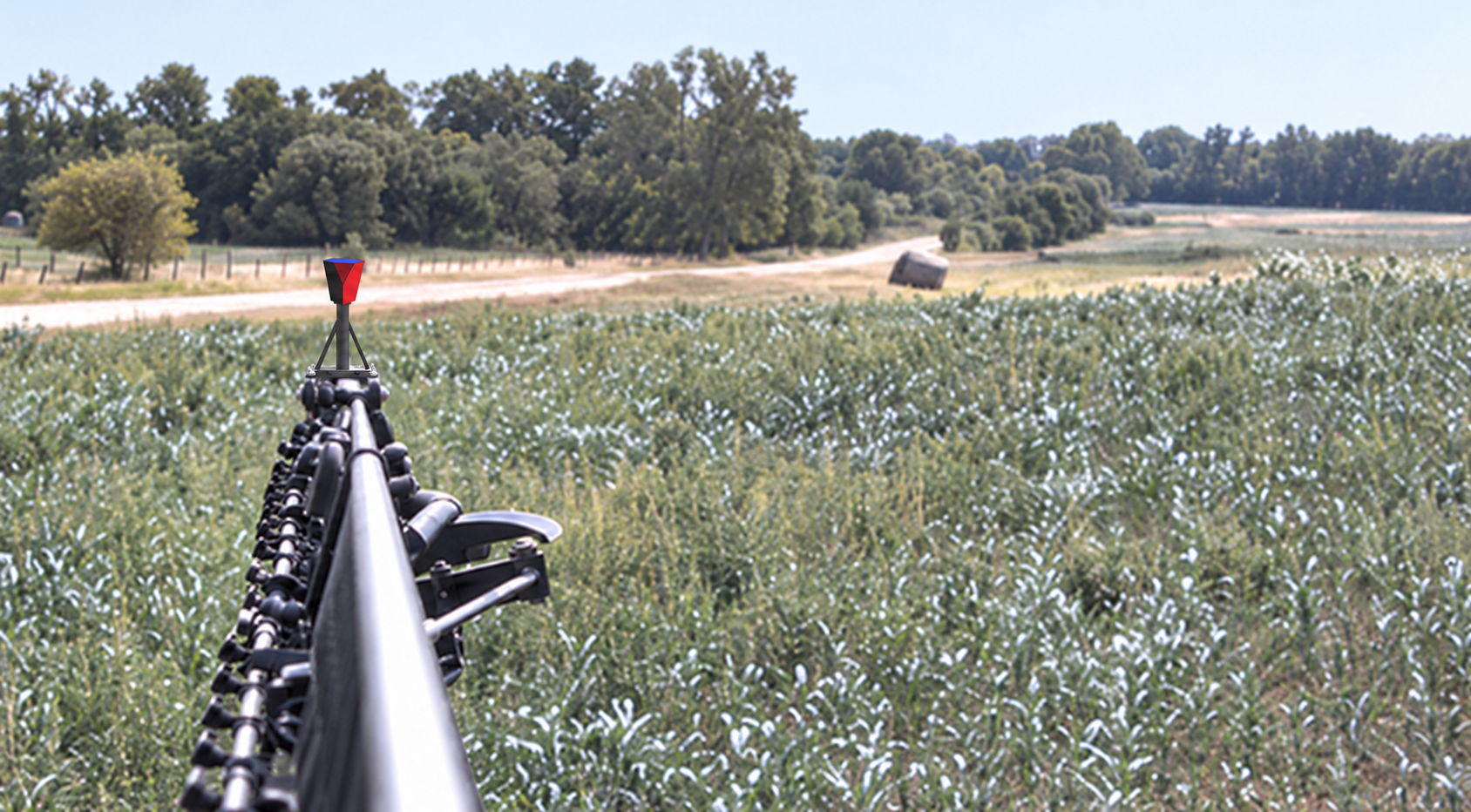
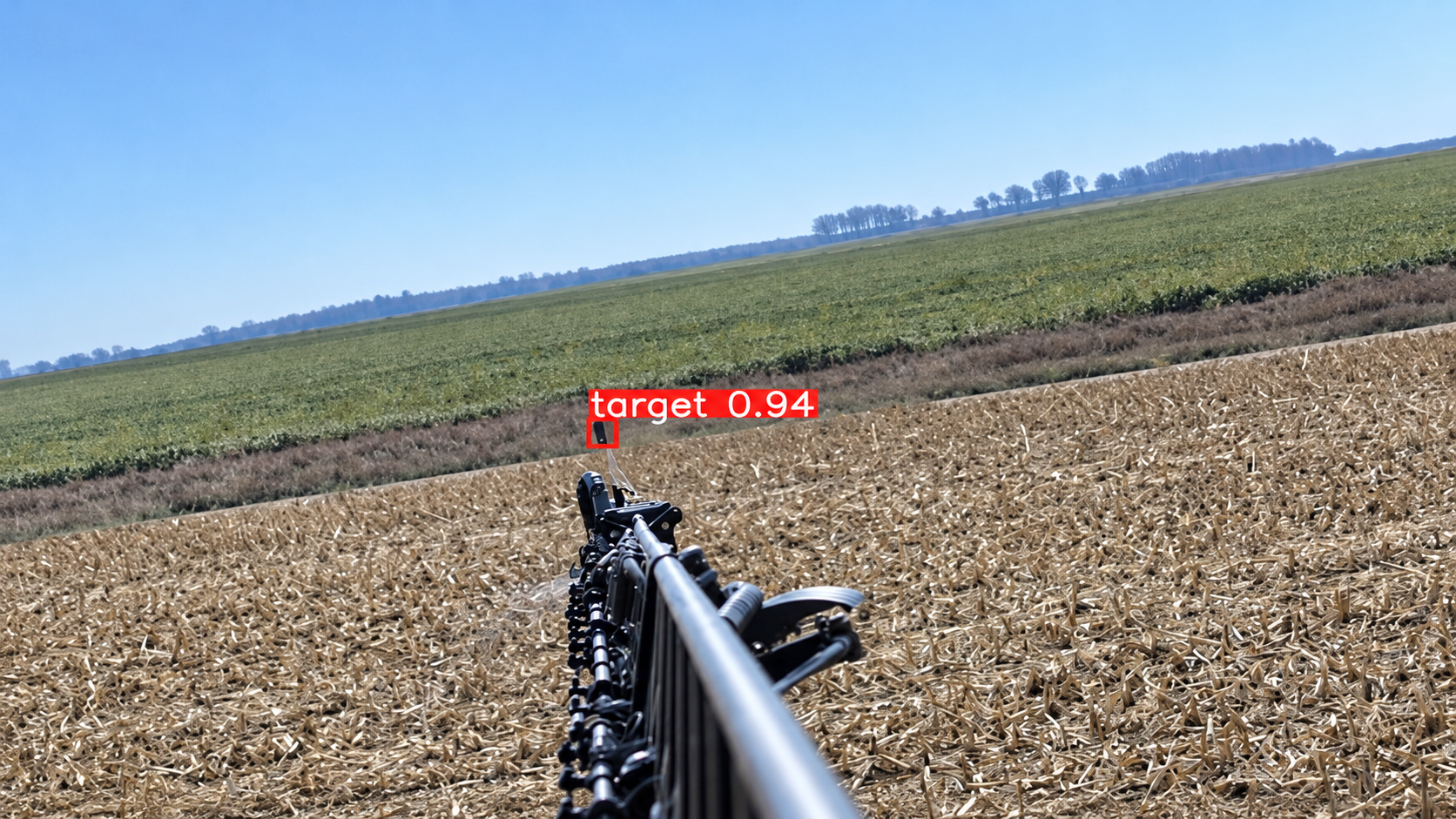
The system Dalal and Sharda developed uses a single camera mounted on the sprayer chassis, aimed at a target fixed to the boom tip about 60 feet away. A neural network locates the target in every frame and converts its movement into distance.
But finding a target the camera could hold onto took several attempts.
Building a solution
The team started with ArUco markers, the black and white squares common in robotics, but gave up on them after field testing.
"At that distance, the marker was only a handful of pixels, the crop canopy kept blocking it, and we could not make it bigger without changing how the boom itself moves," Dalal said. "So we designed our own."
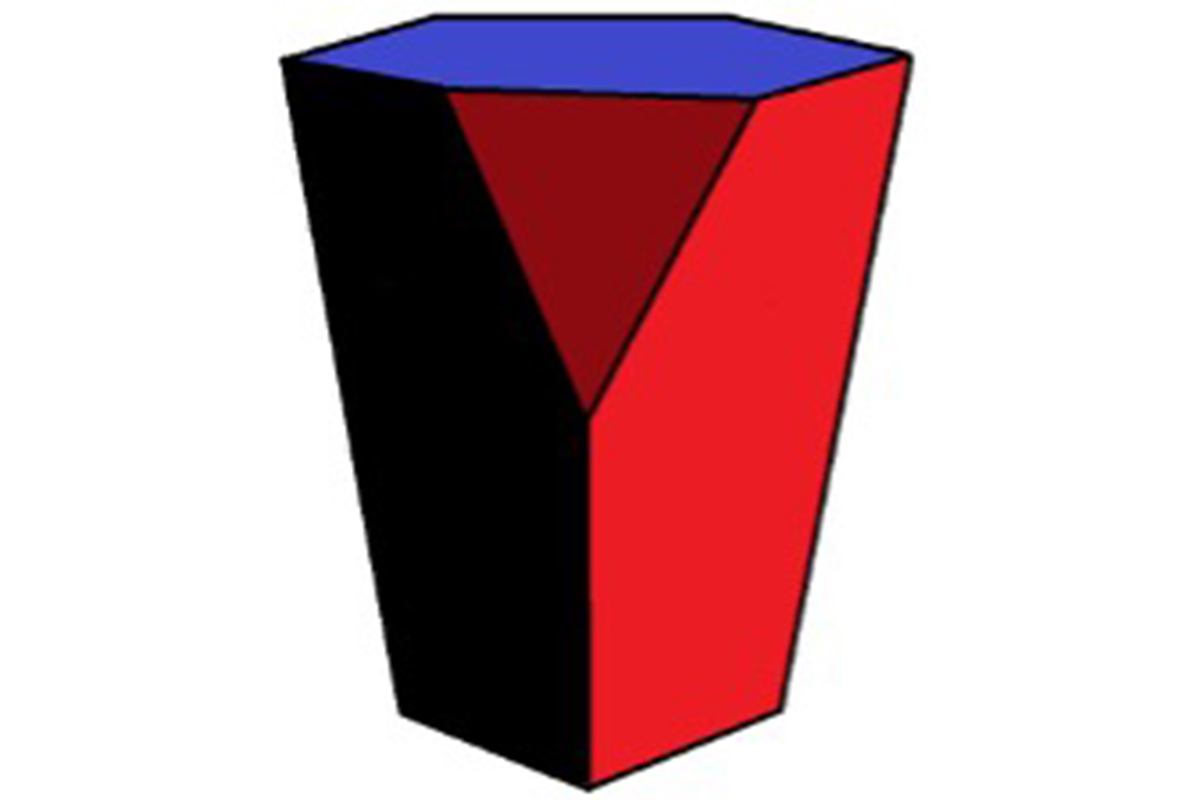
The replacement is a custom three-dimensional shape modeled on the scutoid, a geometric form found in the way biological cells pack together, in a color combination that does not occur generally in agriculture field.
The team validated the system against an inclinometer across more than 20 field trials in corn and wheat, running the sprayer with a full tank so the boom behaved as it does in real work. The camera measurements matched the sensor to within about an inch and held at that accuracy for boom movements up to 10 feet in both directions.
The patent covers what comes next. It uses the sprayer's own data, including speed, acceleration and a model of that specific boom, to predict where the boom should be. It then measures how far off it actually is and responds by adjusting nozzle output, repositioning boom sections, changing ground speed or alerting the operator. When the prediction misses by more than a set amount, the system updates its own model.
The concept is currently awaiting industrialization to be usable by the agriculture industry.
Dalal's co-inventors on the patent are Sharda, along with Kevin M. Smith and Jeremy A. Amundson of CNH Industrial.
Related Stories
Tackling global food security
Two new innovation labs at K-State, funded by the U.S. Department of State, will advance global food security through initiatives focused on cereal grains and...
Eavesdropping on hidden bugs
Some crop pests are nearly impossible to see — but they may still be making noise. Research led by entomology graduate student Emily Sur is testing a new...
Testing the way we've always done it
Testing Ag Performance Solutions program is helping producers rethink irrigation, measure results and apply lessons about water conservation back on the farm.