The Richard H. and Elizabeth C. Hageman Distinguished Lectureship in Agricultural Biochemistry
Made possible by a generous endowment provided by Dr. and Mrs. Hageman and hosted by the Kansas State University Department of Biochemistry and Molecular Biophysics.
About the Hagemans
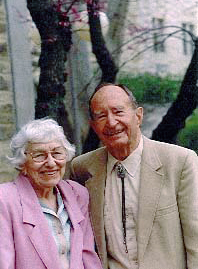 Richard Harry Hageman grew up in Washington County, Kansas. He obtained his B.S. in Chemistry at K-State and an M.S. at Oklahoma State. Following his experience as a research chemist at experiment stations in Kentucky and Puerto Rico, interrupted by 4 years in the army chemical corps, he returned to graduate school and obtained the Ph. D. from the University of California at Berkeley, with D.I. Arnon in 1954. He rose through the ranks at the University of Illinois and in 1984 became Professor Emeritus.
Professor Hageman was recipient of several awards, from the American Society of Agronomy (Crop Science), the American Society of Plant Physiologists (Hoagland), the American Chemical Society (Spencer) and Funke Seed Corn Co. (Funke). In his research, professor Hageman successfully struck a balance between fundamental laboratory research into plant metabolism and application of biochemistry to plant breeding through field studies.
When Richard Hageman was nominated for the first Hoagland award it was pointed out that his distinct contribution was "his formulation, early in his career, that rate-limiting enzymes could be identified and used as a basis to select for specific traits which lead to higher crop yields. This singular focus, which resulted from and contributed to his research on nitrate reductase, is so basic and now so readily understood that it is taken for granted in all of plant science." His major contributions to understanding of plant nitrogen metabolism included the finding that nitrate reductase is an inducible enzyme, and identification of nitrite reductase as a distinct enzyme dependent on ferredoxin in chloroplasts.
Elizabeth C. Hageman obtained her B.S. and M.S. degrees at Oklahoma State University. She worked for many years in biochemistry with distinguished scientists including C.H. Li at Berkeley, and G. Hanson and W. Ogren at Illinois. With Professor Hanson, she was involved in pioneering work on in vitro culture of bovine mammary gland tissue.
Richard H. and Elizabeth C. Hageman were married for more than 61 years, until his death in December 2002. They have three children and a baker's dozen of grandchildren.
Hageman Lectures
|
Date |
Speaker |
Lecture/ Colloquium Titles |
|
Canceled |
Fred Nijhout |
|
|
2025 |
Daniel Herschlag Professor of Biochemistry Stanford University |
|
|
2022 |
Daniel Voytas Director, Center for Precision Plant Genomics, University of Minnesota, Department of Genetics, Cell Biology, and Development |
|
|
2019 |
Harry Klee Institute of Food and Agricultural Sciences, University of Florida |
|
|
2017 |
Jennifer Lippincott-Schwartz Howard Hughes Medical Institute, Janelia Research Campus |
|
|
2016 |
Douglas C. Rees Investigator, Howared Hughes Medical Institute, California Institute of Technology, Division of Chemistry and Chemical Engineering |
|
|
2015 |
Randy Schekman 2013 Nobel Laureate in Physiology or Medicine, University of California, Berkeley, Department of Molecular and Cell Biology |
|
|
2014 |
Elliot Meyerowitz Investigator, Howard Hughes Medical Institute, California Institute of Technology, Division of Biology and Biological Engineering |
|
|
2013 |
Kary B. Mullis 1993 Nobel Laureate in Chemistry |
|
| 2012 October 24-25 |
Jeffrey Palmer Indiana University, Bloomington, Department of Biology |
|
| 2012 April 18-19 |
James Birchler University of Missouri, Columbia, Division of Biological Sciences |
|
| 2010 November 3-4 |
Richard Amasino Investigator, Howard Hughes Medical Institute, University of Wisconsin, Madison, Department of Biochemistry |
|
| 2009 November 16-17 |
May R. Berenbaum University of Illinois, Urbana-Champaign, Department of Entomology |
|
| 2008 November 5-6 |
Dale E. Bauman Cornell University, Department of Animal Science |
|
| 2007 October 24-25 |
Elizabeth Vierling University of Arizona, Department of Chemistry and Biochemistry |
|
| 2006 November 8-9 |
Catharine Ross Pennsylvania State University, Department of Nutritional Sciences |
|
| 2005 October 12-13 |
Steven Tanksley Cornell University, Department of Plant Biology |
|
| 2004 October 27-28 |
Michael Thomashow Michigan State University, Plant Research Laboratory |
|
| 2003 October 29-30 |
Bruce Hammock University of California, Davis, Department of Entomology |
|
| 2002 October 23-24 |
Christopher Somerville Stanford University, Carnegie Institution, Department of Plant Biology |
|
|
2001 |
Virginia Walbot |
|
| 2000 April 20-21 |
Brian Larkins University of Arizona, Department of Plant Sciences |
|
| 1999 April 15-16 |
Maarten J. Chrispeels University of California - San Diego, Department of Biology |
|
| 1998 April 15-16 |
Eugene W. Nester University of Washington, Department of Microbiology |
|