Farm question sparks new yield-prediction method
A planting debate on a western Kansas farm led a K-State graduate student to develop a method for measuring what early-season soil moisture can reveal about the harvest ahead

By Kelsey Stremel
College of Agriculture
Friday, Nov. 20, 2026
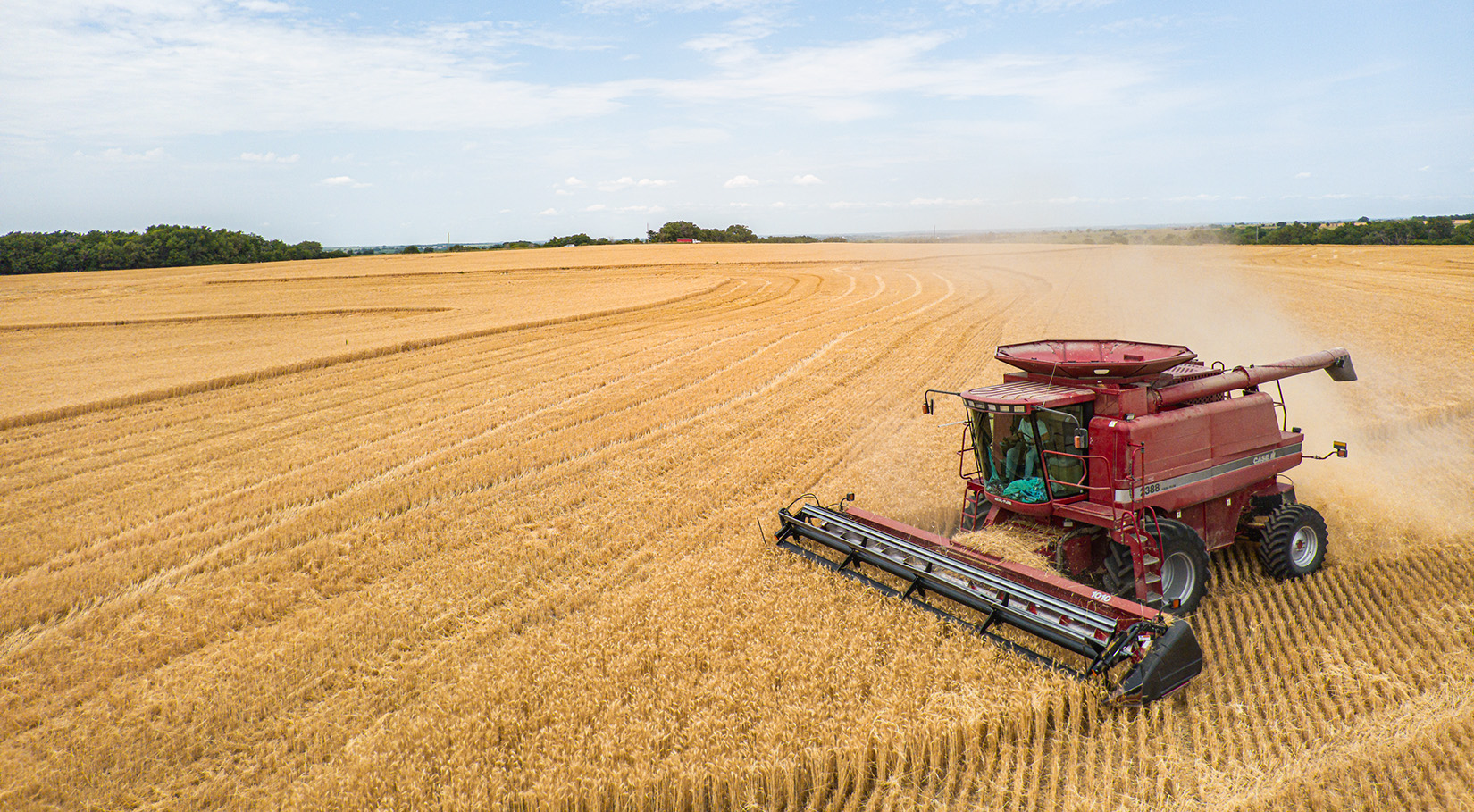
Spring 2024 brought welcome moisture to western Kansas. On the Vulgamore family's farm near Scott City, the talk turned to planting more corn and less sorghum. Parker Vulgamore, then a Kansas State University graduate student in agricultural economics, wondered whether the wet start justified the switch.
"Does that actually follow?" he recalled asking his father, Brian, and the agronomists they work with. "Just because we built up this great soil moisture profile ... does that actually correspond to better yield outcomes?"
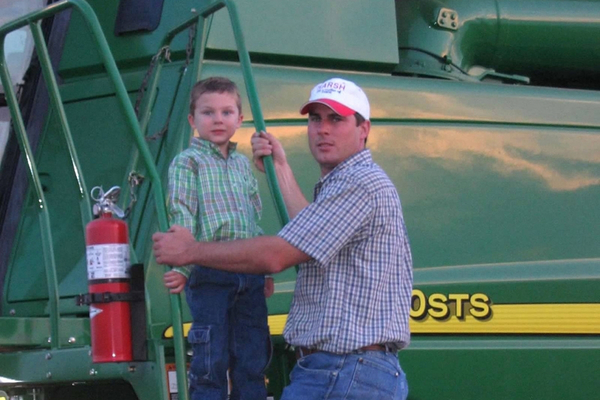
Nobody had a clear answer. Yet early-season moisture helps shape decisions far beyond the farm. Vulgamore set out to measure it. His master's thesis produced both an answer to his question and a new method for finding it, work that earned him one of agricultural economics' top national honors for graduate research.
"While early-season soil moisture conditions are widely used by farmers, insurers, merchandisers and futures markets to form expectations, their actual predictive value had not been clearly quantified until this work," said Jennifer Ifft, Vulgamore's major professor and a K-State Extension agricultural policy specialist in K-State's Department of Agricultural Economics. "It's a critical and timely problem in agricultural economics."
Building a method from scratch
Most crop yield research focuses on the growing season, when plants are especially sensitive to heat and moisture. Vulgamore's team examined the issue from a different timeline: How much can producers know before they make decisions about crop choices, seeding rates, input purchases and insurance coverage?
Micah Cameron-Harp, then a postdoctoral fellow in the department and now an assistant professor, had been working with daily, high-resolution soil moisture estimates modeled by NASA.
"Rainfall is easy to measure," he said, "but it doesn't necessarily reflect how much water is available to plants."
Turning those estimates into something useful meant solving two problems. Because soils hold water differently, the team converted raw moisture readings into relative values that could be compared across sandy and clay soils. To test how moisture levels related to yield, the researchers adapted an approach used in studies of temperature and crops, counting how many of the 30 days before planting fell into each moisture range.
Vulgamore wrote the code that cycled through hundreds of model specifications, testing different moisture ranges on Beocat, K-State's high-performance computing cluster. The models often ran overnight and over weekends. The final data set covered 71,644 county-year observations from 2,318 U.S. counties between 1990 and 2022.
Vulgamore is quick to credit Cameron-Harp for the design.
"Micah helped us import that sort of methodology and way of thinking about the problem specifically for soil moisture," he said. "Once you wrap your mind around it, it is really cool the way we approached the problem."
Ifft said the method could also be applied to other crops, regions and climate variables.
K-State study finds regional differences in moisture effects on yield
Looking at regions separately revealed a critical distinction: The same spring moisture conditions can be associated with stronger yields in one place and weaker yields in another.
"If it's super wet in Kansas early in the year, it's generally beneficial," Cameron-Harp said. "If you go to the Northeast and have the same exposure to soil moisture, the expected yields are below average."
In Iowa, a dry spring could mean planters get into the field on time or that fewer nutrients are leaching out of the soil, Vulgamore said. In western Kansas, it could signal a longer drought or that the corn doesn't have the stored soil moisture it needs.

"Any farmer out here will tell you we need a strong soil moisture profile to carry us through the inevitable stretches without rain," he said.
Those regional differences can get washed out in national averages. Still, the nationwide model found a clear penalty at the dry extreme. Swapping just one typical day in the 30 days before planting for a day when the topsoil sat near the wilting point (the driest conditions measured) was associated with dryland corn yields about 3% lower nationwide. Regionally, the same one-day swap was associated with yields about 7% higher in the Heartland and about 6% lower in the Northern Great Plains.
The stakes extend beyond the field.
A robustness check showed the pattern carried over to crop insurance. In the Great Plains, including most of Kansas, drier early-season conditions were associated with higher loss ratios, meaning insurance payouts were higher relative to premiums collected.
In both the heartland and Northern Crescent — states along the northeast border from parts of Minnesota east through Wisconsin and Michigan to Maine, and south to Pennsylvania and New Jersey — drier starts were associated with lower loss ratios.
Soil moisture research provides a foundation for future forecasting
Vulgamore's team's findings point the way, but they don't yet tell a producer what to plant.
"There's a signal, but that signal varies dramatically by the region," Vulgamore said.
The study looked only at corn, and the choice his family faced in 2024, corn or sorghum, would need its own model. So would decisions about wheat and fallow.
Field-level yield data from USDA's Risk Management Agency could sharpen the next round of analysis. The K-State team is preparing the work for journal submission.
Cameron-Harp sees a practical next step: an annual tool that estimates yields from early-season soil moisture in time for crop insurance and marketing decisions. If a bumper crop looks likely, for example, a producer might sell earlier.
For Vulgamore, the lasting contribution is the method.
"As people are able to use AI and bring in more data, they can potentially rely on this methodology to test it out," he said.
K-State research on soil moisture earns national acclaim
Vulgamore's thesis, "A non-parametric approach to estimating nonlinear impacts of early season soil moisture on dryland corn yields," earned a 2026 Outstanding Master's Thesis Award from the Agricultural & Applied Economics Association. The national professional association for agricultural economists gives no more than three of these awards each year, choosing from master's research across the country. Vulgamore was recognized at the association's annual meeting in Kansas City, Missouri.
Ifft wrote in her nomination that the thesis went "far beyond the scope of most MS theses." Jesse Tack, professor of agricultural economics, also advised the project.
Vulgamore, who earned his bachelor's degree in agricultural economics from K-State in 2023 and his master's in May 2025, chose K-State for graduate school because its research tackles practical problems. He also credits Ifft for backing a project outside her usual policy focus. "Her willingness to take this on and support me and some of my crazy ideas is really appreciated," he said.
Today, Vulgamore is a second-year student at Harvard Law School. After a summer in the U.S. Department of Agriculture's Office of the General Counsel, he will join the food and beverage regulatory practice of a global law firm in Washington, D.C., next summer. The long-term plan points home. "Ultimately, my wife and I want to come back to Kansas," he said. "As soon as possible."
His research efforts offer a new way to investigate one of agriculture's oldest questions: What can the soil tell us about the harvest before a seed ever goes into the ground?
"This research strengthens the bridge between agricultural economics and applied agronomy," Ifft said. "It started with a question producers ask every spring, and it gives the next generation of researchers a way to answer it."