High-stakes engineering in a kiddie pool
K-State's Fountain Wars team looks to be back-to-back champs at ASABE national competition
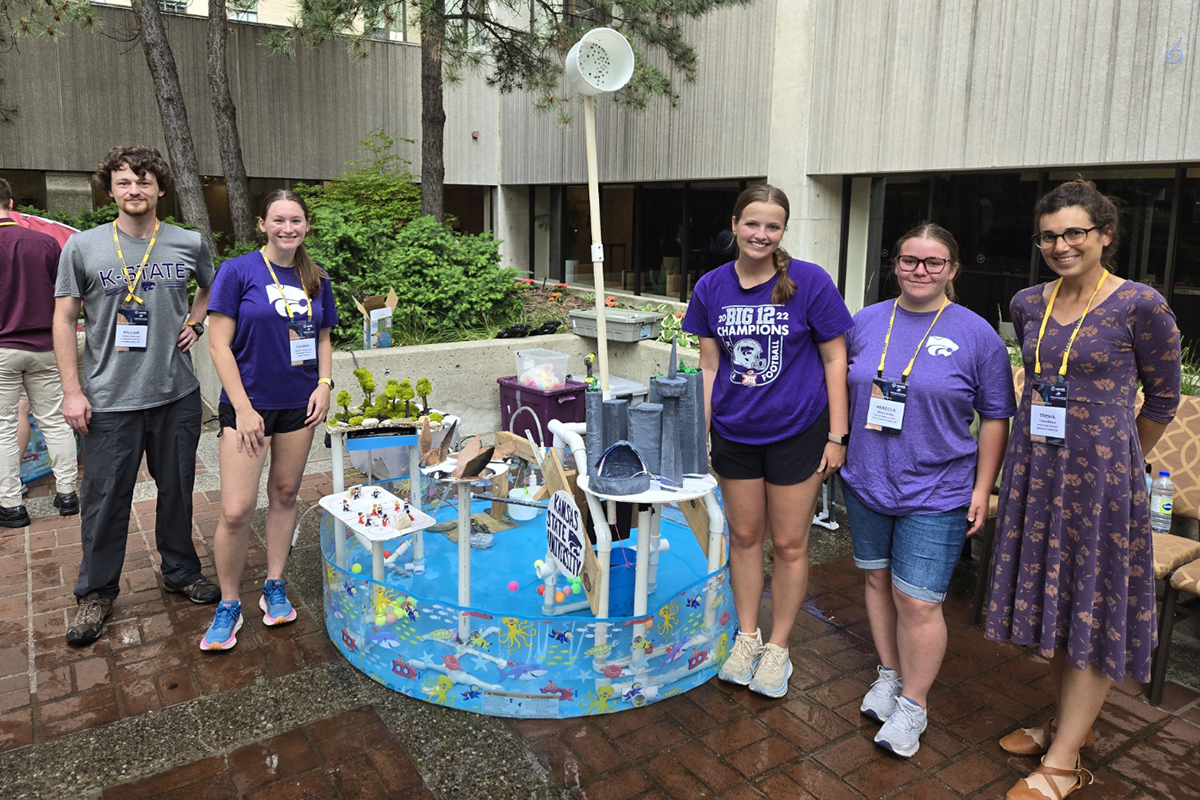
After coming in first in ASABE's 2025 competition, K-State's Fountain Wars team is headed to Indianapolis this summer to defend their title as national champions.
By Grant Guggisberg
Carl R. Ice College of Engineering
Monday, July 13, 2026
Engineering can look like many different things depending on the problem being solved and the skills being applied. Engineers build and innovate nearly all the interconnected systems of modern society, from roads and power systems to the food we eat and water we drink.
For the Kansas State University Fountain Wars team, engineering looks like turning a six-foot plastic kiddie pool into a high-stakes, water-powered competitive arena. The five-member design team, led by president Riley Smart, a spring 2026 graduate in environmental engineering from Olathe, is gearing up for a unique challenge that blends rigorous technical tasks with aesthetic creativity.
The team will travel to Indianapolis this week for the annual international conference of the American Society of Agricultural and Biological Engineers, or ASABE, where the 2026 Fountain Wars competition will take place. K-State's team won the event in 2025, which was the club's first win since 2019 and third win since the competition began in 2003.
Fountain Wars is hands-on, real-time student design competition
The premise of Fountain Wars is straightforward yet leaves room for each team's creativity. Each year, the competition gives teams a unique technical task alongside a theme based on the host location, with the stipulation that the final product must fit completely inside a six-foot plastic pool.
"It's not like an actual fountain you see at a park," Smart said. "You build a mechanism that's water powered to complete different tasks, and then you also want it to be aesthetically pleasing and match the theme."
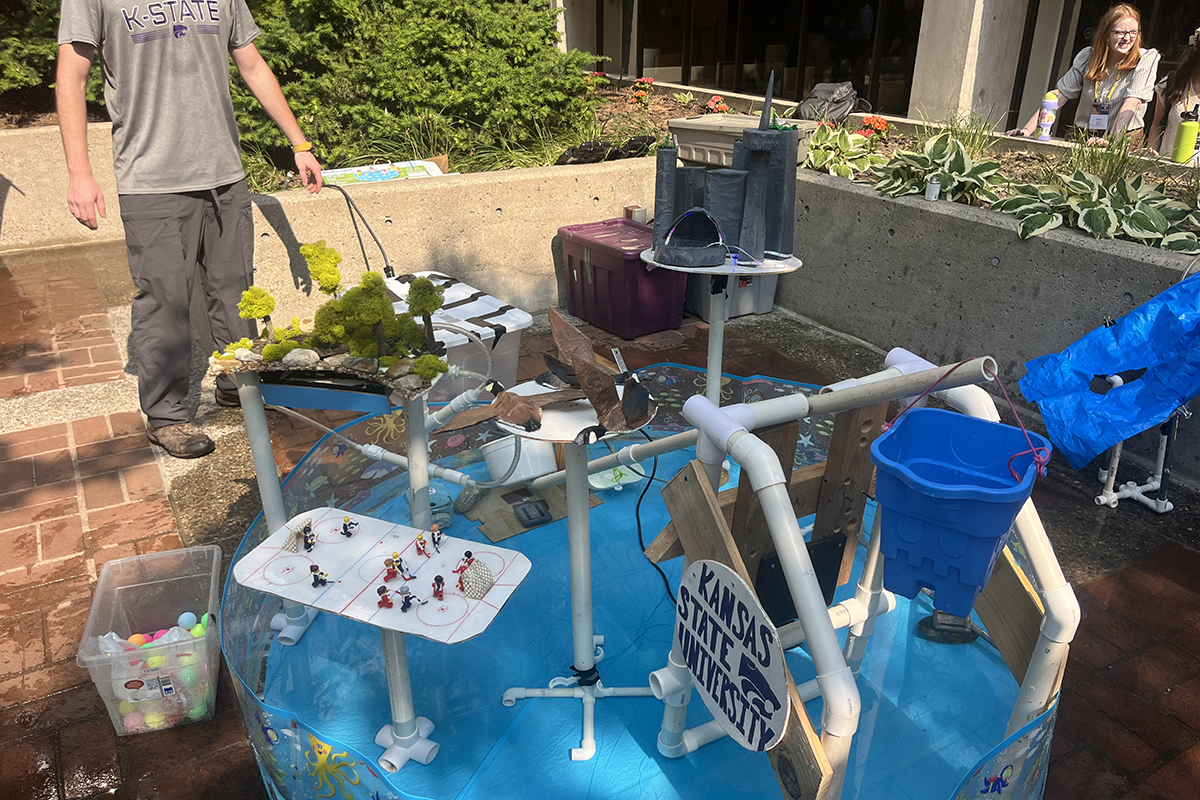
With the upcoming competition in Indianapolis, this year's theme centers on the Indy 500. The team's technical task is to construct a water-driven racetrack. To complete it, teams must move an object of their choice – K-State opted for a lightweight ping-pong ball – along a track with at least three turns and distinct changes in elevation.
The scoring balances velocity with engineering ambition, measuring both time and the track's overall length.
K‑State team is reigning 2025 Fountain Wars champions
This racetrack task is a sharp departure from last year's event in Toronto, where the objective was to construct a mechanism to launch objects into a bucket positioned 15 feet outside the pool within a 90-second window. While other teams built systems that ran continuously, the Wildcat team launched all its ping pong balls at once.
"Last year, we built like a catapult, trebuchet-type shape," Smart said. "It was very Hail Mary. But it worked because it was consistent."
The team's success in 2025 relied heavily on precise experimentation. Team members utilized recycled components, donated class materials and borrowed pumps from the Carl and Melinda Helwig Department of Biological and Agricultural Engineering to stay under budget. To maximize its score, the team also incorporated biological elements into its aesthetic presentation, such as moss and wood.
Fountain Wars team is small but mighty
Including Smart, the K-State team has five members: William Matchell, spring 2026 graduate in civil engineering, Leawood; Rebecca Jilka, senior in biological systems engineering, Westmoreland; Lauren Henderson, senior in marketing, Waller, Texas; and Shaylee Sockel, senior in industrial engineering and mechanical engineering, Gretna, Nebraska.
Trisha Moore, associate professor of biological and agricultural engineering, serves as faculty advisor to the team.
Applied engineering
Build satellites, design racecars and experience engineering like never before at K-State's Carl R. Ice College of Engineering.
While the preference would be to continue to recruit new members to the team, Smart views the group's compact size as an advantage rather than a hindrance. While larger, more established design teams sometimes relegate younger students to minor tasks, K-State's small footprint forces everyone into the trenches during their weekly build sessions.
"I think having a small team kind of helps us," Smart said. "It helped us better understand each other's talents, which I think helped us build a better fountain. We're good at knowing each other's strengths."
Related Stories
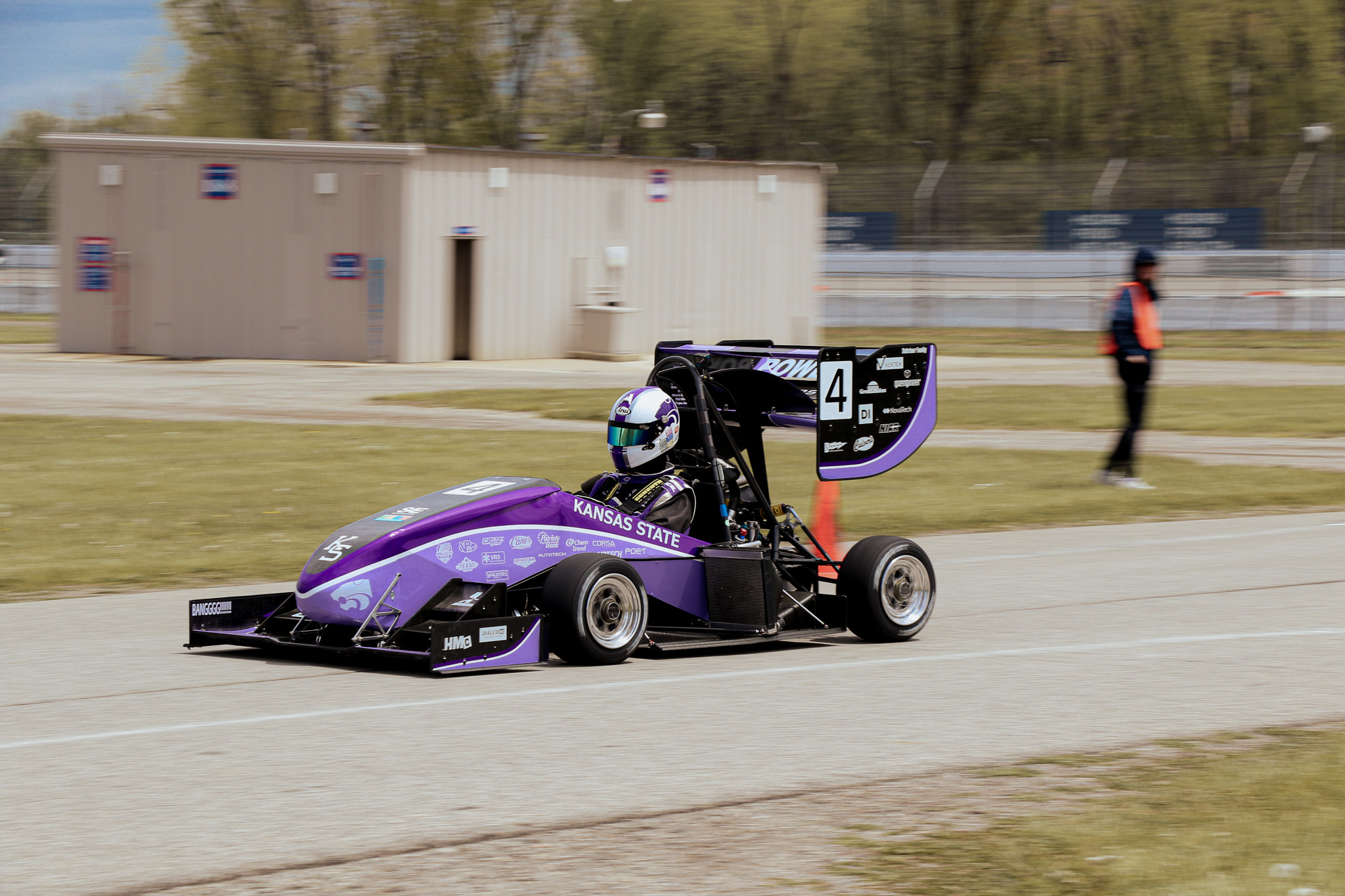
Powercat Motorsports finishes top three at Formula SAE Michigan
The team's trend of constant improvement at the competition continued in 2026 with the club cracking the top three at Formula SAE Michigan, once again resetting...
Engineering Extension wraps up 2026 KidWind Challenge with four Kansas teams named national champions
In a thrilling finish to its 2026 KidWind Challenge season, the Kansas Energy Program, part of K-State Engineering Extension, saw four Kansas teams recognized...
Classroom to the cosmos
The Wildcat Space Program is giving K-State students the opportunity to collaborate across disciplines and tackle the real-world challenges of building satellites...