Sedimentary sleuths
K-State research explores effects of Tuttle Creek Reservoir dredging

By Pat Melgares
K-State Extension
Friday, May 15, 2026
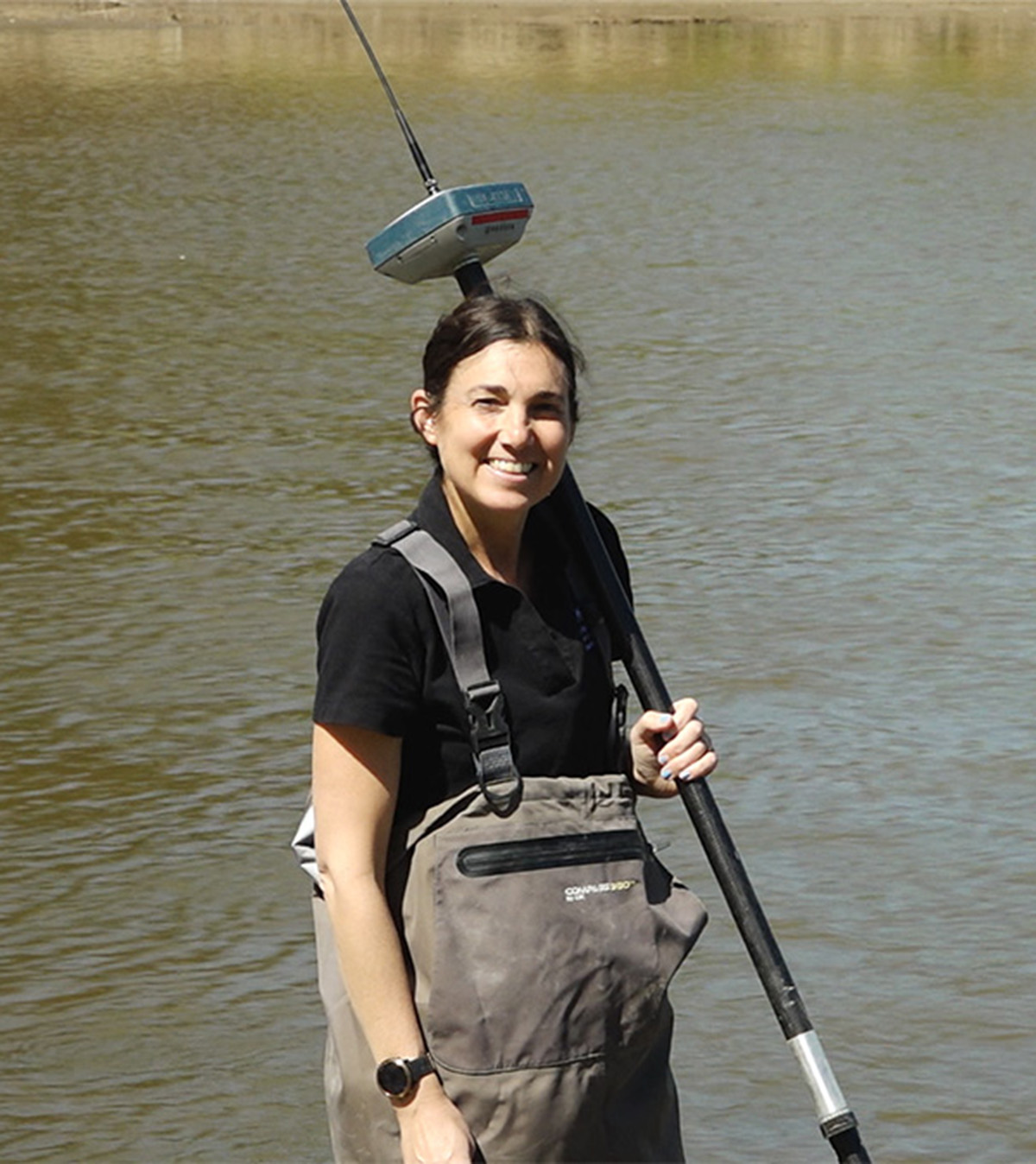
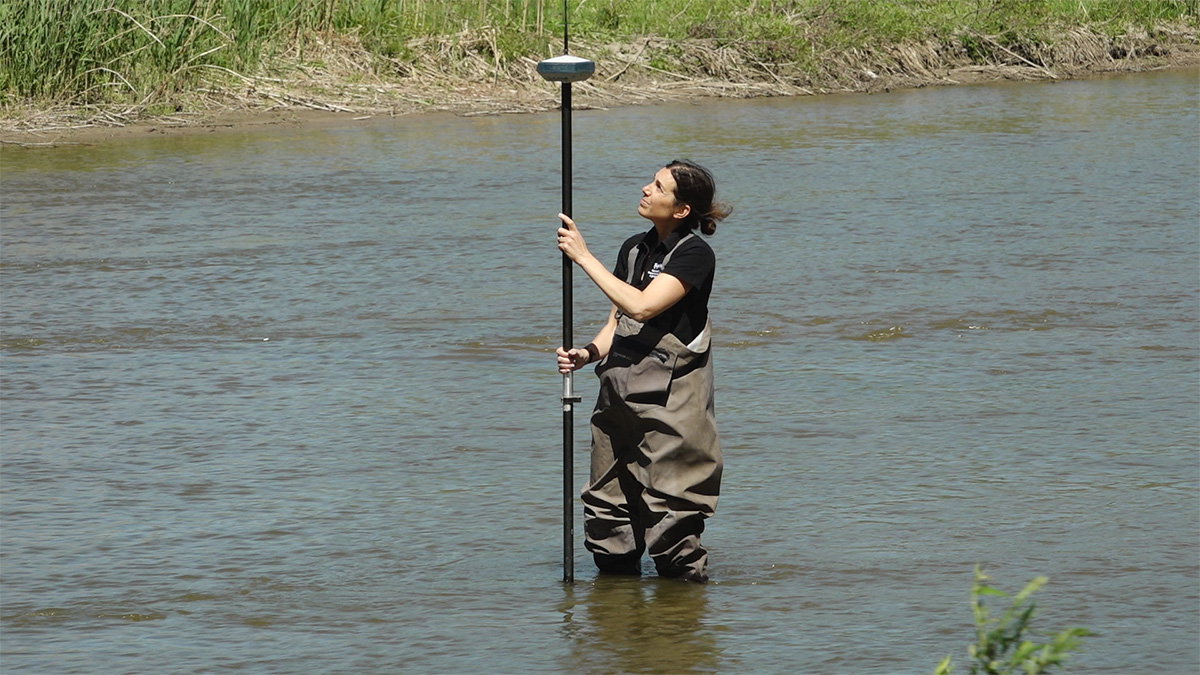
As Trisha Moore wades through a knee-deep portion of the Kansas River in northeast Kansas, each squish-squish movement in her rubber boots gets her one step closer to answering a difficult water quality question.
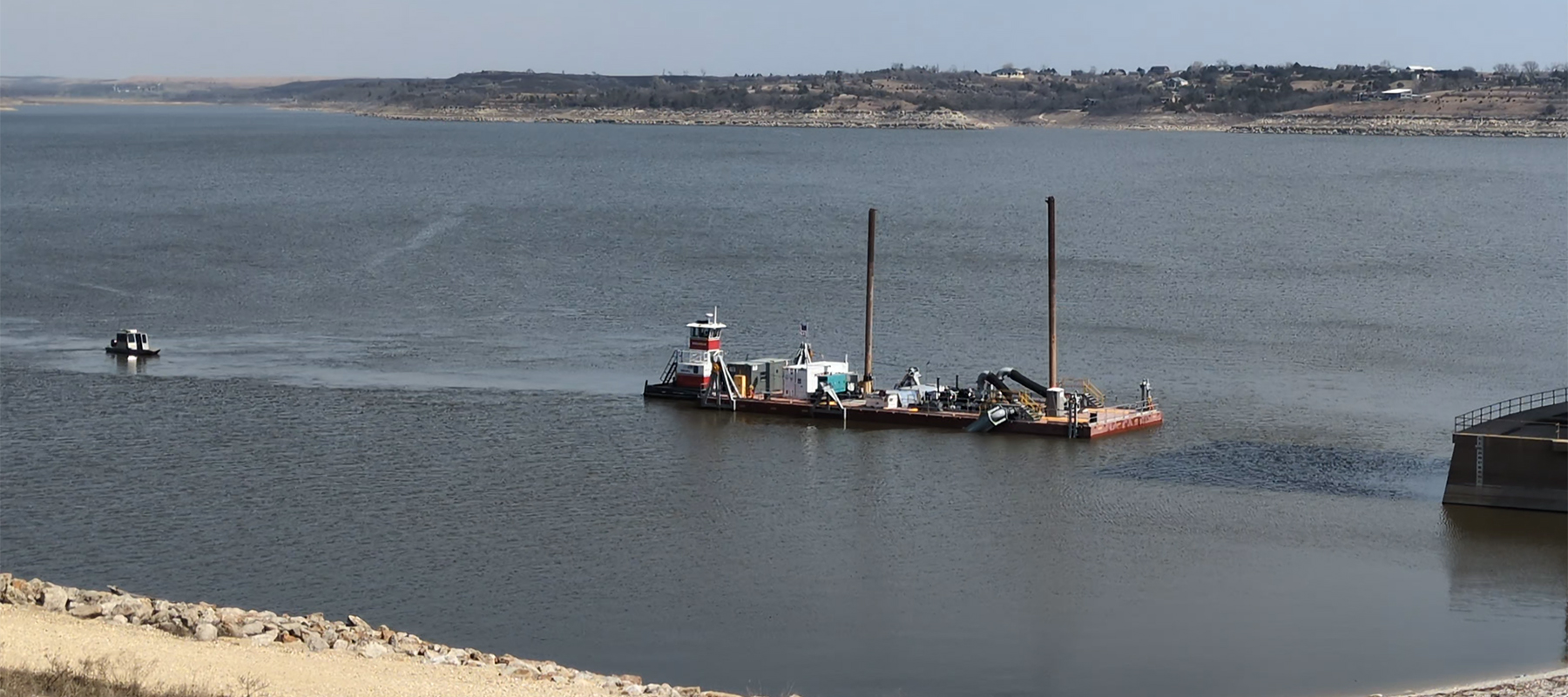
Moore, an associate professor in Kansas State University's Carl and Melinda Helwig Department of Biological and Agricultural Engineering, is using satellite-driven equipment to measure the buildup of sediment downstream from where the U.S. Army Corps of Engineers is testing a water injection dredging system in the Tuttle Creek Reservoir, a vast 10,900-acre artificial lake built more than 60 years ago for flood control.
K-State project analyzes effects of Tuttle Creek Reservoir dredging
Water injecting dredging is considered to have fewer environmental impacts compared to other reservoir sediment management techniques. An alternative is excavating and moving the sediment to a disposal site, a much more costly and resource-intensive technique.
Over time, sediment builds in any reservoir from stream banks, farm fields and other lands upstream. In the case of the Tuttle Creek Reservoir, sedimentation from nearly six decades of use ultimately has affected the dam's ability to hold water that provides flood protection and water supply for downstream communities.
Aside from providing an estimated $62.2 million annually in flood damage protection for downstream communities, the system supplies water for approximately 40% of Kansas residents.
"What we want to learn," Moore said, "is whether sediment moved by dredging at the Tuttle Creek dam is depositing in the river, and if so, is it changing the shape, or morphology, of the channel? Is that beneficial to the waterway, or is it something we need to be aware of so that we can address it?"
Wildcat researchers, partner institutions, evaluate dredging effects on ecosystem
Partners at Virginia Tech University, the Kansas Biological Survey and K-State's Division of Biology are studying other water quality effects in the reservoir and downstream rivers, including potential impacts on aquatic insects and the fish population.
"All of that is important to the ecosystem, right?" Moore said. "It's incredibly important work for the Kansas River system and for areas downstream."
Moore and her team of graduate students will cover several miles of the water system, spanning areas just south of the Tuttle Creek Dam reservoir in the Big Blue and Kansas Rivers. A control site — where they'll measure the system's natural buildup of sediment — is located upstream of the dam near the Highway K-177 bridge entering Manhattan’s south side.
Moore says K-State's work includes three locations — called reaches — that may be affected by sediment flow from the dredging project, and one reach that is not thought to be affected — the control site.
The research team is meticulous in its work. A single reach takes researchers several hours to weave side-to-side across the width of the river, taking elevation measurements of the stream bed, sand bars and banks with their survey equipment to determine if additional sediment has deposited following the dredging activities.
So far, sediment variation appears 'well within natural background levels'
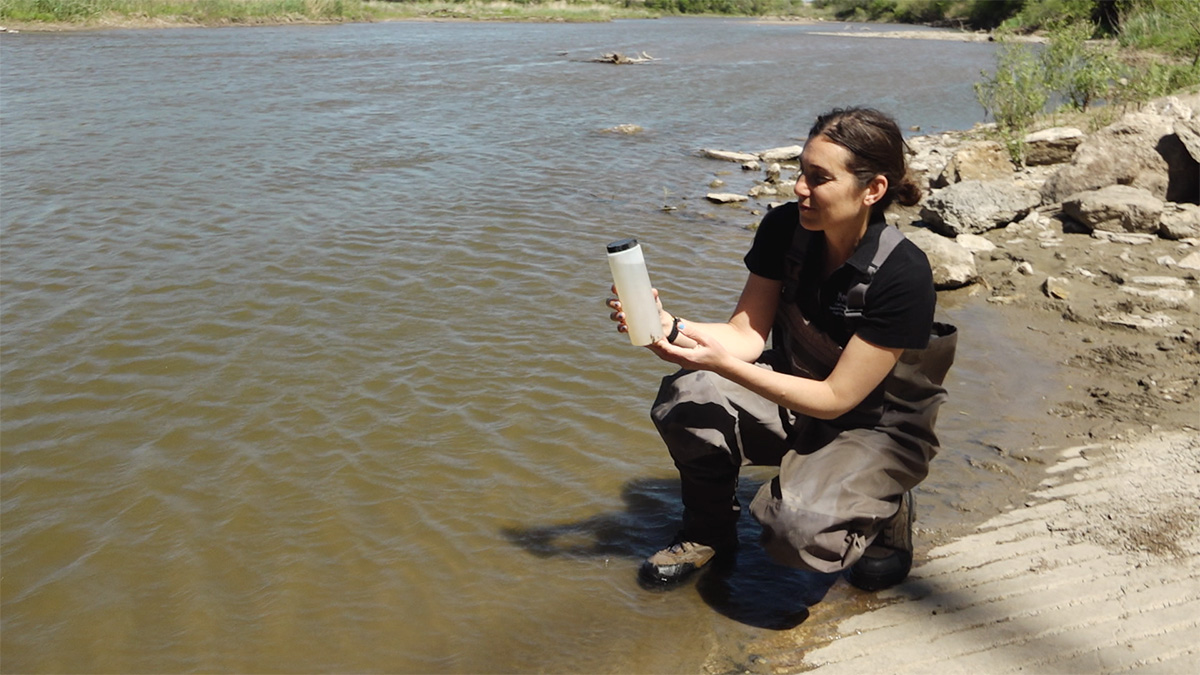
"The Kansas River is a very dynamic river," Moore said. "In the sand beds, the sand moves; you can stand in the water and feel the sand moving under your feet as the river flows."
That seems to favor the Corps' water injection dredging strategy because sediment – mostly fine clay material – has thus far not been causing unusual sediment buildup in the bed of the river.
"The variation that we have seen with our monitoring equipment so far is well within the natural background levels we would see in areas where this dredging technique is not used," Moore said.
“To be part of something like this is really special and a great opportunity for us to learn about reservoir sedimentation. This project has the potential to show a meaningful impact for how we can address a really, really tricky problem ”
TRISHA MOORE
The team has observed thin layers of sediment that deposited on sandbars near their monitoring sites, Moore said, and further study is needed."
"We will have to continue monitoring these areas to see what the long-term effects are — it's hard to make a lot of conclusions in short-term studies — but so far, we are seeing positive signs that the effects of water-injected dredging may be within the natural variability of the Kansas River."
'Gift' of a research project explores freshwater reservoir sedimentation
The U.S. Army Corps of Engineers completed construction of Tuttle Creek Reservoir in 1962 and maintains the waterway and dam. Moore notes that the Corps' use of water-injected dredging represents "the first time, to our knowledge, that a water injection dredging project has been applied to a freshwater reservoir in the world."
"My colleague at Virginia Tech put it this way: For a water researcher, it's like receiving a big gift under the Christmas tree, unwrapping it, and there is this wonderful research project," Moore said. "To be part of something like this is really special and a great opportunity for us to learn about reservoir sedimentation.
"This project has the potential to show a meaningful impact for how we can address a really, really tricky problem."
Thus far, the U.S. Army Corps of Engineers has injected water through the reservoir's channel twice — once in fall 2025 and again in spring 2026. The third and final planned session is expected to take place in summer 2026.
Moore's work began in 2024 when K-State researchers began gathering baseline data for the project. They'll continue monitoring this spring and for a period past the Corps' summer work.
"I think it's important that our team not just ask questions about whether we can get sediment out of the reservoir, but can we do so in a way that is sensitive to the stream ecosystems downstream," Moore said. "We don't have the full answer yet because we haven't completed the study, but so far it appears that there could be a balance."
More information on the larger project is available online from the U.S. Army Corps of Engineers.