Getting Connected & Frequently Asked Questions about CAT Communities:
Our learning communities are one of the most powerful and positively impactful programs at K-State in helping you find success from the first moment you begin your journey here. But they can be a bit complicated too! Below we break down ways to get connected, some frequently asked questions, and how being in a CAT Community can impact your success and well-being. If you have any additional questions though, you can always reach out to our team and we are happy to answer or walk you through the process of getting involved.
How do I sign up?
Space is limited as each learning community only has 22 seats available. Students may only enroll in one Residential CAT Community or CAT Community.
If you are interested in enrolling in a Residential CAT Community, follow the directions below.
-
- Read through the Residential CAT Community options to find the best fit for your academic needs and interests.
- When considering a CAT Community, you should NOT have earned credit through transfer or AP courses in any of the three classes that make up the CAT Community, as all three are required. If you do or will have credit for one of the classes by the time the fall semester begins, consider a different CAT Community based on your interests and degree needs.
- Indicate which Residential CAT Community you would like to be a part of on your Residence Hall Application.
- After you make your selection on the Housing Application, you will receive an email from Housing and Dining with details about your Residential CAT Community choice, including the required courses and hall, and a link to a brief survey that you must fill out to confirm your interest.
- After you complete the survey, our K-State First team will email to confirm your spot, we will enroll you in the three courses in the Spring semester, and those classes will be on your schedule before your advising appointment in the Spring/Summer!
- You can also work with your advisor during your Advising Appointment to get connected if you aren't sure which option is right for you!
- Read through the Residential CAT Community options to find the best fit for your academic needs and interests.
Space is limited as each learning community only has 22 seats available. Students may only enroll in one Residential CAT Community or CAT Community.
If you are interested in enrolling in a CAT Community (that doesn't have a Residential component), follow the directions below.
- Read through the CAT Community options to find the best fit for your academic needs and interests.
- When considering a CAT Community, you should NOT have earned credit through transfer or AP courses in any of the three classes that make up the CAT Community, as all three are required. If you do or will have credit for one of the classes by the time the fall semester begins, consider a different CAT Community based on your interests and degree needs.
- Talk with your advisor during your advising appointment in the spring/summer to get connected. Learn more about how to make your advising appointment online.
- You can also fill out our CAT Community interest survey. This is not a guarantee for a spot, but our team will reach out to you with next steps for enrollment directly before you work with your advisor if you choose to indicate your interest this way.
Frequently Asked Questions:
In a CAT Community, you'll take three courses with the same group of about 22 students each fall: two three-credit hour general education classes and a one-credit hour connections course. All three count toward your K-State Core requirements for graduation. Those familiar faces make even the larger lecture classes feel more manageable and connected.
Your weekly connections course is where things get hands-on. You'll meet with your 22 classmates and your professor who's an expert in your community's focus to dig deeper into what you're learning. A Learning Assistant, a student who's already succeeded in these same courses, plans engaging activities both in and out of the classroom, and answers your real questions about navigating college life.
Each CAT Community has a unique theme or topic. Some are organized around your general academic interests, which allow you to explore a bit more and focus on the interdisciplinary ways we build knowledge (for example: Fandom and Film Studies, Exploring Scientific Research, Find Your Fit, or Leadership and Service). Other CAT Communities offer discipline specific topics, and these pre-professional CAT Communities allow you and your peers with the same major and/or career interest to take courses in your field of study (for example: APDesign, Pre-Med, Child Development Around the World, Global Engineers, or Horses and Hounds).
Some of our CAT Communities are also Residential, which means that in addition to taking the three classes together, you'll also live in the same residence hall or communities, so your classmates become your neighbors. Study together late at night, grab meals between classes, and build friendships that extend beyond the classroom.
Below is a visual to share how the classes work together, the people involved, and the credit-hours that typically get built into one of the CAT Communities: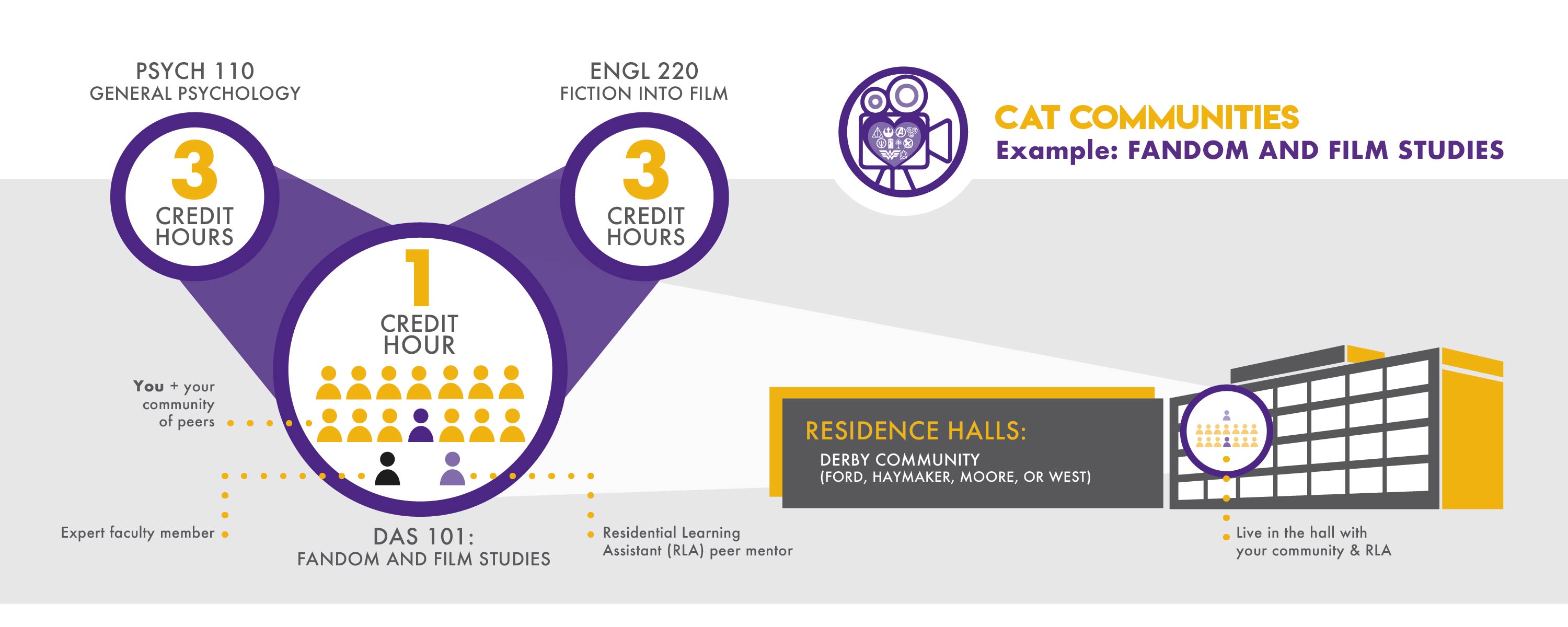
Classes:
Short answer: Yes.
Longer answer, Yes, but with explanation: you must be enrolled in all three of the classes (and they must be the specific sections that are listed) to be a part of the CAT Community. The whole concept of a learning community is that learning is social. You are not only learning from your professors, but also from your peers and your shared experiences. To do that, you must be in the same classes together throughout the semester so you can build on your shared knowledge. If you are only in one or two of the classes, then you are missing out on all of the skill building, learning, discussions, and even fun things like inside-jokes that are happening amongst your CAT Community peers in that other class.
The CAT in CAT Community also stands for Connecting Across Topics, which emphasizes the interdisciplinary knowledge building happening between all of your CAT Community courses. Being in all three classes means you are building up those integrative learning skills to begin solving complex problems!
Sometimes you might be excited for a CAT Community, get signed up, and then realize that you are coming in with the credit for one of the classes. Now you need to drop the course and find a new one. What happens next?
If you still want to be part of a CAT Community, we can work with you and your advisor to find another one that might fit your degree needs and interests a bit better. If another CAT Community doesn't work, a First-Year Seminar is also a great option for a smaller, engaging class that provides an opportunity to get to know your peers and professor.
If you have to drop one of the classes that is part of the CAT Community, we will drop you from all three courses that are a part of it. You can potentially re-enroll in one of the general education 3-credit hour courses if there is still space available outside of the saved CAT Community seats, but depending on the enrollment date, some of those classes might be full at that time.
If you are dropping your classes from a Residential CAT Community, we will also work with our Housing partners, and you will be moved from the room space you selected as part of the CAT, as it will need to be opened up for another student who has signed up to be in that Residential CAT Community. You will be able to select from other available room spaces from the day you drop.
Please do not drop your CAT Community class(es) on your own if you find that you need to; reach out to our K-State First team, and we will work hard to make sure that your schedule and housing needs are met!
Roommates/Rooms:
Your roommate does not have to be in the same Residential CAT Community as you, they simply need to be willing to live in the hall(s) that your Residential CAT Community is located in. In fact, we recommend that students have a roommate outside of their CAT Community to build their network here at K-State (although you are more than welcome to have someone in your CAT Community as your roommate too).
For more information about the room styles available within the halls, you can use the Explore Your Options page on the Housing and Dining site. Select the Residential CAT Community you might be interested in, and it will narrow down the styles available to you!
Student Impact:
Students consistently demonstrate high levels of mastery in our four core student learning outcomes (applying learning, building community, communicating effectively, and thinking critically). Below are the percentages of students who achieved mastery in those four categories in Fall 2024:
- Applying learning: 91%
- Building community: 93%
- Communicating effectively: 92%
- Critical thinking: 91%
K-State First helps you persist at K-State! Students in our CAT Communities and First-Year Seminars are more likely to return to K-State for their second semester and second year here. You start out on a path to success with the academic and social support that you need.
General retention rates:
- K-State First first-to-second-year retention rate (excluding Student Success courses): 87.1%
- compare to University-wide first-to-second-year retention rate: 85.8%
First-generation:
- Retention for first-generation students enrolled in a K-State First First-Year Seminar or CAT Community: 79%
- Compare to University-wide retention of first-generation students: 76.2%
Admitted by exception:
- Students admitted by exception enrolled in a K-State First Student Success First-Year Seminar, (primarily EDCEP 111: Foundations of College Student Success): 80.0%
- Students admitted by exception enrolled in any KSF First-Year Seminar: 72.7%
- Compare to University-wide retention of students admitted by exception: 67.7%
K-State First also supports students that, on average, might enter with greater academic risk factors yet we achieve equal or higher retention rates than the university overall. If you are admitted to K-State by exception, are unsure of what your major is, or just want to explore a bit more, we are here to help you find your place, space, and people so you can succeed!
K-State First has strong, skilled, and caring cohort of teaching faculty and staff. These faculty/staff members are part of a team of instructors who are coordinated at the university-level and work with each other to plan, design, teach, and assess our program. These instructors, drawn from all over campus, are pedagogically excellent, experienced, and interested in undergraduate education at K-State.
The CAT Community instructors have done the work to design these learning and living-learning communities from the ground up, and they are excited and passionate about the community of learning they will get to do with you. They work very closely with the Learning Assistant peer mentor to make sure that you are connected to your peers, understanding the material, and that they have the opportunity to share and engage with you inside and oustide of the classroom through the theme/topic of the CAT Community.
They are among the best instructors at the university and they are dedicated to helping you succeed.
"My instructor and Learning Assistant offered practical and helpful advice about academics and college life. I made great friends and learned so much in a safe and comfortable environment."
"As the Learning Assistant, I helped organize tours of local restaurants and businesses so students could see what areas might interest them. The class is a hands-on-experience and really shows students what the industry is like."
"What makes your CAT Community unique is that it combines two of the most important parts of a person, identity and passion, and gives you a community to share them with."
“The K-State resource that has been the most helpful is honestly my [Learning Assistant] peer educators. Being able to get direct feedback on my projects from individuals who were once in my shoes has helped a ton, especially since they have a sense of what to expect and can guide me to become a better designer. I also have had no trouble accessing the resources that have been discussed.”
“My favorite interaction with the LA was our one-on-one about how school really has been going for me. He gave me honest responses on how to help me not be so home sick. I need him to still have those conversations with me. He is very helpful!”
The CAT Communities are a great place to make friends that just might last a lifetime.