Faculty Research in Criminology
Check out the latest research projects and publications from our Criminology faculty. These are only some examples of the outstanding work produced by K-State Criminologists. For more information about specific faculty research, check out the faculty profiles available on our people page.
Exploring Cybercrime Policing
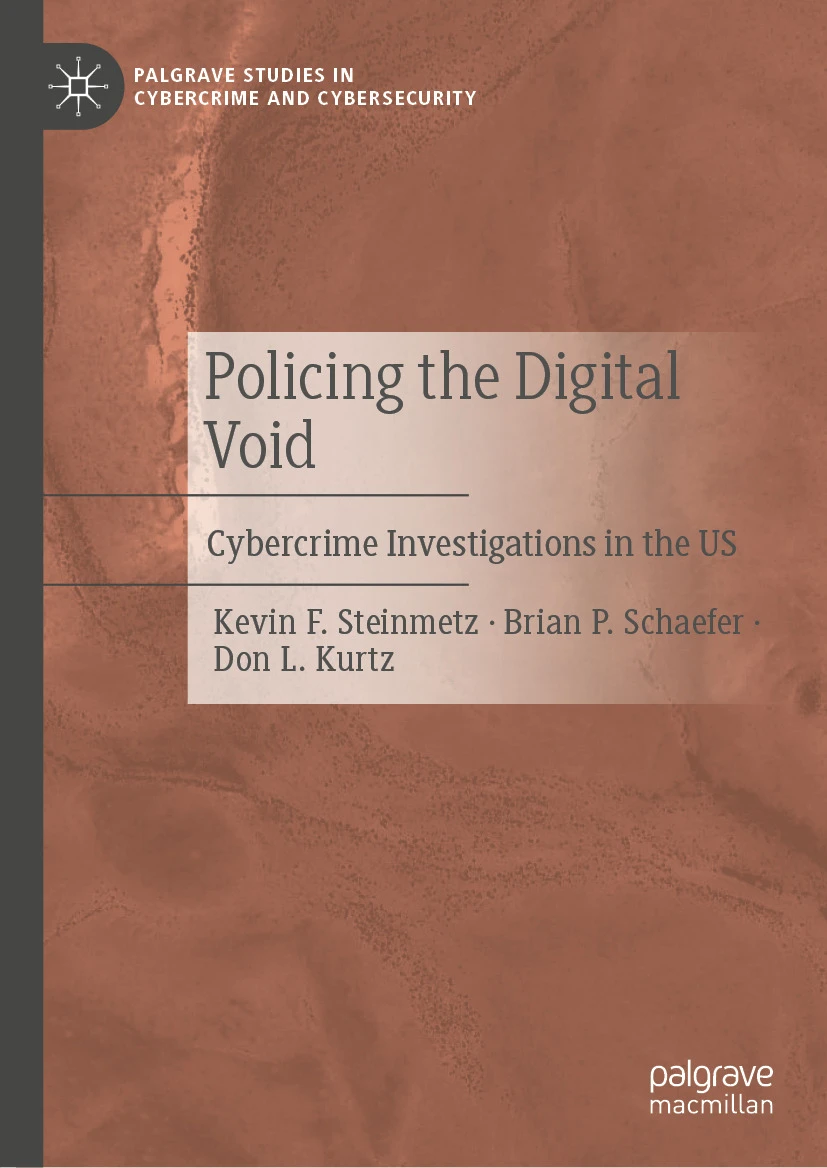 Drs. Kevin Steinmetz and Don Kurtz recently published a book summarizing their research on cybercrime investigations in the US entitled Policing the Digital Void: Cybercrime Investigations in the US (Palgrave MacMillan). Below is the publishers description of the book.
This accessible book examines American law enforcement cybercrime investigations. Through semi-structured interviews with forty-seven cybercrime law enforcement investigators, it explores the characteristics of investigators, the development of cybercrime units and task force programs in the US, the processes involved in these investigations, and the culture of American cybercrime investigations. This includes how cybercrime investigators relate to police occupational culture, their perceptions of offenders and victims, and use of humor. It also considers the technological, economic, political, and cultural contexts that shape and structure cybercrime investigations, units, and task forces. It adopts a sociological approach to the study of cybercrime policing by tracing connections between the individual and organizational levels of analysis to the macro-structural. In other words, it situates cybercrime policing in the “big picture” of technological change, the political economic of internet platforms, the transformation of “force” in the internet age, and related matters. Finally, this book builds from this comprehensive analysis of American policing to discuss pathways forward by curating institutional and organizational policy suggestions to promote both effective and just cybercrime policing.
Investigating Gender-Based Violence Victimization
 Dr. Lisa Melander has been exploring a topic that is both pervasive in the media but also hidden from public view: the lived experiences of those seeking asylum in the United States. Her latest co-authored research in this area appears in an article entitled, “Nevertheless She Persisted:” Confronting the Silencing and Reproduction of Gender-Based Violence among U.S. Asylum Seekers. This article appears in a special edition on vulnerable victimizations in Victims and Offenders. Here is the article abstract for more information:
Gender-based violence is a pervasive global crisis that affects people in myriad ways. Little is known about the impact of victimization experiences of one particularly vulnerable group: women who are “defensively” seeking asylum in the United States. Our ethnographic research with asylum seekers and legal advocates reveals how systems of oppression interact across borders to multiply women’s vulnerability to victimization, obstruct their access to critical resources, bar their flight and safe passage, and restrict their access to asylum. We urge recognizing gender as a protected ground for asylum and enforcing robust rights and protections for women transnationally.
Charting the Future of Cybercrime Research
 Dr. Kevin F. Steinmetz charts new pathways in the criminologyical study of cybercrime. Check out his upcoming book Against Cybercrime: Toward a Realist Criminology of Computer Crime (Routledge, September 2023). Below is a description of the book from the publisher:
This book advances a theoretically informed realist criminology of computer crime. Looking beyond current strategies of online crime control, this book argues for a new sort of policy that addresses the root causes of computer crime and criminality, reduces the harms experienced by the victims of such crimes, and does not unduly contribute to state and corporate power and surveillance.
Drawing both on the proponents of realist criminology and on those who have leveled critiques of the approach, Steinmetz illustrates the contours of a realist criminology of computer crime by considering definitions of harm with online crime, the idiosyncrasies of online locality and community, the social relations of computer crime, the tension between piecemeal reform and structural changes, and other matters. Furthermore, Steinmetz surveys the methodological dimensions of computer crime research, offers a critique of positivist ‘computational criminology’, and posits an agenda for computer crime policy.
Against Cybercrime is essential reading for all those engaged with cybercrime, realist criminology, criminological theory, and social harm online.