Every drop counts
K-State researcher connects water, timing and farmers across continents
K-State researcher connects water, timing and farmers across continents

By Kelsey Stremel
College of Agriculture
Monday, Nov. 30, 2026
When water began flowing through the first small irrigation system Kabateraine Tumwesige helped install in eastern Uganda, he watched more than a field change.
The farmers’ faces changed, too. For families accustomed to planning around uncertain rains, irrigation offered something weather could not: a measure of control. Crops could survive dry spells, and another harvest no longer depended entirely on what the sky delivered.
“In those smiles, I saw that a single pipe carrying water could also carry dignity, stability and hope,” Tumwesige said.
The moment raised a question that would follow him to Kansas State University: If one irrigation system could help a household, what might be possible if water and nutrients were managed more wisely across farming communities?
Today, Tumwesige, who also goes by Maxwell, studies irrigation and nitrogen management in western Kansas, where the challenge feels familiar. Dryland crops depend on unpredictable rainfall, while irrigated fields rely on groundwater from the declining Ogallala Aquifer. In either system, farmers must make consequential decisions with limited water.
A purpose takes shape
Tumwesige grew up with four siblings on a small farm in Kyeicumu, in western Uganda’s Kagadi District. His mother raised crops and cattle, and the family knew both good harvests and seasons of scarcity. When rain came late, stopped early or fell short, the farm’s prospects changed with it.
He earned a bachelor’s degree in agricultural engineering from Makerere University in 2024, although his career direction was still taking shape. His first job gave it focus.
Working for W&S Consult International through Uganda’s government-supported UgIFT program, Tumwesige helped install more than 50 small drag-hose and sprinkler irrigation systems in the hotter, drier eastern part of the country. Each served about 2.5 acres. Seeing water reach farmers’ fields led him to think beyond installation: How much water did crops need, when did they need it, and how could fertilizer management improve the return on every application?
“From that point on, I knew that I had to start chasing a future where every drop of water and every unit of fertilizer truly count for the people who depend on it most,” he said.
From Uganda to Kansas
Tumwesige first met Daran Rudnick, K-State professor and director of sustainable irrigation, during Rudnick’s 2023 visit to Makerere University. As his irrigation work in Uganda drew to a close, Tumwesige reached out about graduate study. Rudnick’s research in water-limited agriculture matched the purpose he had begun to define.
That alignment brought him to K-State, where he joined Testing Ag Performance Solutions, or TAPS, in September 2024 as an intern collecting data in a corn field near Colby. He is now a TAPS graduate research assistant in the College of Agriculture and a master’s student in the Carl and Melinda Helwig Department of Biological and Agricultural Engineering.
TAPS gives participating teams responsibility for decisions that producers face, from hybrid selection and seeding rates to irrigation, nitrogen, insurance and marketing. Researchers compare how those choices affect yield, efficiency and profitability. For Tumwesige, the program connects scientific measurements to the constraints farmers manage every season.
“Through TAPS, our work is directly connected to real decisions growers are making about irrigation and nitrogen, rather than staying only at the research-plot level,” he said.
When matters as much as how much
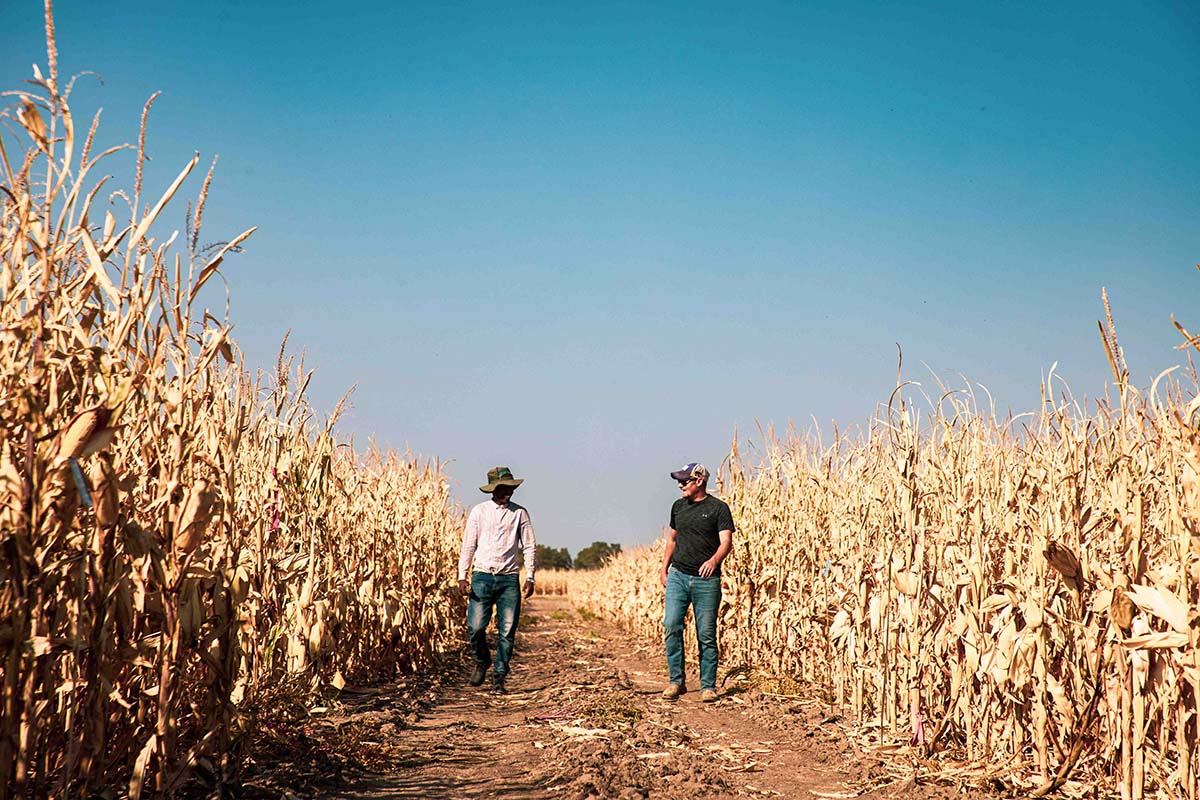
Analyzing TAPS corn data, Tumwesige examined how irrigation and nitrogen related to yield, crop water use and nitrogen uptake. Irrigation amount showed a strong relationship with yield, while total nitrogen rate alone did not have a statistically significant effect in the dataset. Higher inputs could support greater uptake and production, but heavier nitrogen use also brought efficiency trade-offs.
The management records revealed another distinction. Several high-yielding teams concentrated irrigation during the corn crop’s reproductive stages and split nitrogen into multiple applications. One lower-yielding team applied more of both inputs earlier, leaving less support later in the season. The comparisons suggest that timing deserves attention alongside total application rates, rather than establishing one prescription for every field.
“We’ve seen cases where two growers apply almost the same total amount of water or nitrogen, but because the timing and distribution were different, their yields and efficiencies were completely different,” Tumwesige said. “More is not always better.”
Researching sustainable irrigation
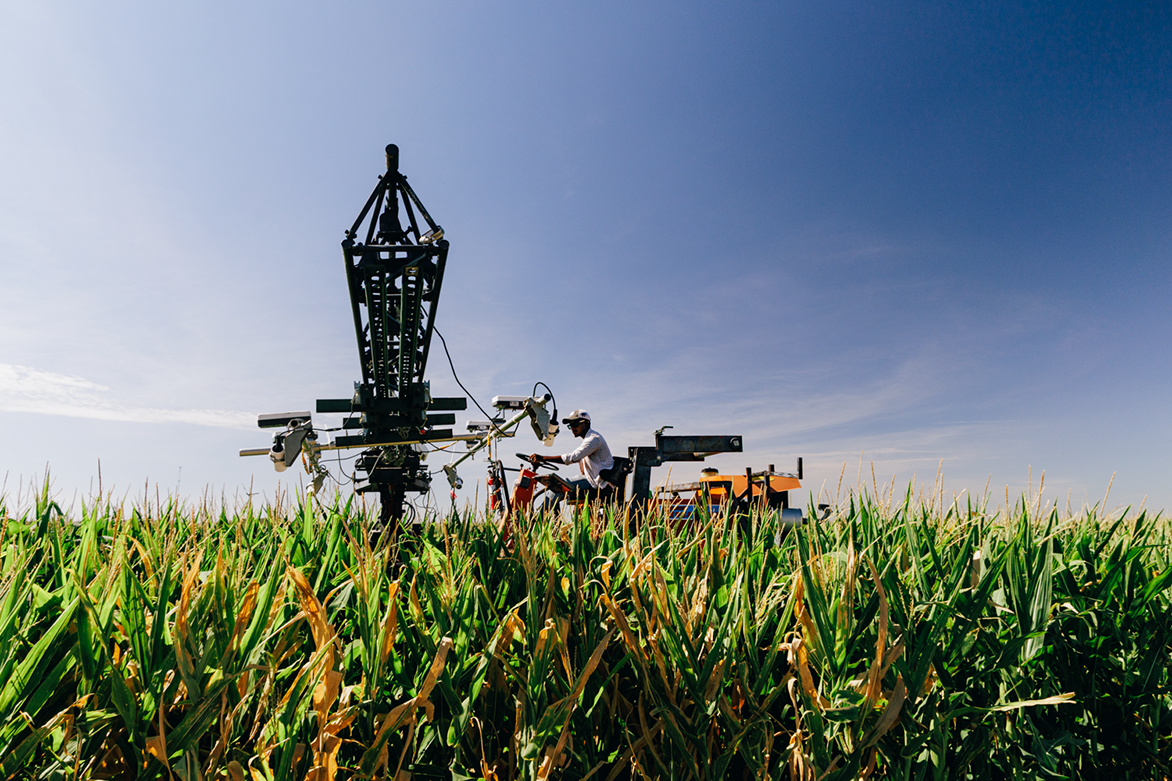
His current research takes that lesson further, using sensors, remote sensing and artificial intelligence to explore how producers could recognize water stress before deciding to irrigate.
Tumwesige is measuring canopy temperature with infrared radiometers. A well-watered crop cools itself through transpiration; when water becomes scarce, that cooling slows and the canopy warms. He is using machine-learning methods to predict the temperature of a non-water-stressed crop, creating a reference point for thermal irrigation-scheduling measures, including the Crop Water Stress Index.
Nitrogen stress, however, can also change canopy temperature and reflectance. Tumwesige is investigating how to distinguish those effects so that a nutrient problem is not mistaken for a signal to irrigate. Alongside soil moisture and weather data, the research could help inform a decision-support suite that identifies when water is needed rather than relying solely on a fixed schedule.
In western Kansas, where declining groundwater supplies narrow the room for error, information on more reliable timing could help producers protect yields while avoiding unnecessary applications.
Learning in both directions
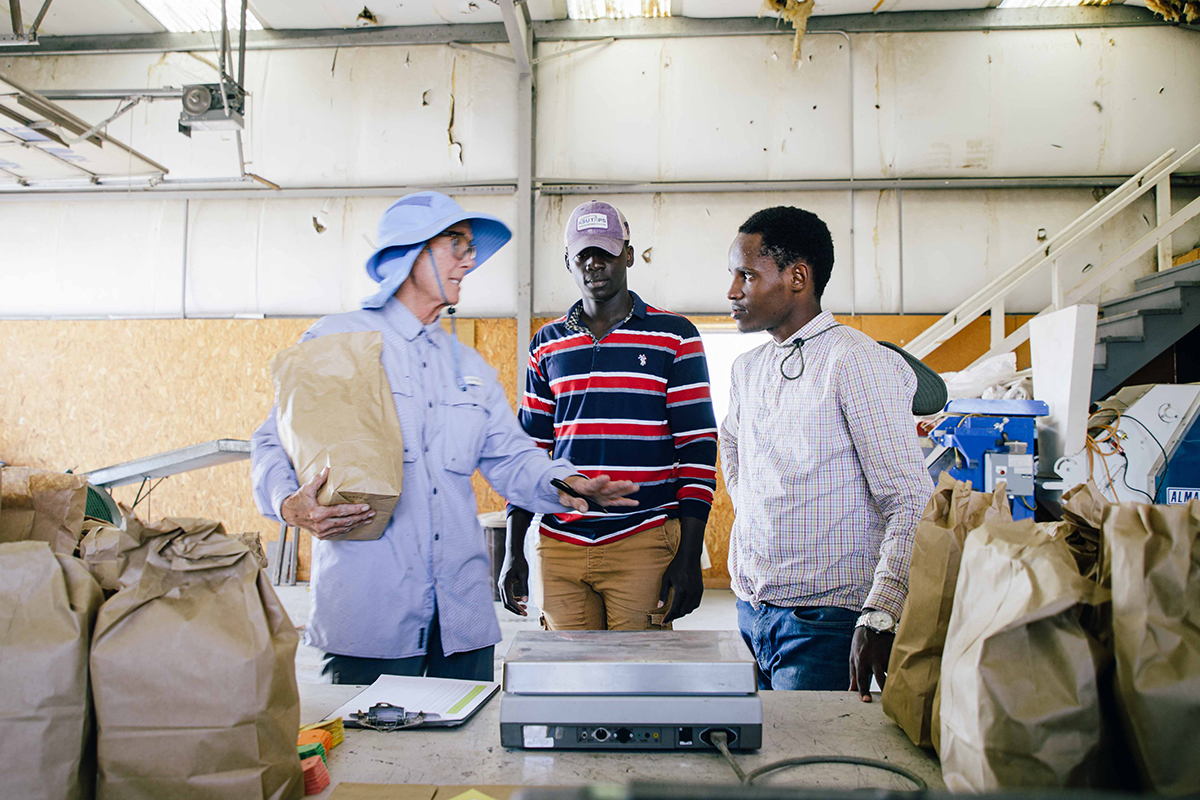
For Tumwesige, TAPS has reinforced that useful research is built with producers, not simply delivered to them. Farmers contribute experience, researchers bring measurements and analysis, and students ask new questions. Together, they can investigate results that neither group could fully explain on its own.
“Farmers bring years of experience and intuition, researchers bring sensors and statistics, and together we arrive at insights that neither side could reach alone,” he said.
Tumwesige hopes to apply what he learns in Kansas to water-limited regions elsewhere, particularly East Africa. Farming systems and resources differ, but the questions that brought him into research cross borders: When should farmers apply water, how can they use nutrients wisely, and what will help them make each application count?
They are questions he first began asking beside a small irrigation system in Uganda. In western Kansas, he is learning how to answer them.