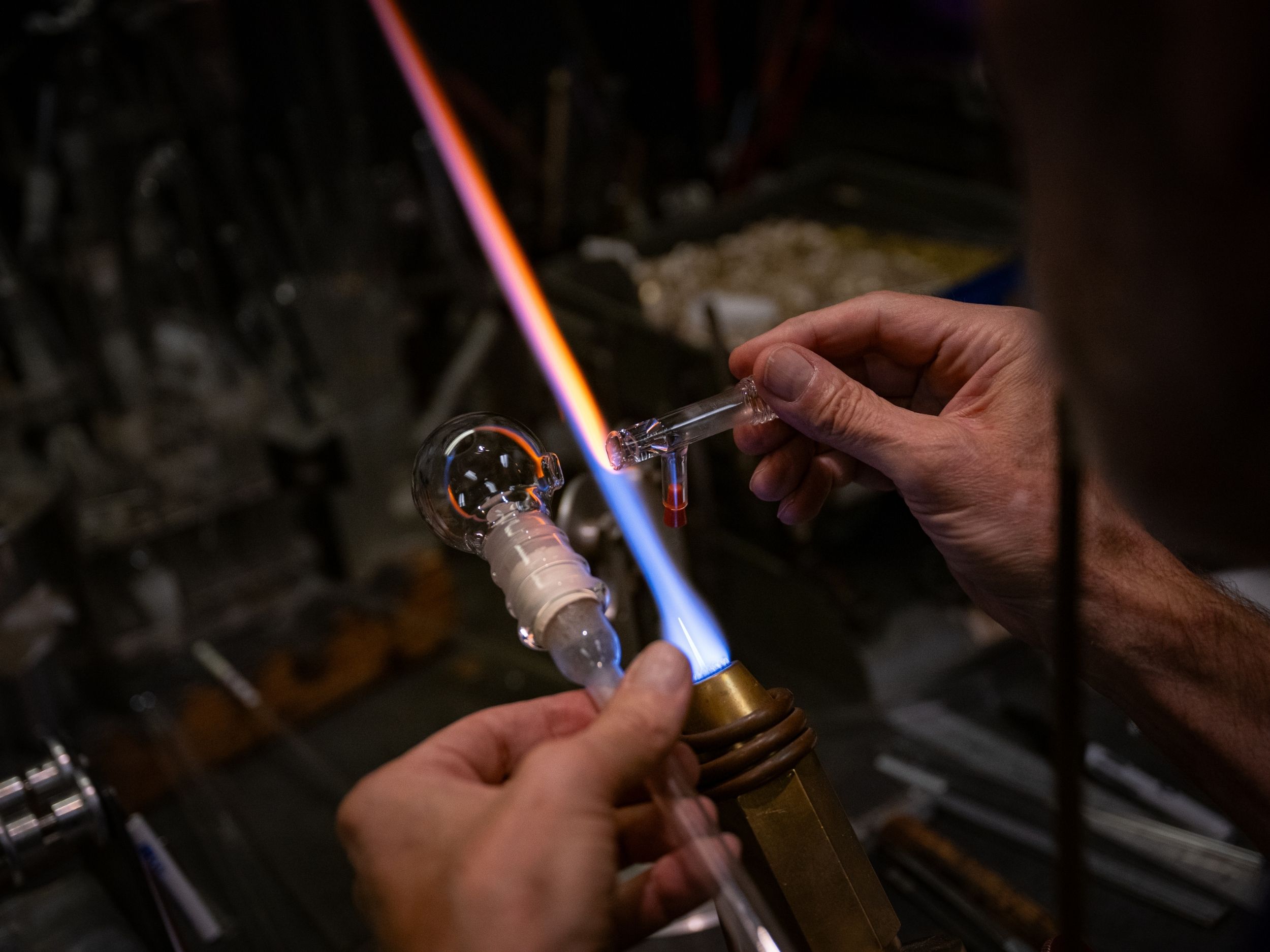
Beyond the breaking point
In-house glassblower Jim Hodgson keeps the flame for scientific discovery alive at K-State

By Abbigail Marshall
Division of Communications and Marketing
Tuesday, Oct. 27, 2026
Jim Hodgson’s soundtrack to scientific discovery is quite unlike the beeps and hums of a research lab. His begins with the dull hiss of a blowtorch — matched with the crackle of a jazzy cassette tape playing in his basement studio.
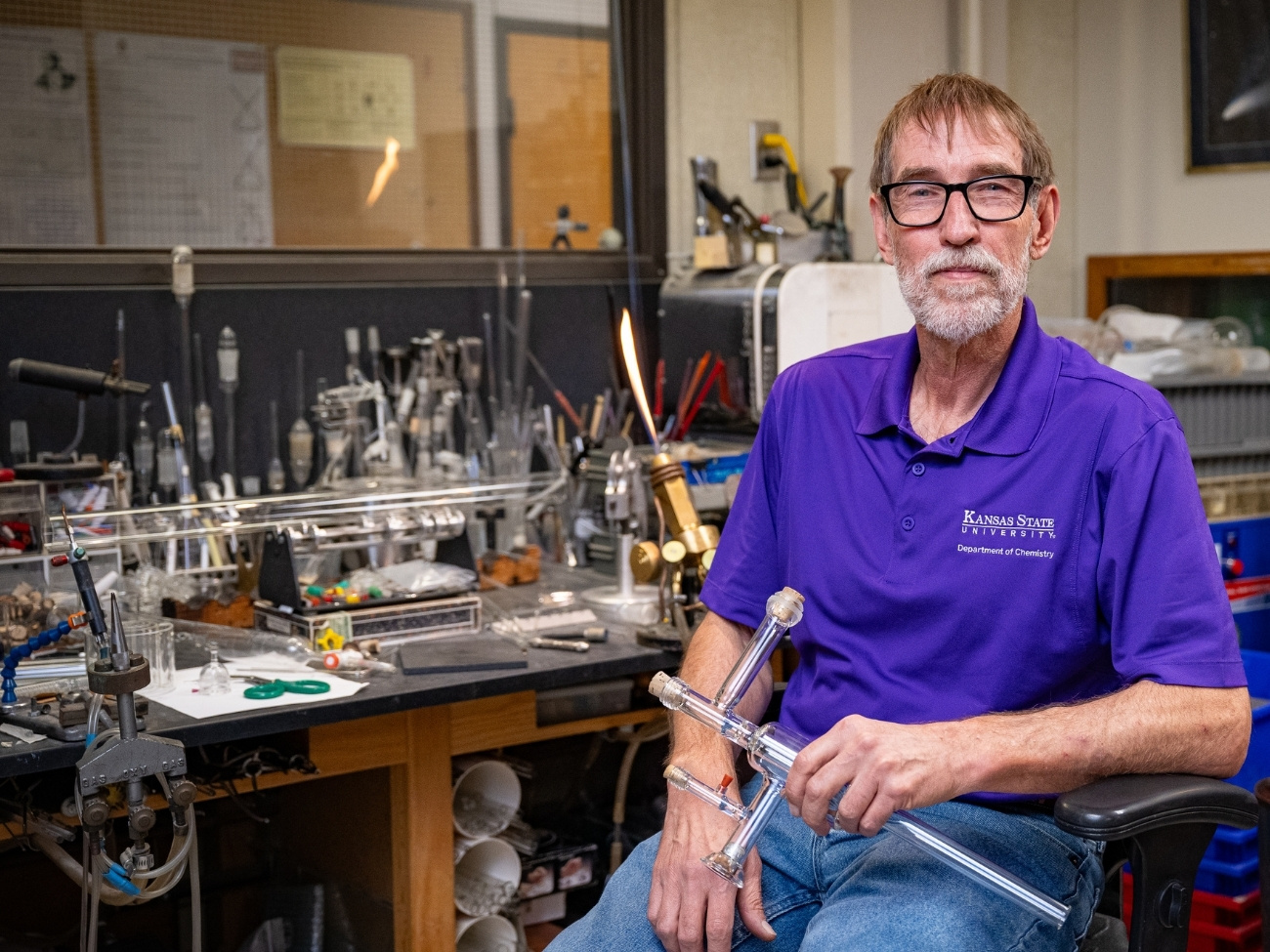
Hodgson, senior scientific glassblower, has sat at his workbench in Kansas State University's Chemistry and Biochemistry building since 1996, with blowtorch in hand, purple eyewear in place and Dave Brubeck's quartet playing nearby. Three decades later, he's still helping to solve researchers' toughest challenges — one carefully crafted piece of glassware at a time.
'When I grow up'
From his perspective, Hodgson's work for the Department of Chemistry is cinema.
"The best reference I have is an old Frankenstein movie," he said. "There are things bubbling, there are coils and condensers and beakers; all of the wonderful glass stuff. That's the stuff I get to do."
The setup may call to mind a mad scientist's lab, but scientific glassblowing requires extreme precision; a skill Hodgson spent years honing before ever picking up a blowtorch.
Before he was creating labware for researchers, he was conducting research himself.
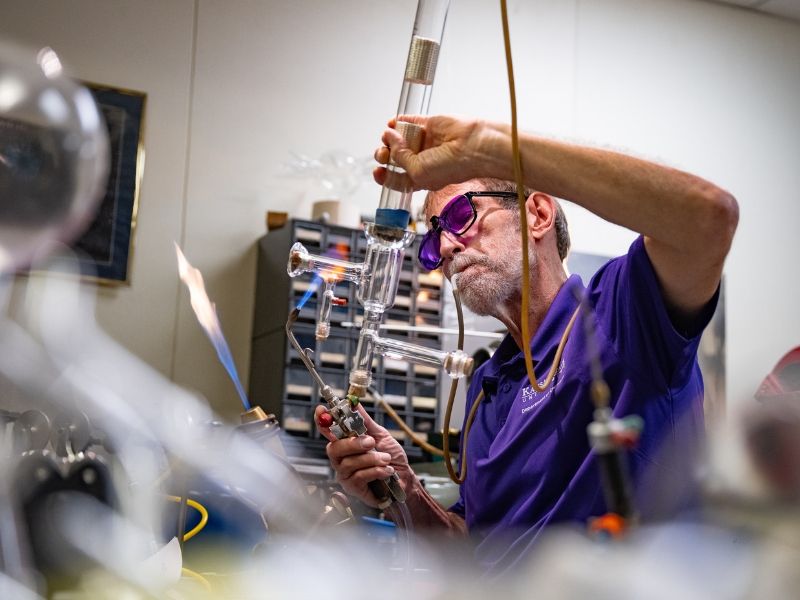
Hodgson graduated from K-State in 1982 with a bachelor's degree in geology and spent a decade conducting seismic exploration before deciding it was time for a change. Uncertain of his next step, he went back to school and took a variety of different classes: accounting, logic and, fatefully, jewelry making and metalsmithing.
"I really liked how hands-on it was. You look at it and can say, 'I made that'," Hodgson said. "But I also wanted to take advantage of my scientific training."

I wanted to be someone who could contribute to research by making something new.
Jim Hodgson
Scientific glassblowing offered a way to bring the two interests together. It was no small decision: at the time, the only school in the country offering an associate's degree in scientific glassblowing was in New Jersey. He packed up his pickup and went.
Shortly after finishing his degree, Hodgson returned to K-State to succeed famed K-State glassblower Mitsugi Ohno. What began as a childhood fascination with science and the tools behind it had come full circle. Now, he was ready to help researchers bring their own dreams to life.
Playing with fire
So, what exactly does a scientific glassblower do?
Hodgson primarily works with borosilicate glass, a type known for its strength, durability and resistance to thermal shock. While not unbreakable, borosilicate can withstand rapid temperature changes that would cause ordinary glass to crack. It's also resistant to many acids and other chemicals, making it ideal for demanding laboratory conditions.
Simply put, it's a dream material for scientists. But shaping it into specialized labware takes a steady hand and a precise eye.
"Glass is pretty interesting. It's not a piece of metal," Hodgson said. "You don't just take a pass or a cut on a piece of glass. You have to heat it and then shape, seal or bend it to make whatever it is you're trying to do."
Before Hodgson can shape the glass, he has to see it. In the glow of the torch, the nearly transparent borosilicate can be difficult to distinguish from the flame itself; his purple protective glasses help him see the glass more clearly as he works.
Then comes the delicate shaping process. Glassblowing is a constant balancing act between heat, pressure and motion. Hodgson heats the glass to 1260 degrees Celsius, making the borosilicate pliable without compromising the forming piece's strength. The finished apparatus may have several connected tubes, chambers and openings designed for a researcher's particular experiment. Getting to the final product requires an assortment of specialized tools.
New borosilicate most often begins at the glassblowing lathe. The lathe itself rotates the glass at a controlled speed, allowing Hodgson to apply even heat and preventing the tube from collapsing. His blowtorch supplies the intense heat needed to make the borosilicate pliable, while handheld tools give him greater control over its shape. Graphite tools help shape and smooth the softened glass without sticking to it, while metal tweezers allow him to grip, pull and manipulate smaller sections.
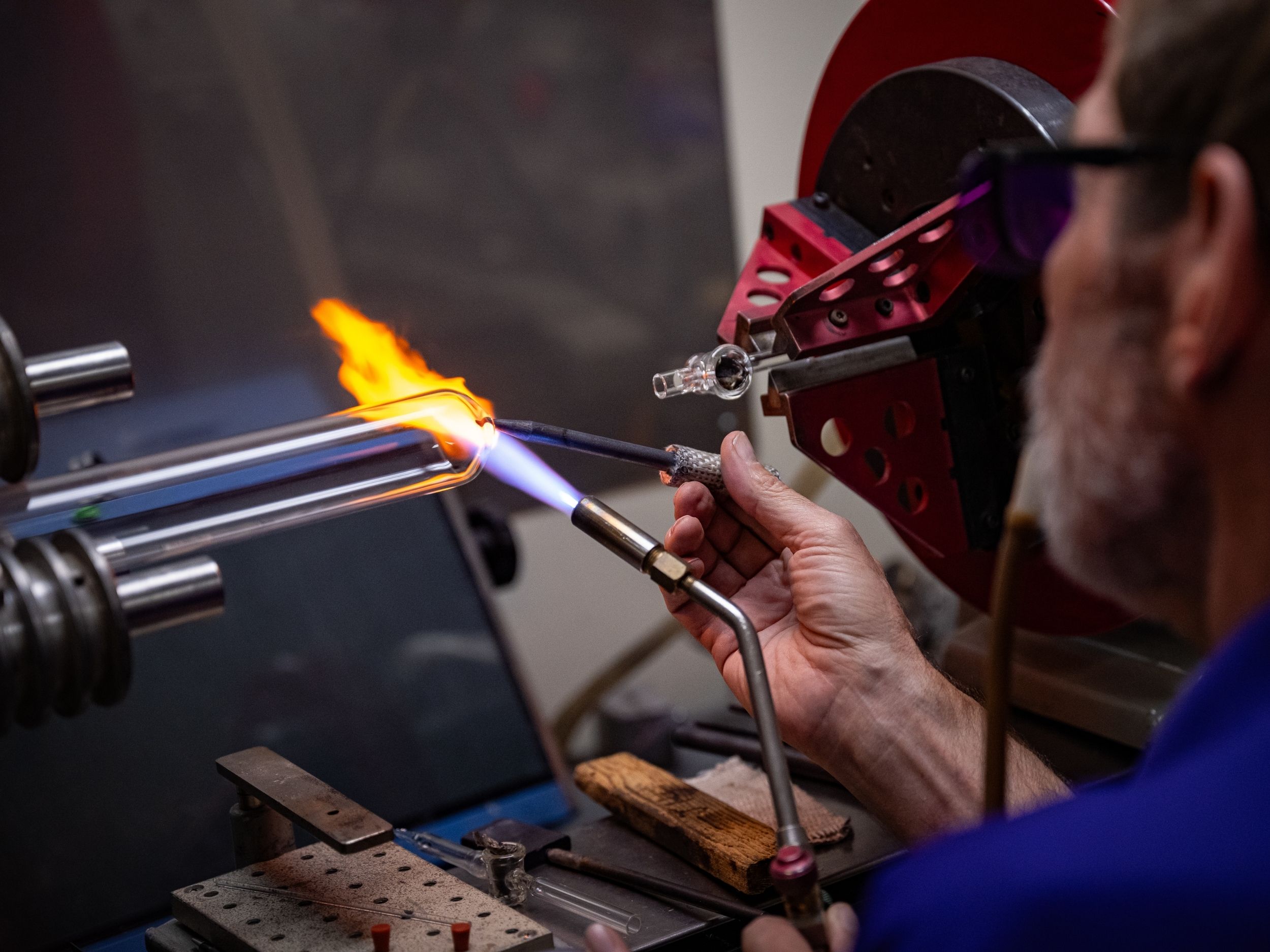
At his glassblowing bench, Hodgson has additional equipment for work that requires a different approach. A bench burner provides a stationary flame for heating smaller sections of glass, joining pieces and making precise adjustments without the lathe. At both stations, Hodgson may also use a blow hose to regulate pressure or expand and inflate softened sections from within.
With each tool serving a different purpose, Hodgson can move between heating, shaping and refining the glass until it meets the specific requirements of the researcher who will use it. Although he occasionally makes minor repairs to beakers and flasks, he spends most of his time creating specialized equipment.
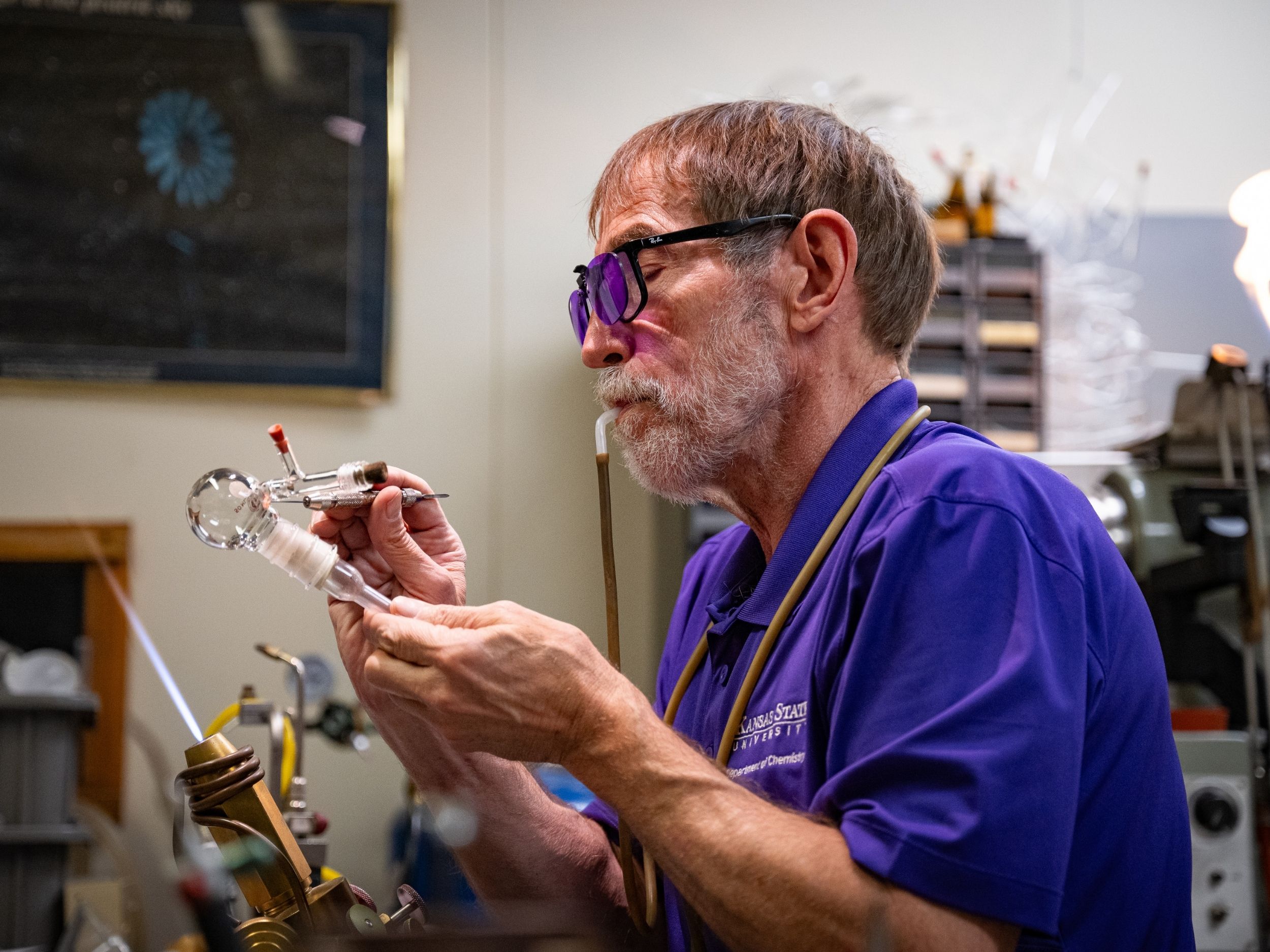
"Doing repairs is like doing piano scales. They're always important to practice," he said. "But that's not the kind of glassblower I wanted to be. I wanted to be someone who could contribute to research by making something new."
Designed discovery
Hodgson's work often starts with a problem that off-the-shelf equipment can't solve.
Beyond repairs and adjustments, researchers turn to Hodgson when their experiments call for specialized glassware, from entirely new equipment to something as specific as a carefully shaped bend in a tube. Translating a researcher's idea into a functional piece of glass takes collaboration and a clear understanding of what the research requires.
“You don't always know how you'll impact research, but it feels like you're contributing.”
Jim Hodgson
For Kristen Michel, professor in the Division of Biology, that meant finding a safer way to feed mosquitoes used in research on malaria and other mosquito-borne diseases. When Hodgson met with Michel, they discussed how to deliver blood safely and at the ideal temperature to ensure the mosquitoes bite.
"You need to keep them alive and do the study, but you don't want to stick your arm in a cage that has mosquitoes carrying malaria," Hodgson said. "And, as it turns out, mosquitoes only like blood at body temperature."
Hodgson fabricated a double-layered glass feeder that allows researchers to maintain the blood at body-like temperatures without exposing themselves to mosquito bites.
The outer chamber acts as a water jacket, circulating warm water and helping to maintain the temperature of the blood within the inner chamber. A piece of parafilm stretched across the appropriate opening serves as a membrane that mimics human skin. The apparatus is then set on top of a wire cage containing the mosquitoes used in the experiment. The mosquitoes have enough space for their proboscis to poke through, penetrate the membrane and drink — without escaping the confines of their cage.
Another of Hodgson's memorable projects was with the Stable Isotope Spectrometry Lab. The "spider manifold," named for its spider-like appearance, allowed researchers to direct gas samples through a network of valves and connections for isotope analysis. Its large, intricate design challenged Hodgson to develop new techniques for assembling the components and making them fit together.
"It was something I wasn't sure how to approach. We tried some things, we went back and changed some things, " Hodgson said. "A photo of it ended up being featured on the cover of the American Scientific Glassblowing Society's publication, and I wrote an article on how I put it together. That was a fun project for me."
Hodgson's collaborative approach, he said, has been shaped by years of experimentation, trial and error. He continually pushes the limits of his skills and equipment to expand what's possible for researchers.
Because scientific glassblowers are relatively rare at universities, his work also reaches beyond K-State, with researchers across the country turning to him for specialized glassware.
"Glass is special because it lends itself to developing an instrument where there's a lot going on in a small space. You don't always know how you'll impact research, but it feels like you're contributing," Hodgson said. "Am I going to help create a new, efficient battery? A cure for cancer? Malaria problems?"
The art of science
After 30 years, Hodgson has watched science evolve, both through the research itself and through changes in the field of scientific glassblowing.
One thing has remained constant: Hodgson's belief in the value of his work.
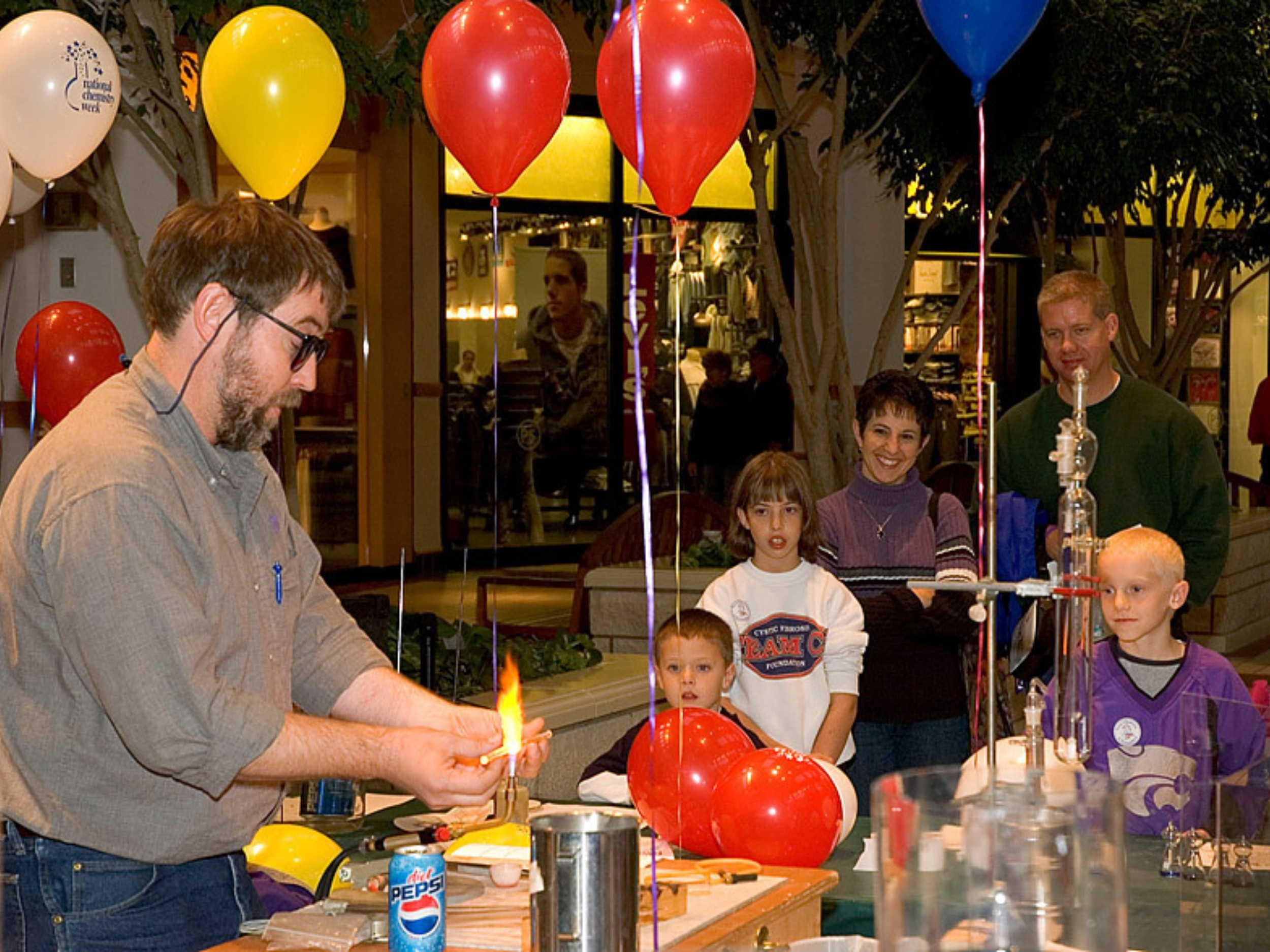
"It's just as important, or more important, than ever. Some universities used to have multiple glassblowers cranking out massive amounts of glassware," he said. "That's not so true anymore, but you're doing things for research that's more unique and challenging. And I think scientific glassblowing can really meet those challenges on a different level."
For Hodgson, that constant change is part of the appeal. Each project presents an opportunity to try something new, learn through experience and find a solution that helps someone else's research move forward. He may never know the full impact of the research his work supports, but he finds satisfaction in knowing that what he creates plays a role in discoveries still to come.
"People will ask if I ever do anything fun. To me, this is fun," he said. "Doing something new and then seeing it be used toward a research breakthrough, that's what I really like."
Related Stories
Radiant research
The newest member of K-State's nuclear engineering team is already transforming lives through her research and preparation of the future workforce.
Eavesdropping on hidden bugs
Some crop pests are nearly impossible to see — but they may still be making noise. Research led by entomology graduate student Emily Sur is testing a new...

'Collaborative in nature'
How does land shape the people who call it home? During a recent residency, K-State professor Ursula Emery-McClure explored that question through the lens of...