Skills on the range
Rannells Ranch offers students immersive grassland learning experiences in the Flint Hills prairie
By Emerson Tarr
Department of Communications and Agricultural Education
Wednesday, Sept. 30, 2026
How does a landscape as expansive as the Flint Hills transform into a classroom?
The answer, says Colin Tobin — assistant professor of range management in Kansas State University's Department of Agronomy and associate director of the Hilas Bay and Emma Browning Rannells Flint Hills Prairie Preserve, or Rannells Ranch — starts with getting students in the grass.
This fall, Tobin is teaching AGRON 462: Range Grasses and AGRON 660: Grassland Monitoring and Assessment. While the courses focus on different skills, both use Rannells Ranch as a space for students to apply what they learn in class.
"We can sit down and look at everything on a slide, or look at things in the book, but there's only so much [what's on] paper can show us," Tobin said. "Rannells Ranch gives students an opportunity to have a living laboratory."
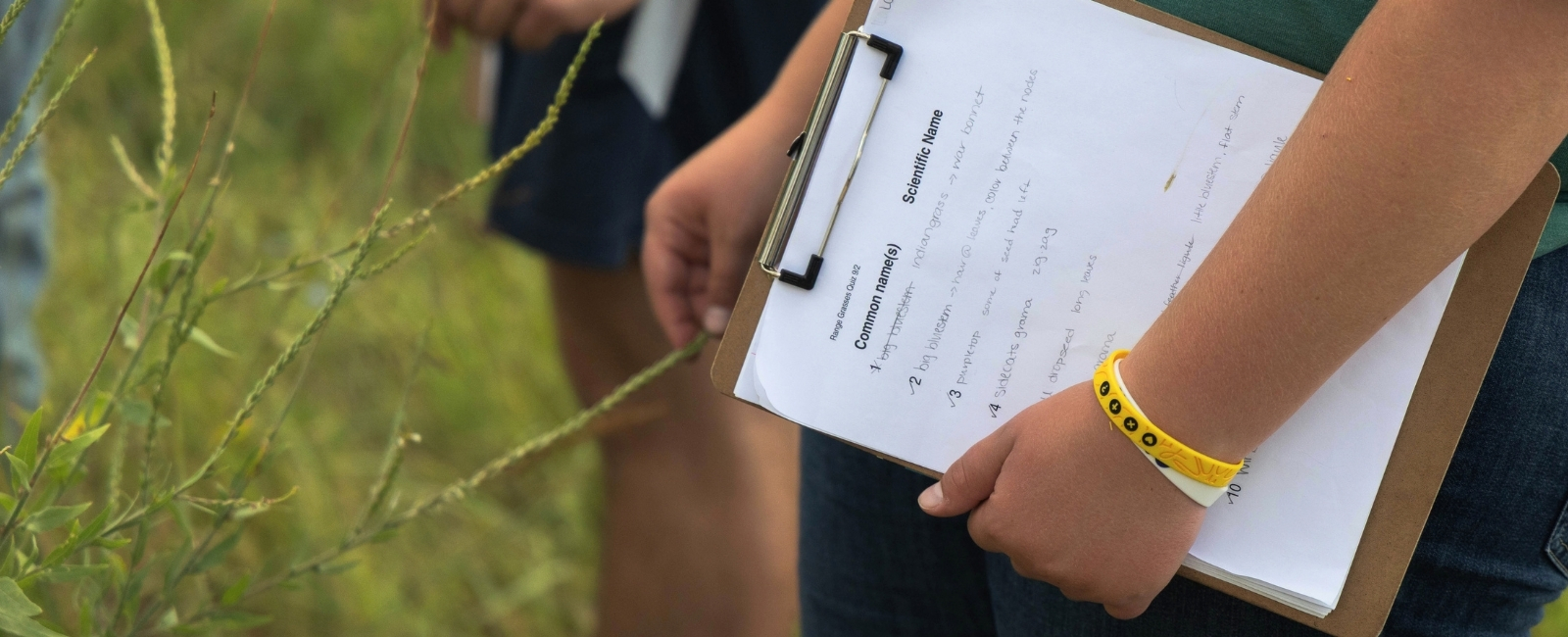
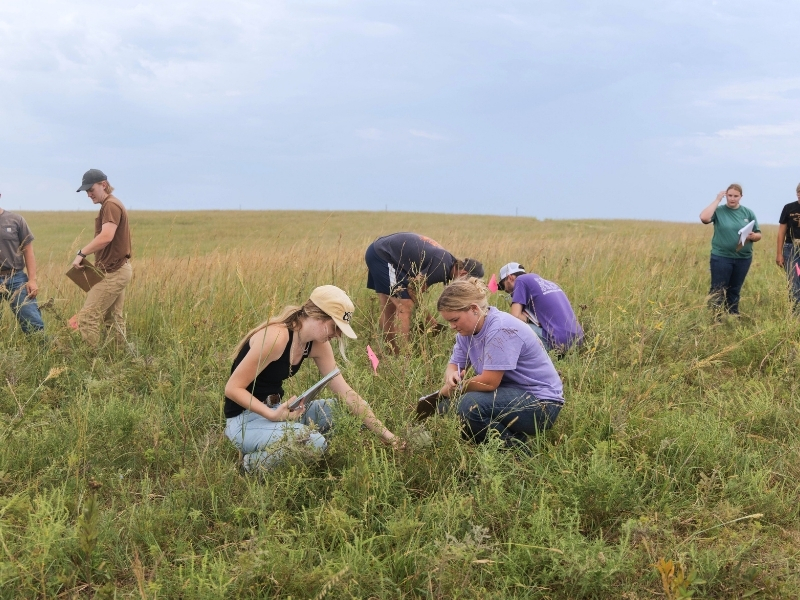
In Range Grasses, students learn to identify native and invasive grasses found throughout Kansas. By utilizing the space at Rannells Ranch to get an up-close look at the plants and their impact, that learning comes to life.
"We're taking students out and getting their noses right to the ground, looking at grass species, how they differ and how to identify them," Tobin said.
Being in the field also challenges students to identify grasses that may not look exactly as they did in the classroom. As they observe plants at different growth or grazing stages, students must pay closer attention to each species' specific characteristics.
Luke Bates, senior in animal sciences and industry, says applying what he learns in class to what he sees in the pasture will be valuable long after graduation.
"It's one thing to see it as a PowerPoint, but being able to actually see it in person, feel it and know what it looks like out on the range is really beneficial," Bates said.
When looking at the native vegetation, students work together to identify grasses and justify their answers — a setting in which Tobin says allows him to step back and put problem-solving into the students' hands.
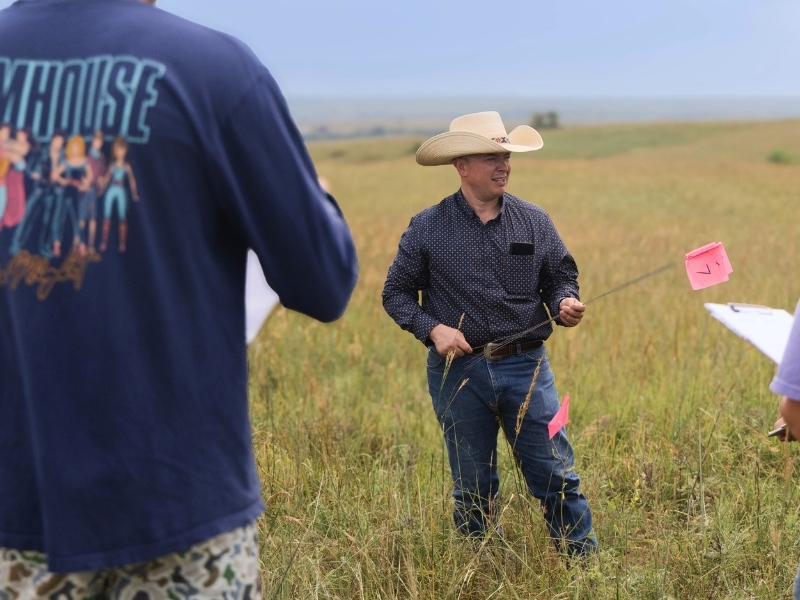
“When we bring students out to the ranch and get them out here in their small groups and conversing with one another, they're also teaching each other.”
Colin Tobin
Students in Grassland Monitoring and Assessment dive even deeper into hands-on learning, examining how management practices shape the prairie and its rangeland. At Rannells Ranch, students develop monitoring plans, measure production, utilization, cover, frequency and density and put those skills to work in the field.
"Students are getting to see the management objectives and the management goals of an active cattle property in real time," Tobin said.
For Bates, who plans to return to his family's operation after graduation, the ability to identify grass species will help him to assess forage conditions and make informed cattle management decisions.
"Seeing what type of grasses I have out there and what their nutritional content is will help me better the operation," Bates said.
Tobin hopes the role of Rannells Ranch in his students' education continues to grow, giving current and future students a consistent place to visit during their coursework, build on their learning and see how the pieces of rangeland management come together.
"My goal for the Rannells property is to turn this into a career-learning hub," Tobin said. "There's no better way to learn than to practice how we play."
Related Stories
Capturing change in the Flint Hills
Katie Starzec's time-lapse camera project at Rannells Ranch is documenting prescribed fire, grazing and grassland change across the Flint Hills, revealing processes...
Eavesdropping on hidden bugs
Some crop pests are nearly impossible to see — but they may still be making noise. Research led by entomology graduate student Emily Sur is testing a new...

K-State, NASA highlight satellite technology for Kansas farms at Flickner Innovation Farm
K-State partners with Flickner Innovation Farm to test NASA satellite data under real-world farm conditions. NASA's Space for Ag tour recently brought researchers,...