People with Purpose: Justin Kastner
Justin Kastner’s teaching invites students to look beyond the obvious and see where unexpected connections can lead.


By Abbigail Marshall
Division of Communications and Marketing
Sunday, Sept. 20, 2026
Learning rarely stays within the boundaries of a single subject.
Justin Kastner, professor in the Department of Diagnostic Medicine and Pathobiology and winner of the Commerce Bank and W.T. Kemper Foundation Distinguished Undergraduate Faculty Award, has made a career of embracing that notion.
Whether examining public health through the lens of Sherlock Holmes, discussing the forces shaping global food trade or expanding perspectives through travel-based learning, Kastner finds creative ways to make complex subjects engaging and approachable — finding his purpose in making curiosity part of the curriculum.
Q: What drives you to support students?
Kastner: The joy of learning! I love learning alongside students and, whether in the classroom or on a Frontier Field Trip, helping them feed their own intellectual curiosity.
Q: Are there any moments you saw a student's hard work pay off? How did you get to be a part of that story?
Kastner: I think helping students take memorable trips that involve the joy of learning has been my favorite moment. I remember taking students on a Frontier Field Trip to California in 2025 to learn about water systems and other public health infrastructure.
During that trip, one of the students told me it was their first time flying. This student had also authored one of the most persuasive cases for why they wanted to go — I treasure the fact that they took the time to express their scholarly interests, and I was, in a metaphorical sense, able to "fuel" their intellectual fire by helping them learn experientially through travel.

Q: How have the students you've mentored shaped the way you approach your work?
Kastner: My students have helped me become increasingly lighthearted in my work. In today's high-achievement academic culture, there are innumerable pressures on students, and over the last 23 years as a faculty member, I have learned the importance of doing what I can to help students learn for the sake of learning and not just for achievement.
Q: How do you encourage others to think beyond the boundaries of their own field?
Kastner: The short answer is history! By incorporating real-life historical and trade-related events into my courses, students gain a more comprehensive picture of the overlap among science, policymaking and personalities.
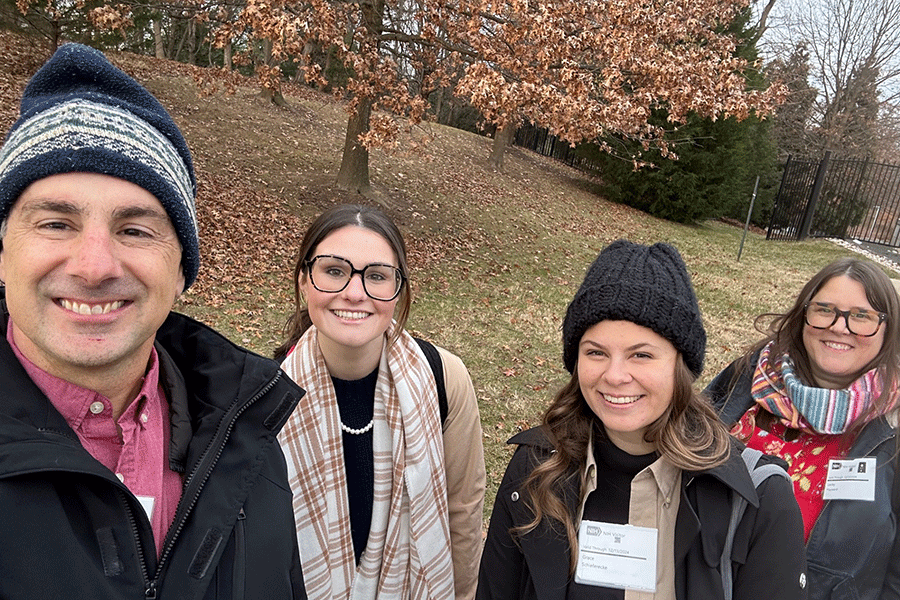
Q: How do challenges facing our world today teach us about the importance of connection?
Kastner: Connections are about both ideas and people, and both matter. By helping students build interpersonal relationships through friendships while learning through an interdisciplinary lens, we promote integrated wholeness for scholarly learners.
Q: What is something you're still curious about exploring?
Kastner: I am always curious about the historical events and pioneering professionals in the realm of public health, food safety and international trade.
Related Stories
People with Purpose: Lauren McDaniel
Lauren McDaniel, kinesiology instructor and Exercise is Medicine campus coordinator, believes that every moment counts — whether through movement or meaningful...
People with Purpose: Steven Snyder
As Landscape Services superintendent, Steven Snyder pairs a passion for people with a commitment to caring for the outdoor spaces that shape the campus experien...
People with Purpose: Siny Joseph
A professor of economics at K-State Salina, Siny Joseph is driven by a desire to understand what people need and turn that understanding into meaningful change,...