K-State steps up corn leafhopper monitoring after detections in Oklahoma
Partnership with Kansas Corn supports statewide surveillance and free testing

By Kelsey Stremel
College of Agriculture
Tuesday, June 23, 2026
Kansas farmers will have access to expanded monitoring and free diagnostic testing this growing season thanks to a collaboration between Kansas Corn and Kansas State University that's improving early detection of corn leafhoppers and the pathogens that cause corn stunt disease.
As of June 11, corn leafhoppers, an invasive species, have been confirmed in Texas and Oklahoma. Neither the insect nor its transmitted pathogen, corn stunt spiroplasma, has been detected in Kansas in 2026. K-State specialists say the insect's movement into neighboring states makes continued scouting and early detection especially important.
"Corn leafhopper populations can move quickly, and early detection gives Kansas farmers the best opportunity to understand the risk in their area and make informed decisions," said Rodrigo Onofre, row crop plant pathologist. "Kansas Corn's support allows us to maintain a statewide monitoring system, test insects and plant samples, and provide producers with timely information throughout the growing season."
The Kansas Corn Commission supports Onofre's work to monitor corn leafhoppers, corn stunt and other emerging corn disease threats across Kansas. That support also allows the K-State Plant Diagnostic Lab to offer free testing of suspected corn leafhoppers, carried pathogens and plant tissue showing corn stunt symptoms.
The 2026 effort follows the establishment of the Kansas Corn Disease Network during the 2025 growing season. The network brings together Kansas Corn and K-State's Department of Plant Pathology with university, extension and industry partners to track corn diseases and provide farmers with timely scouting and management information.
For the 2026 growing season, the network has expanded to 35 corn leafhopper trapping sites across Kansas. Participants have monitored the sites weekly since April 15, and monitoring will continue for 40 weeks to track the insect's movement during and after the corn growing season.
Additional collaborators include K-State's agronomy and entomology departments, Kansas Independent Crop Consultants, K-State Extension agents and Corteva.
"This is a good example of what can happen when commodity partners, university researchers, K-State Extension professionals and crop consultants work together," Onofre said. "No single trap or sample can tell us what is happening across Kansas. A coordinated network gives us the coverage needed to identify changes sooner and communicate those findings directly to farmers."
Leafhoppers collected through the network will be tested to determine whether they carry pathogens associated with corn stunt disease. Confirmed detections will be added to online maps, providing farmers, crop consultants and agricultural professionals with an updated picture of potential risk.
The network also monitors tar spot and southern rust.
The importance of scouting
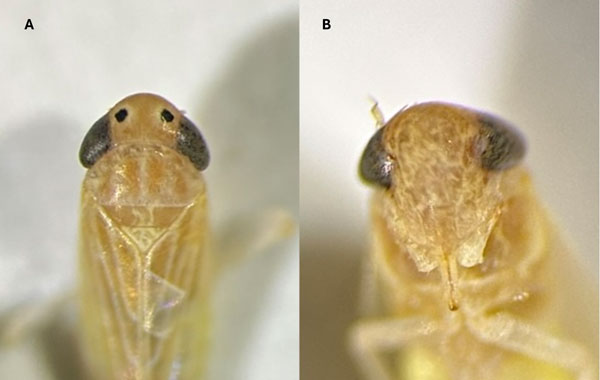
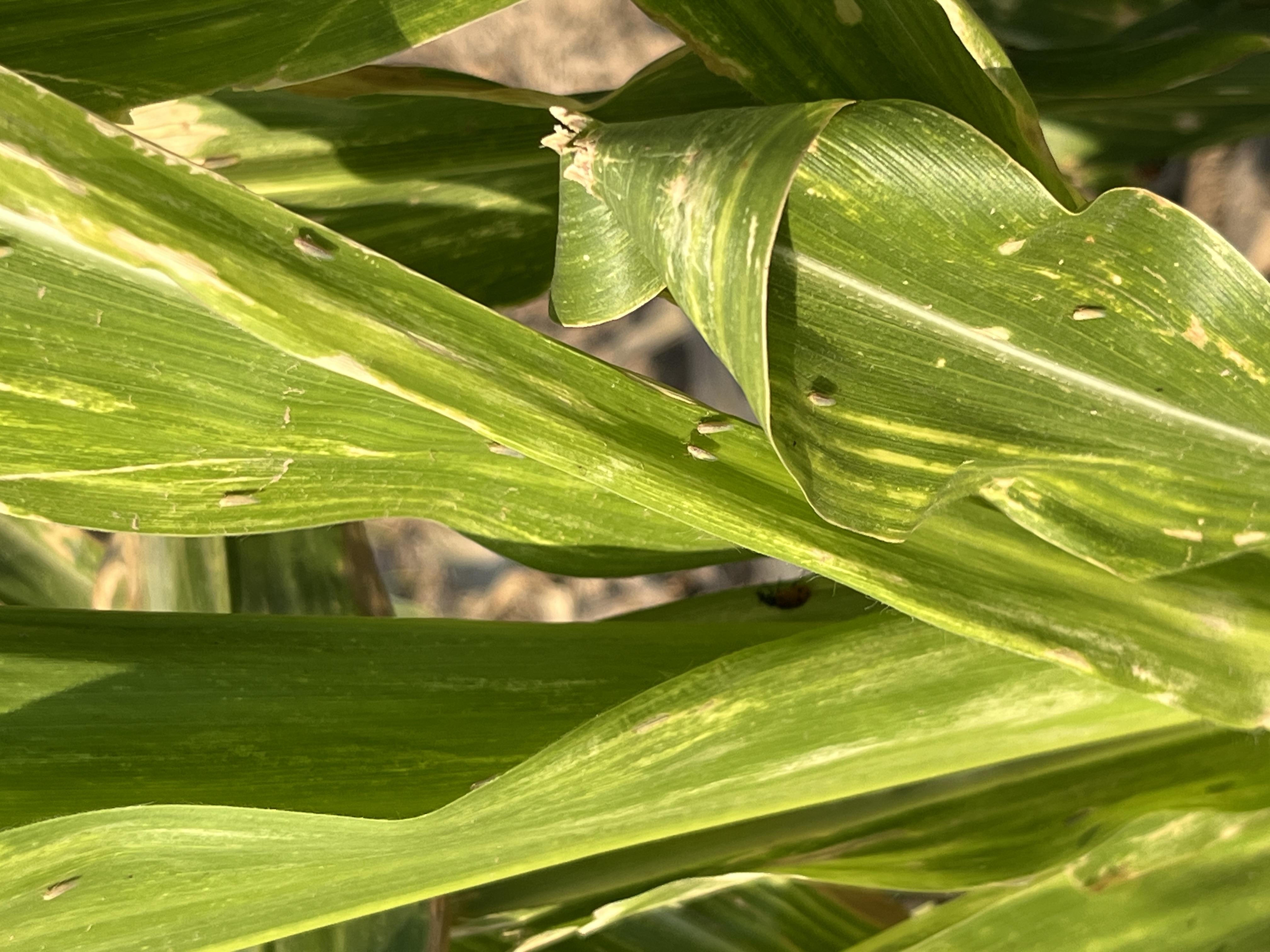
Corn leafhoppers are light tan or yellowish-white and approximately one-eighth of an inch long. Two dark spots surrounded by lighter areas between the eyes are characteristic of the species; unlike similar-looking leafhoppers, corn leafhoppers lack additional dark facial markings.
The insects move quickly when disturbed and often hide in shaded areas of corn plants. Adults and immature leafhoppers can be collected using a sweep net.
Anthony Zukoff, K-State entomology specialist, cautions that several leafhopper species can be mistaken for corn leafhoppers. Look-alike species, including aster leafhoppers, are not important corn pests and do not transmit corn stunt pathogens.
Producers and crop consultants who find suspected corn leafhoppers are encouraged to submit samples to K-State for confirmation rather than relying solely on field identification.
"Correct identification matters because not every leafhopper found in a cornfield is capable of transmitting corn stunt pathogens," Zukoff said. "The free testing program takes some of that uncertainty away and helps us improve the statewide picture at the same time."
The insects move quickly when disturbed and often hide in shaded areas of corn plants. Zukoff said adults and immature leafhoppers can be collected using a sweep net and transferred to a gallon Ziplock bag. Yellow sticky cards can also be placed near cornfields and checked weekly for the presence of adult leafhoppers.
Limited management options
Insecticide applications may temporarily suppress corn leafhopper nymphs, but trials conducted in 2025 in Oklahoma and Texas found that broad-spectrum insecticides were generally ineffective against corn leafhoppers.
Some suppression of nymphs was observed for up to 14 days following applications of indoxacarb, flupyradifurone, thiamethoxam and lambda-cyhalothrin. However, multiple waves of adult leafhoppers may enter a field during the growing season, limiting the effectiveness of insecticide applications in preventing corn stunt disease.
Applications may also reduce beneficial insect populations or increase the potential for spider mite infestations.
Insecticide and fungicide applications cannot cure plants already infected with corn stunt disease. By the time symptoms appear, the infection has already occurred.
Producers should follow all pesticide label directions and consider confirmed corn leafhopper populations, crop growth stage, disease risk and potential effects on beneficial insects before making an application. The label is the law.
Building on prior monitoring
K-State and its partners operated 31 trapping locations in 29 Kansas counties during the 2025 growing season. Corn leafhopper populations increased later in the season before declining as corn harvest progressed.
By the end of the season, corn leafhoppers had been reported in 31 Kansas counties and corn stunt spiroplasma in 25 counties, although disease detections remained relatively low.
Following harvest, researchers established 15 winter trapping locations across 11 counties to evaluate whether corn leafhoppers could survive Kansas winter conditions. Traps were placed in alfalfa, rye, triticale, winter wheat and corn residue.
No corn leafhoppers were trapped in the winter network between Dec. 8, 2025, and the beginning of the 2026 monitoring season.
Free testing available
Producers, crop consultants and extension professionals may submit suspected corn leafhoppers or symptomatic corn tissue to the K-State Plant Diagnostic Lab for free testing through the Kansas Corn-supported program.
Samples should be collected and shipped on or before the Wednesday of each week to avoid weekend storage.
Collecting insect samples
- Use a sweep net to collect insects.
- Empty the net into a gallon-size plastic bag.
- Do not add water.
Collecting plant samples
- Collect fresh leaf tissue from symptomatic plants.
- Place the tissue in a plastic bag, not a paper bag.
- Do not add water.
Submitters should complete a printed diagnostic lab submission form and label "2026 FREE CORN STUNT TESTING." Samples should be shipped as soon as possible, preferably overnight, to the address below.
K-State Plant Diagnostic Lab
4032 Throckmorton Plant Sciences Center
1712 Claflin Road
Manhattan, KS 66506
Scouting videos, identification resources, sample submission information and interactive disease maps are available on the Kansas Corn disease webpage.
As the growing season progresses, the Kansas Corn Disease Network will continue providing timely, science-based information to help Kansas farmers protect yield potential and make informed management decisions.