Brains & Blueprints
Mary Park brings quiet project leadership to K-State's massive Global Center for Grain and Food Innovation
Editor’s note: This article was originally published June 2, 2025 by the K-State News and Communication Services unit. It is being reprinted here with permission.
By Vikki Watson
Photo by Dan Donnert
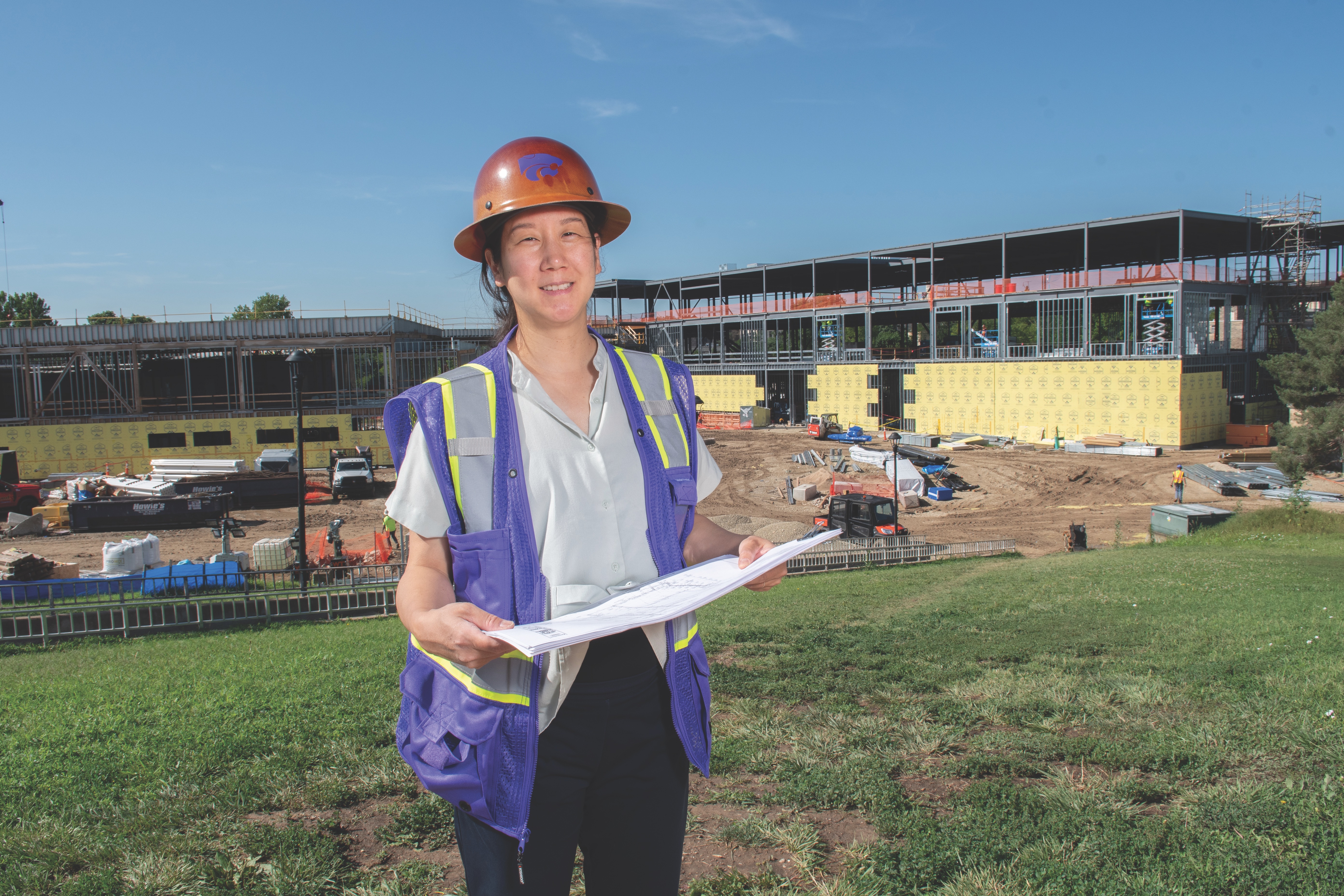
To understand the massive scope of Mary Park's role as senior project manager for Kansas State University's Global Center for Grain and Food Innovation, consider the comparison her manager makes.
"Mary's the Chris Klieman of the project," said Lisa Johnson, assistant vice president of planning, design and construction in the Division of Facilities, referring to K-State's Big 12 championship-winning head football coach. "She's the coach. She leads projects on behalf of K-State and the state of Kansas. The global center is big and aspirational, and she leads it extremely well."
Park appreciates Johnson's praise and the comparison to Coach Klieman, although she admits it took a moment for its significance to register.
"I didn't know who he was," she said, laughing. "I do now."
That's Park in a nutshell: humble, unassuming and completely dedicated to her work.
"She's collaborative, innovative, and a problem-solver," Johnson said. "She connects people."
 Managing thousands of moving parts
Those connections include literally thousands of contractors, architects, project team members, engineers, subcontractors, suppliers, alumni and university leaders that Park has coordinated with over the course of the project. Construction broke ground at the corner of Claflin Road and Mid-Campus Drive in Manhattan in spring, 2024, with completion estimated for fall, 2026.
The center represents the final and largest piece of the K-State Agriculture Innovation Initiative, a $210 million project that includes $127 million for the global center. The facility will connect Weber Hall and Call Hall — both of which are undergoing renovations — and create shared spaces where faculty and staff in animal science and industry, and grain science can collaborate on projects. Additionally, 30% of the space will be dedicated to partnerships between public resources and private enterprises, promoting an interdisciplinary environment for problem-solving.
When complete, the center will span three stories and 178,000 square feet. That's more than three times the size of the White House and the football field at Bill Snyder Family Stadium, bigger than the base of the Eiffel Tower in Paris and equal in size to North Carolina's Biltmore Estate, the largest home in the United States.
Delivering results
Big projects demand exceptional results, which is where Park excels, said Caroline Kolins, assistant director for agriculture and extension in the College of Agriculture and a project partner.
"Mary is amazing," she said. "What she delivers as just one individual is truly remarkable. I rely heavily on her, and she's a delight to work with. Whoever hired Mary is a genius."
That mastermind is Casey Lauer, associate vice president of facilities, who hired Park 3 1/2 years ago from Auburn University, where she served in a similar but smaller-scale project management role.
"Mary is very humble, but her work directly contributes to the mission and strategic direction of the university," Lauer said. "She's like a Swiss Army knife — dynamic in how she communicates and leads different teams while also having the technical expertise to understand everything that goes into constructing the largest agriculture project in K-State's history."
Ernie Minton — who assumed new responsibilities over thesummer after seven years as the Eldon Gideon Dean of the College of Agriculture to a full-time development role in partnership with the K-State Foundation to complete fundraising for the Agriculture Innovation Initiative — echoed others’ praise for Park.
“I think it’s clear that a major part of the success of this project is largely due to Mary’s outstanding work,” Minton said. “This is a pivotal moment for K-State and the College of Agriculture, and it’s reassuring to know that we’re on track to receive the first-class facility that we envisioned when we began planning these campus improvements.”
Building on strong foundations
An engineer at her core, Park earned her undergraduate degree in structural engineering from the University of California, San Diego, and a master's in historic preservation from Columbia University's Graduate School of Architecture, Planning and Preservation. During the following eight years, she honed her expertise at engineering and architectural firms that took her from Seattle to New York City before joining Auburn in 2019 as a project manager. She came to K-State in 2022.
"I wanted to transition into more of a developer and owner role, to help implement (leadership’s vision of a project{?}) a project vision and work with a variety of different people," she said.
That vision requires Park to handle everything from scheduling; hiring architects, engineers and contractors; ensuring student and staff safety; meeting with university leaders; engaging with interested alumni and community members; collaborating with designers and builders; budgeting; creating reports and proposals; estimating costs; troubleshooting job site issues; and muchmore.
"Mary brings everything together so effortlessly," Kolins said. "She doesn't even have to refer to her notes. She always has a timeline in mind and knows how all the variables will impact each other. What she delivers is truly remarkable."
Park, one of 10 project managers in the Division of Facilities, reflects the team's commitment to operational excellence in delivering exceptional facilities for K-State students, faculty and staff to excel and advance the university's key opportunities in community health and well-being, enabling technologies, food security and biosecurity, and sustainability. Each project manager oversees an average of 22 projects simultaneously.
"People assume the global center is my only job," Park said. "Some even think I'm actually building it myself or that I'm an architect or engineer. But that's part of the job — educating and listening to people and answering their questions. And I learn interesting things, too, like how to design a ramp that helps a large animal enter a building without getting startled."
Before breaking ground on the global center, Park led the exterior renovation of historic Ahearn Field House, including demolition of the natatorium and attached gymnasium. The project served as a visible testament to Park's meticulous efforts to enhance facilities while preserving the university's rich history.
"That project was extremely visible and important to the university and our alumni," Lauer said. "But Mary has never backed down from a challenge. She understood Ahearn's meaningful connection to the university and handled everything the project required. It was challenging, but she was five steps ahead the entire way."
Looking forward
Lauer sees a bright future for Park and hopes it includes a long stint in Manhattan, where Park and her family feel right at home.
"I've always been attracted to higher education," she said. "When I first came to K-State for a visit, I walked the campus to see the buildings and get a feel for the university. There was a sense of timelessness and history to it. The limestone, the creek, the feel of nature — it was all walkable and just really pretty.
"It was a beautiful walk."
Soon, Park will have her own piece of history to take in on her campus walks: a global innovation center where interdisciplinary research teams, industry experts and partners come together to address grand challenges in agriculture.