Curricula

K-State Proposed Democracy Studies Curriculum

ICDD promotes courses across the university curriculum that prepare students for fulfilling important roles as citizens, regardless of their chosen careers.  The following classes recommended by ICDD for their contribution to students' understanding and engagement in democracy are being considered for a proposed Certificate in Democracy Studies.  Note: (Courses listed as of Fall 2007/Spring 2008)

CHE 670 “Sustainability Seminar at Kansas State University”  – this seminar course emphasizes the intersections of sustainability science, engineering, social science, and economics. The topics covered will include water, green engineering, life cycle analysis, energy, environmental management, sustainability development, policy, and decision-making. This will be offered as an intersession course in January 2008.

HIST 555 “American Constitutional History” Survey of constitutional and legal development from colonial times to the present. English constitutional ideas and the common law in the American colonies, formation of the Constitution, the role of the Supreme Court, development of the modern American legal system, growth of the legal profession, the problem of civil liberties. The course offers insight into the relationship of constitutional-legal institutions to American society.  

HIST 556 “Bill of Rights in American History” This course provides a topical survey of the American Bill of Rights from the colonial era to the present. It begins with the origins of American rights in England and colonial America. An analysis of the need for a Bill of Rights at the founding and Supreme Court interpretations in 1835 and during the Reconstruction era follow. The bulk of the course is concerned with the nationalization and expansion of the Bill of Rights in the twentieth century and its meaning in the everyday lives of American citizens.  

HIST 586 “Advanced Seminar in History”  This is the capstone course for history majors/minors and topics differ according to professor. Lynn-Sherow’s topic is Public and Local History and explores the ways in which historians tell the ‘story’ of American history to non-professional groups. Research paper topics are usually local in nature but must be told in the context of the broader discourse of American development, including growth and change within American democratic institutions.

MC 630 “Mass Communication – Public Relations Case Studies” – special focus on case studies surrounding environmental controversies relevant to Kansans. The course will cultivate a meaningful understanding of the relationship between publics, media, and motivated communicators, and how this interplay ultimately determines public policy and action. Focusing on environmental case studies addresses the fundamental tension concerning limited resources and politics—a fundamental tension that demands our attention as citizens of the twenty-first century.   PHILO 135 "Introduction to Social and Political Philosophy” Examines rival theories of justice and applies them to current debates about economic inequality, gender, race, and sexual orientation. Combines some influential historical texts with contemporary philosophical literature on current political issues.

PHILO 525 "Social-Political Philosophy” Examines key developments in contemporary political philosophy in such areas as liberalism, libertarianism, communitarianism, Marxism, and feminism, and on topics of special interest where these theories are applied.

PHILO 550
"Philosophy of Social Sciences” I or II in alternate years. Epistemic methods and metaphysical presuppositions in the social sciences. Topics selected from: models, measurement, reduction, explanation, theories of function, theories of ideal types, and rational choice theory.

PHILO 670 "Advanced Social-Political Philosophy” I or II in alternate years. A study of a single topic in con- temporary philosophical literature, with application to current political issues. Topics will vary as determined by the instructor. Topics selected from: multiculturalism, minority rights, nationalism, justifications of democracy.

PHILO 675 "Advanced Philosophy of Law” I or II in alternate years. A current issue in analytical jurisprudence (such as the nature of law, the relation between law and morality, the proper standards for constitutional interpretation) or normative jurisprudence (such as the basis for tort liability, whether and when strict criminal liability is justified, the rights of criminals).
PLAN 660 " Community Development Planning” Examination of past and present approaches to community development planning in the United States. Review and assessment of community development planning policies, programs, and practices.

PLAN 661 “Community Development Workshop” The organization, planning, design, development, and evaluation of community development projects with real clients and actual locations.

POLSC 321 “Kansas Politics and Government ” – an introduction to the political institutions of, the political behavior in and surrounding, and the public policies flowing from governmental units in the state of Kansas  

POLSC 333 “World Politics ” – introduction to the study of politics among nations-states and other world actors, including a survey of major contemporary problems of world politics and focusing on the pursuit of power, order, wealth, and safe environment.  

POLSC 366 “Practical Politics ” – xtrategies and techniques of running for office, organizing a campaign, mobilizing community resources, direct action lobbying, and related practical aspects of local level citizen politics.  

POLSC 508
“The Mass Media and Political Campaigns ” – examines the role of the mass media in the electoral process. Dynamics of voter decision making and the impact of the media on voter attitudes and choices.  

POLSC 603 “Political Parties and Elections ” – origins, structure, and function of political parties. Dynamics of the two-party system. Roles of third parties. Analysis of election results and voting behavior.  

POLSC 604 “Interest Groups and Public Opinion ” – group theory and politics. Structure, internal politics, and techniques of interest groups and their impact on public policy. Formation and measurement of public opinion. 

POLSC 605 “The American Presidency ” – the presidency as an institution, its evolution, congressional relationships, executive organization.  

POLSC 611 “The Legislative Process ” – legislative decision-making in modern democracy with emphasis on the United States, the concept of representation, and political behavior of participants in the legislative process.  

POLSC 620 “State and Local Government ” – the U.S. system of federalism with emphasis on a comparative analysis of the government and politics of the 50 states and their subdivisions  

SPCH 331 “Criticism of Public Discourse ” – an examination of public influence based on study of historical and contemporary models of rhetorical criticism. The students' critical experiences will focus on a broad array of public discourse including political, social, and cultural messages.  

SPCH 450 “Dialogue on Democracy” - offers a unique selection of topics from multiple K-State professors, and challenges students to active learning through dialogue with the faculty.  Selected historical texts are used to establish a framework for the study of American democratic thought.  Central themes to these excerpts, such as individual rights and federalism, are then examined in light of contemporary democratic practice.  

SPCH 454 “Communication and Democracy - How communication, specifically speechmaking, has shaped notions of being a citizen in U.S. democracy.  The focus of this course is the role communication plays in struggles over meaning(s) of democracy.  We explore conceptual possibilities of the change notions of “citizen” and “civic leader” by employing a student-led facilitation process.  This communication process develops an important skill-set for students who choose to nourish and sustain democratic institutions. 

SPCH 470 “Rhetoric of Community Building. ” – an examination of the symbolic processes of community building. Specifically, the study of the role language plays in sustaining the viability of rural community  

WOMST 380 "Women and Global Social Change” I, alternate falls. This course explores contemporary approaches that help meet the needs of women and their families in different parts of the world, including the Plains region. Students will learn how approaches to social change in the Third World influence women in North America, and how First World women relate to women's movements and organizations in the Third World. Students develop some basic skills in deliberative democracy as it relates to identifying problems and designing an educational program that addresses these problems.


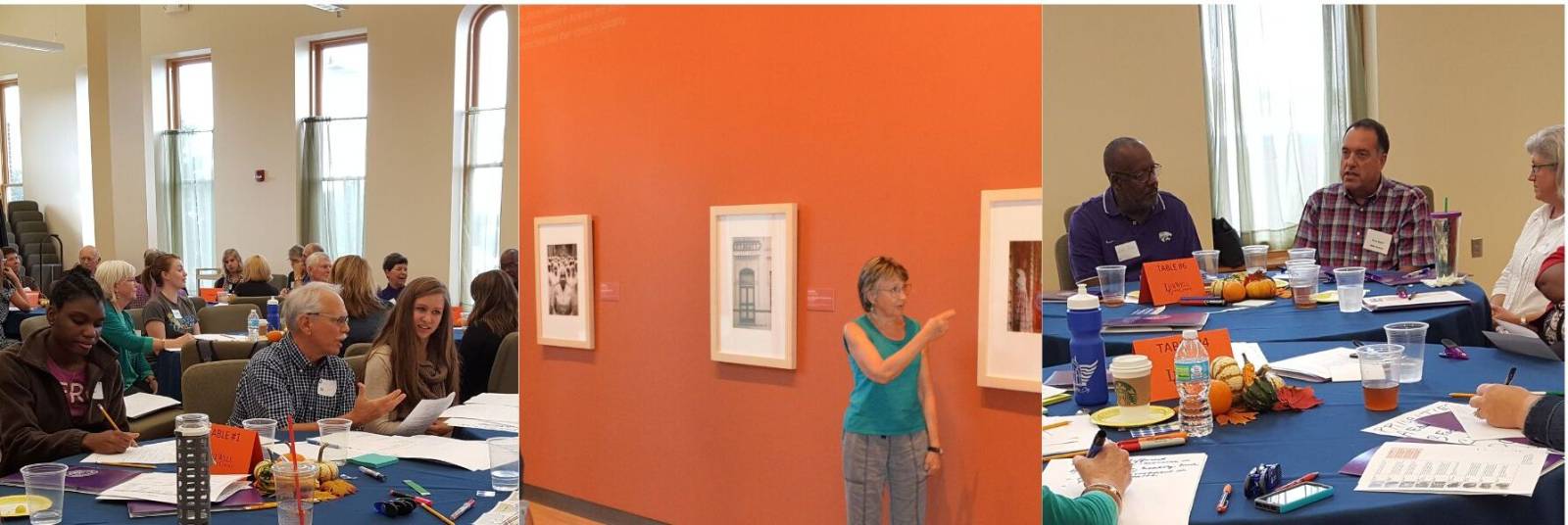
Pictures from the Dialogue and Democracy Class

Class1

Class2

Class3

Institute for Civic Discourse and Democracy
202 Ahearn Field House
Kansas State University
Manhattan, KS 66506