From pastures to pixels
K-State Olathe researcher Haley Larson is gathering cattle health insights with high-tech drone-based thermal imaging

aking cattle care to new heights is a ground-up effort for Haley Larson, who is pioneering a way to better understand the invisible dynamics of cattle pens.
This includes where cattle spend most of their time, and where they leave traces of that time. She can even figure out differences in the animals’ diets from the slight differences in the chemistry and moisture of those traces.
Larson gleans this information from hundreds of rainbow-colored images of a cattle pen taken by a drone equipped with a thermal camera, all stitched into a single digital tapestry.
Through an interdisciplinary research project that crosses all three Kansas State University campuses, Larson — assistant professor of animal health at K-State Olathe — is leading a research pilot to establish aerial thermal imaging as a valuable tool for cattle producers and feedlot managers to monitor their animals.
Using affordable, off-the-shelf recreational drones and basic analysis through commercially available software, the research puts scientific power into the hands of producers to help them better understand their animals’ environments, Larson said.
“Normally, as animal scientists, we focus on the animals themselves, and not as much on the surrounding environment,” she said. “But with this research, we sought to see what we could learn about animals from their environment.”
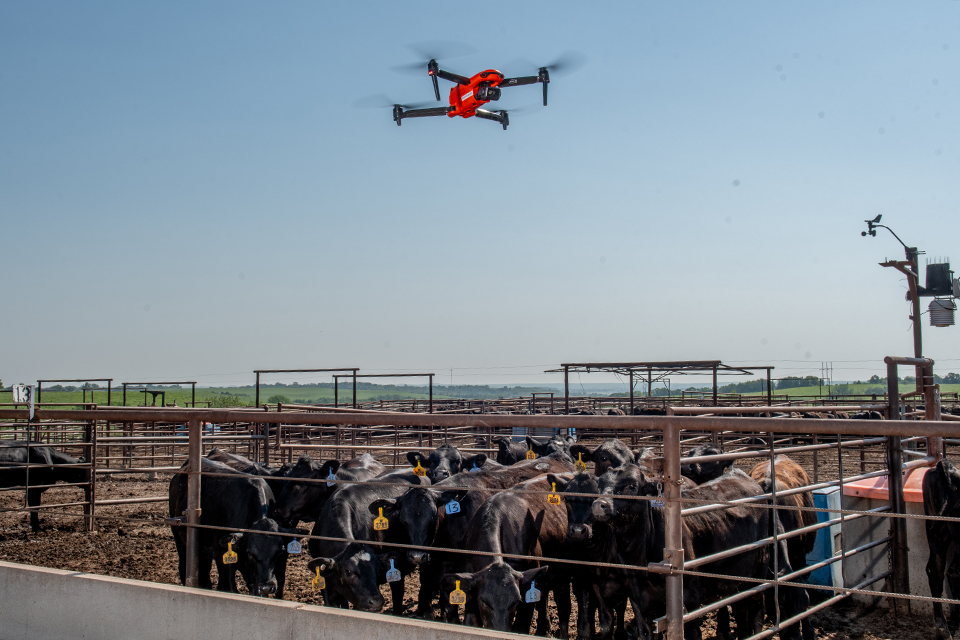
“Labor is one of the highest costs for cattle producers and feedlot operators,” said Haley Larson. “Our research looks to provide an additional eye-in-the-sky way of determining where to use those resources best.”
Creating a thermal landscape
K-State Olathe is at the forefront of the Greater Kansas City region’s burgeoning animal health and nutrition industry. Larson and other faculty have used their professional backgrounds and experiences in the industry to tackle some of the biggest challenges in the field.
One of those challenges has been demonstrating the effects of feed products and additives on cattle nutrition, some of which seek to reduce cattle emissions.
With current methods, collecting emissions measurements like methane and ammonia on operational farms would significantly burden scientists and producers alike, Larson said. Ranchers would either need to bring heavy, cumbersome equipment to their cattle operations, or they would need to send samples to corporations and academic institutions that own the advanced, but pricey, equipment needed for analysis.
Even with their advanced analytical capability, these methods can’t survey all the cattle traces in a single pen and instead must rely on human selection of the right random samples collected.
But what if K-State research could help with enabling technologies, such as a drone, to help operators know where cattle are spending their time and where to collect samples?
“In a feedlot, not all cattle are on the same diet,” Larson said. “Some are starting out, some are in a later finishing stage. If we were to have an aerial image that could help us detect the different areas where we should be sampling to best represent that pen mathematically, that could give us a more accurate landscape of the pen than someone who’s going in and trying to guess where to randomly pull samples.”
To that end, Larson and her research team connected with Kurt Carraway, executive director of uncrewed aircraft systems at K-State Salina’s Applied Aviation Research Center, to figure out how to approach the challenge using drone technology and skills that anyone could easily obtain.
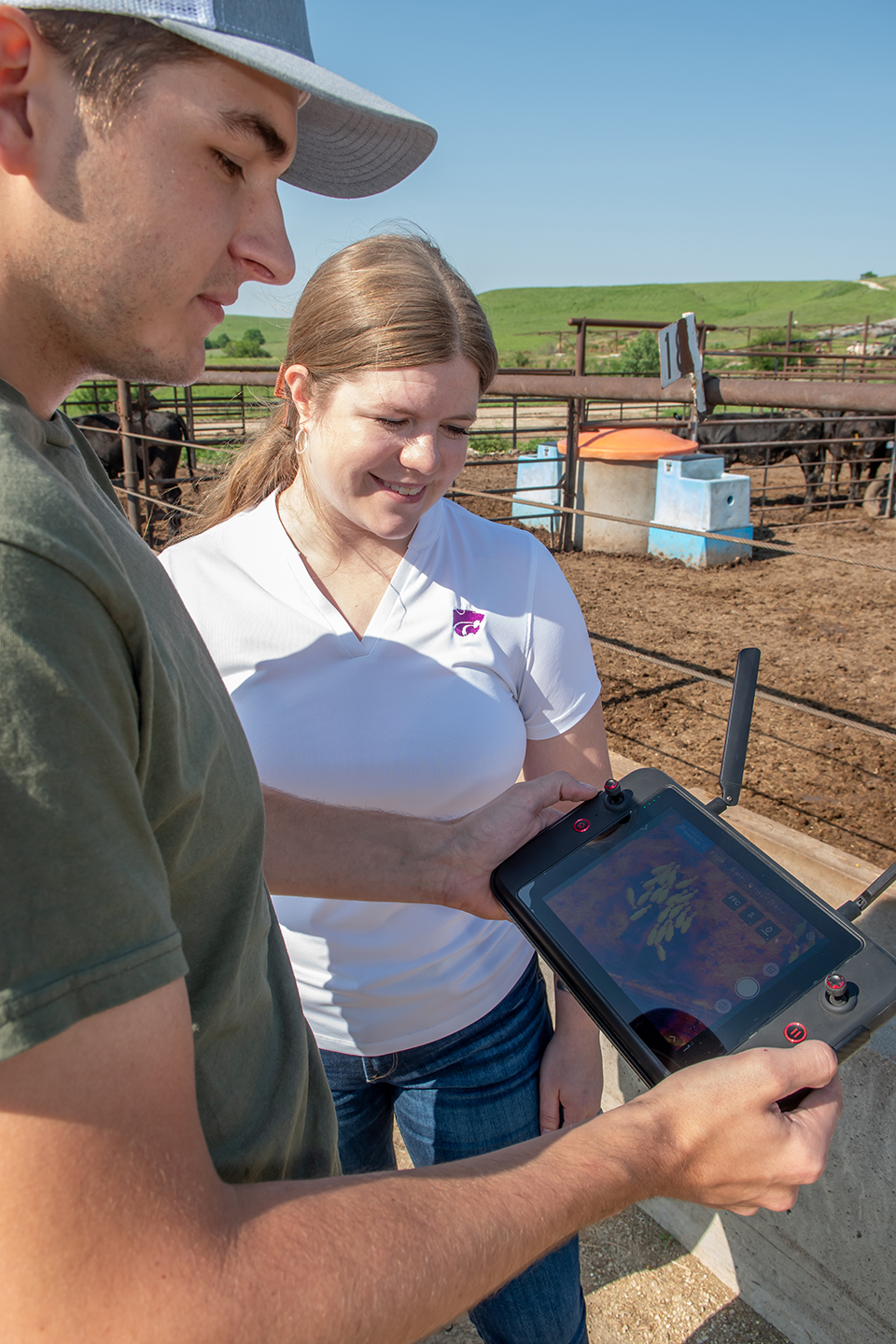
After completing K-State Salina’s single-day drone operation training, Larson’s graduate research assistant Logan Diller worked with animal sciences professor Dale Blasi and the research team to fly a thermal camera-equipped drone over K-State’s Beef Stocker Unit in the Flint Hills just west of Manhattan.
By flying preprogrammed flight paths to collect and stitch together a few hundred images, the team tested several variables, including flight height, drone speed and percent overlap between pictures, to determine how to best collect the needed data.
“Especially in the Kansas summer, cattle want to find the coolest spots in a pen,” Larson said. “But we were also able to see how factors like concrete or buildup of organic matter around the outsides of a pen factor into things like cooler environments.
”Because of that, we know that cattle will congregate in these areas because they are cooler, and we’ll observe higher emissions because of the higher rates of defecation and urination in these areas.”
Over the past year, the project has evolved from the original focus on emissions sample collection points to look at cattle health more holistically, especially in determining how feedlot operators can maintain pen conditions to best support cattle health and well-being.
“Labor is one of the highest costs for cattle producers and feedlot operators,” Larson said. “Our research looks to provide an additional eye-in-the-sky way of determining where to use those resources best. This helps producers save on those costs, as well as improve the performance of cattle and the revenue they can generate.”
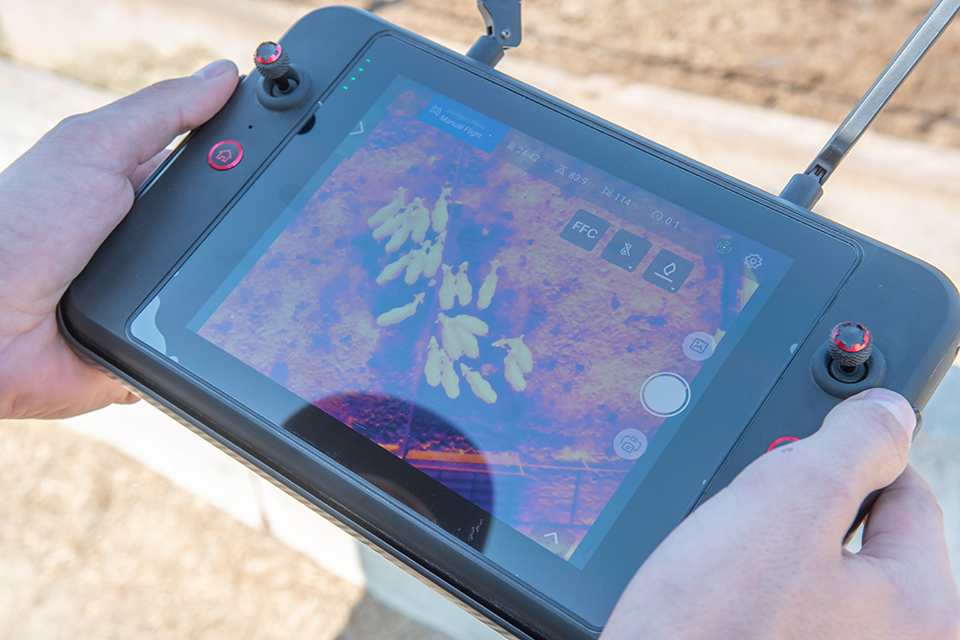
Logan Diller, graduate research assistant in Haley Larson's lab, controls a drone equipped with a thermal camera and observes the temperature gradient from above a cattle pen.
Building a toolbox for cattle producers
Cattle producers and feedlot operators already have access to applications that use drones to calculate their cattle headcounts.
Larson’s research looks to build on that capability and investigate other uses for the technology that can be additive to what’s already available. The research has focused on recreational drone operation, which is easy to learn and cheap enough for most producers to invest in a basic drone.
Eventually, it could expand into more advanced commercially licensed drone operations, allowing drone imaging from greater distances and over wider areas.
“Not every cattle producer is going to be able to, or even want to, fly their own drone,” Larson said. “Some will want to contract this type of work out, maybe to a neighbor or even someone with a formal business that offers this service.”
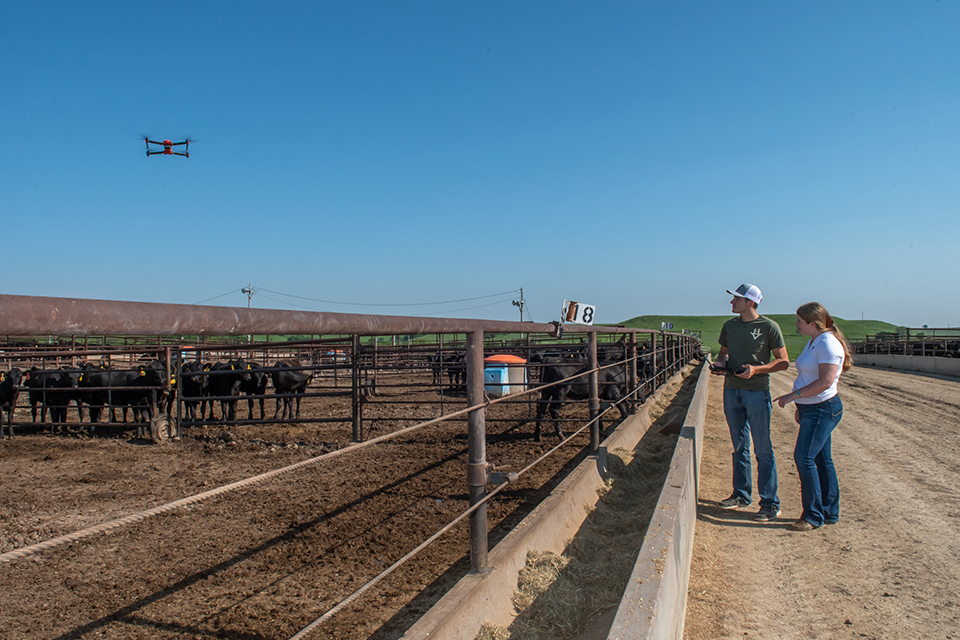
Haley Larson works with graduate research assistant Logan Diller as he operates a drone over cattle pens at K-State’s Beef Stocker Unit.
One application could also be in the emerging carbon credit market, where cattle producers can earn credits by reducing their cattle’s emissions and then create an additional revenue stream by selling those credits.
That market is still taking shape, Larson said. Still, as agencies develop infrastructure to validate emission reductions, her research shows thermal imaging as a viable method to measure and monitor products that help lower emissions.
“As sustainability initiatives evolve, this model can better reflect the stewardship that cattle producers have on their operations,” Larson said. “They are the ones who best understand their cattle and their environment, and this allows these producers to have a stake and input in how these sustainability initiatives evolve.”
The research team is building on the work of Brent Auverman, a Texas A&M University professor of biological and agricultural engineering who is a leading expert on dust in feedyards.
“Labor is one of the highest costs for cattle producers and feedlot operators. Our research looks to provide an additional eye-in-the-sky way of determining where to use those resources best.”
Auverman’s work has resulted in techniques to analyze the amount of dust in a feedyard by taking photos of pre-determined patterns hundreds of feet away, then using computer software to analyze the “fuzziness,” or dustiness, of the air in those images.
Larson’s team wants to accomplish that same work, but through the vertical space above a pen.
“If we can take a top-down image and understand dust and other emissions, we can get a better understanding of the risks cattle might face in dealing with respiratory issues like bovine respiratory disease or acute interstitial pneumonia that are health concerns for cattle operations, and how cattle producers could best disperse drugs and preventatives,” she said.
“That’s just one example, but there are so many pieces as we build out this toolbox that producers could use in being responsible stewards of their cattle operations.” 
◊◊◊
Nuclear engineering sees resurgence, renewed purpose Plant lab remains vigilant toward protecting food systems Faculty collective tackles insect threats from every angle
Seek magazine
Seek is Kansas State University’s flagship research magazine and invites readers to “See” “K”-State’s research, scholarly and creative activities, and discoveries.