Conversation through concert
How Anna Marie Wytko uses music to transcend words and nations

ven after thousands of performances on some of the world’s most famous stages, Anna Marie Wytko takes no performance for granted.
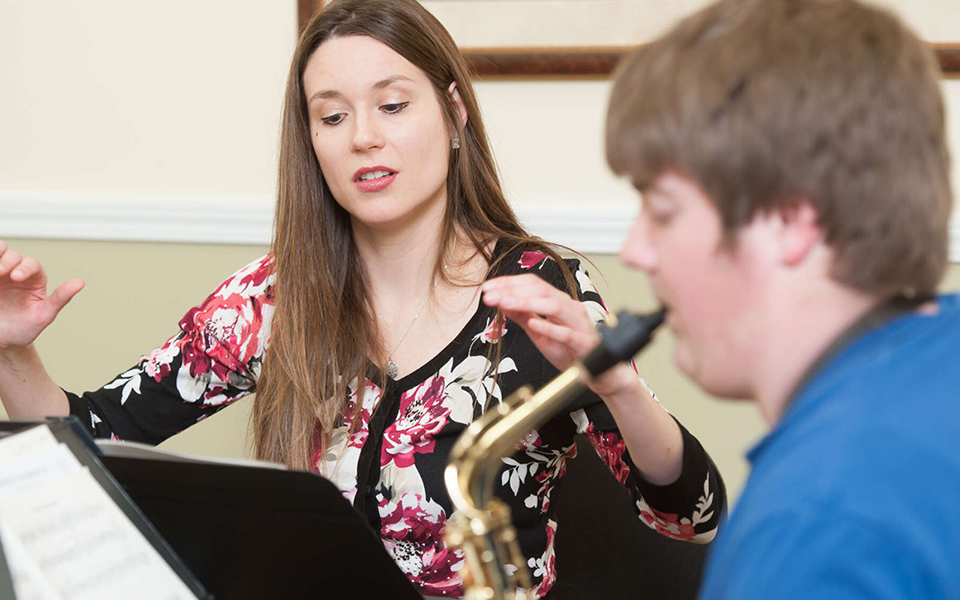
To Wytko, every saxophone concert is a conversation, a precise yet passionate exchange between artist and audience.
Whether she’s onstage at Carnegie Hall or teaching at Kansas State University, Wytko brings the same conviction: that music, when taught and performed with care, can transcend words and expectations.
Sonate pour Saxophone alto et Piano
The Sonate pour Saxophone alto et Piano by Russian composer Edison Denisov is arguably one of the most influential works in contemporary saxophone literature, says Anna Marie Wytko. An intense piece metrically, rhythmically and tonally, Denisov explores the boundaries of the saxophone in terms of range, color/sonority, and pure technical virtuosity.
Wytko, university distinguished professor of music in K-State’s School of Music, Theatre, and Dance, is a dynamic soloist, chamber musician and educator.
Her artistry has led her to perform with the Phoenix Symphony Orchestra, the Polish Air Force Wind Symphony, the Banda Sinfónica de Montevideo in Uruguay, the National Symphony Orchestra of Costa Rica, at the Royal Academy of Music in London, the National Conservatory of Music in Paris, the National Conservatory of Music in Buenos Aires, the University of Zagreb Academy of Music, music conservatories throughout Italy in Florence, Milan, Bologna, and Perugia, and at the New York International Music Festival in Carnegie Hall.
“My goal as a performer is to find human connection within each concert and each piece presented,” she said. “This is why no performance can or should be exactly the same as the last, including with pieces I’ve played multiple times. What I am currently experiencing in my life and what my audience members are currently experiencing in their lives influences these human connections and my approach to making music.”
Wytko will perform as soloist in San Francisco’s Herbst Theatre during Spring of 2026. Located within the San Francisco War Memorial Performing Arts Center, the Herbst Theatre is considered one of the most iconic and prestigious performance venues worldwide.
Rooted in music
Wytko credits her upbringing for shaping her musical path.
As a child, her parents encouraged her to explore music without pressure to pursue any one instrument or path.
“I was very fortunate to grow up in a musical family and to have constantly been surrounded by music of all kinds,” she said. “I could not help but become passionate about the saxophone, an instrument capable of producing many voices and telling many stories.”
Her work today reflects this early exposure and a sense of responsibility, and she said she uses music as a vehicle for embracing compassion, understanding and respect for all people.
Just as she hopes audience members can find strength, healing or even simply beauty in her performances, Wytko hopes to understand more about the people who hear her music.
“In live performance, I can often sense these ‘intangible’ connections,” she said. “Audience members will also often communicate to me directly following a concert or in written form the expressive impact of the musical event. They share their personal, musical journeys with me. These human journeys directly and indirectly influence how I think about the music and every future performance.”
Amplifying artistry through education
As a Yamaha Performing Artist–Clinician, Wytko is a world leader in developing saxophone education and training.
In addition to her recordings, Wytko is the author of two books — “The Saxophonist as Rank Beginner and Beyond” and “The Saxophonist as Musician First” — that have been widely adopted in saxophone classes around the nation and world.
Additionally, she serves as an adjudicator for the North American Saxophone Alliance biennial competition. She has been invited by the Latin American Alliance of Saxophonists to perform and teach at global congresses, including in Costa Rica and Argentina.
In other global work, she has mentored emerging saxophonists in countries where concert saxophone has had limited representation.
Nocturne pour Saxophone alto et Piano
The Swiss composer and radio producer Conrad Beck was greatly influenced by his time spent in Paris, where he experimented with bitonality, dissonant formations, tonal stridency, and complex textures, Wytko said. Nocturne pour Saxophone alto et Piano is a lyrical and expressionistic work that clearly suggests a “nocturnal” atmosphere.
“My work has taken me around the world and given me the opportunity to share what I’ve learned with others, which is a true privilege,” Wytko said.
At K-State, Wytko’s influence extends far beyond performance.
Wytko views her studio as a place where students and educators learn together. She takes the initiative to surround herself with experts in the field and learn as much as possible from them.
“The most rewarding component of my career at K-State is the work that I do with my students,” she said. “Mentoring a wide range of students from diverse backgrounds with the development of their own diagnostic skills often challenges me to refine my own thinking about pedagogical-performance approaches.”
Paving the way for future generations
As one of only a few women saxophonists to hold the rank of full professor, Wytko remains focused on increasing visibility and opportunity.
“I want to continue to break barriers for women saxophonists as they navigate their careers in a field that has historically provided women with fewer opportunities,” she said. “I hope the impact of my research will cultivate an awareness that all people are worthy of dignity and capable of excellence.”
Last spring, Wytko was named a university distinguished professor — a lifetime title representing K-State’s highest honor for faculty and a career of outstanding teaching, research and service. She is the youngest professor in K-State history to be given this honor.
Conversation through concert
“My goal as a performer is to find human connection within each concert and each piece presented. This is why no performance can or should be exactly the same as the last.”
“Professionally, it reaffirms to me that my research, teaching and service are paving the way for future generations of saxophonists worldwide,” Wytko said. “Personally, it reaffirms to me that the privilege of creating, sharing and teaching music is a valued part of the human experience.”
In every rehearsal, concert and classroom, Wytko offers a lifelong commitment to the art of communication through sound.
And for those who learn from or perform with her, that legacy resonates long after the final chord.
“It is my hope that my research will continue to encourage young people to consider some form of the arts as a career option, or, at least, to strengthen serious respect and passion for creating, performing and listening to music,” she said. 
◊◊◊
Undergraduate finds big ecological role from tiny creature Outstanding Scholar studies High Plains wastewater recovery Graduate landscape architect bolsters green roof resilience
Seek magazine
Seek is Kansas State University’s flagship research magazine and invites readers to “See” “K”-State’s research, scholarly and creative activities, and discoveries.