All Things Kansas: One powerful tool to understanding the Sunflower State
All Things Kansas tool supports state’s communities through insights and analytics

cross Kansas, individuals, businesses and communities are navigating a rapidly changing world. Whether searching for child care options, broadband internet access or economic development opportunities, Kansans need resources they can trust and tools that meet them where they are.
All Things Kansas, an online platform developed by Kansas State University and collaborators, is helping residents, business owners and local leaders make more informed decisions — faster.
The website serves as a central hub for county-specific data. It highlights everything from demographic and health statistics to workforce insights, education levels and infrastructure access.
But the impact and value of All Things Kansas go beyond numbers and charts.
“This isn’t a top-down data tool — it was built with Kansans, for Kansans,” said Jessica Gnad, K-State’s director of economic development. “We work with K-State Extension, our academic experts and community leaders to ensure the tool reflects needs and real use cases across the state.”
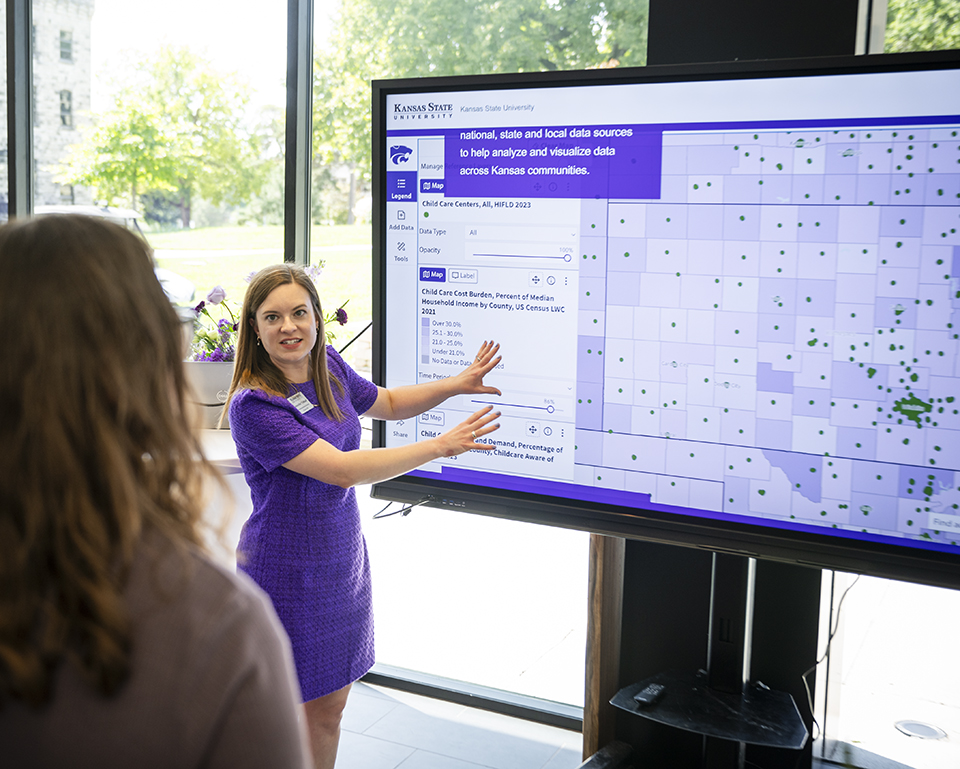
All Things Kansas is a one stop shop for data, making it easy for Kansans to sort through more than 30,000 data layers to identify opportunities and understand communities.
A dynamic snapshot of Kansas
At its core, All Things Kansas is a free interactive website that offers a county-by-county overview of key indicators affecting local growth and quality of life.
The platform includes intuitive graphics and easy-to-navigate dashboards powered by publicly available datasets. Users can explore and compare population trends, educational attainment, workforce participation, income levels and more across all 105 counties.
The tool has access to more than 30,000 data layers from more than 120 state and national sources, said Jennifer Tidball, communications director for economic development at K-State.
“You could go to several different websites and find all this content yourself, but this tool saves time by making it a one-stop shop,” she said.
The platform’s design supports the university’s Next-Gen K-State strategic plan and reflects its commitment to advancing community vitality through engagement and innovation.
From small towns to statewide solutions
One of the platform’s greatest strengths is its ability to lower the barrier of entry for users, said Greg Erickson, K-State enterprise business intelligence and data analyst.
For the Clay Center native, the project’s impact is personal. Erickson said the tool supports him in his job as he works to help the lives of Kansans and neighbors in his community.
“All Things Kansas takes data that might require multiple searches across different databases and makes it as simple as typing into a search box, just like you would on Google,” he said.
This ease of use opens the door to a wide range of users — from policymakers and entrepreneurs to nonprofit leaders and grant writers.
“This data tool is now a part of the conversation when Kansans walk into congressional offices,” Gnad said. “It gives decision-makers a clearer view of local challenges and opportunities — and that helps tell a more complete story of our state’s economic potential.”
Designed to evolve
As a living platform, All Things Kansas is built to grow alongside the state it serves.
Community visits and user feedback have shaped new features, added data layers and guided ongoing development, Tidball said.
“Every time we go out to communities and do demo sessions, people say, ‘Hey, we have great data we'd love to add,’” Tidball said. “And we do.”
Thanks to its collaborative infrastructure with the University of Missouri’s Center for Applied Research and Engagement Systems, the site is updated regularly with the most current data available.
“It’s free. It’s current. And it’s built to keep growing.”
— JENNIFER TIDBALL
K-State’s team works with partners like Child Care Aware of Kansas and the Kansas Health Institute to visualize local challenges and opportunities.
“It’s about helping Kansans make better decisions,” Tidball said. “Whether you’re expanding your business, applying for a grant or trying to understand broadband gaps, we want this tool to give you clarity.”
Tidball believes the platform’s flexibility makes it a valuable resource for entrepreneurs and small business owners, and explained how users can explore population trends, workforce statistics, housing markets and infrastructure to identify the best location for a new business or support an expansion.
“We even have a map that shows business births and deaths over time,” she said. “It gives you an economic snapshot of what’s happening in the state.”
Visualization leading action
While traditional spreadsheets may leave users overwhelmed, All Things Kansas aims to turn complex information into interactive visuals.
It includes maps, dashboards and downloadable reports that can be used and shared.
“People don’t just want access to data — they want help making sense of it,” Gnad said. “Our job is to turn information into action, so that Kansans can use it to grow businesses, strengthen local communities and plan for the future.”
Grant writers are among the platform’s most active users. According to Tidball, the ability to export custom maps and compare county reports side by side is especially powerful for rural leaders who often juggle multiple responsibilities.
“If you’re one economic development director covering a whole region, you may not have time to create graphics for every grant,” Tidball said. “This tool does it for you.”
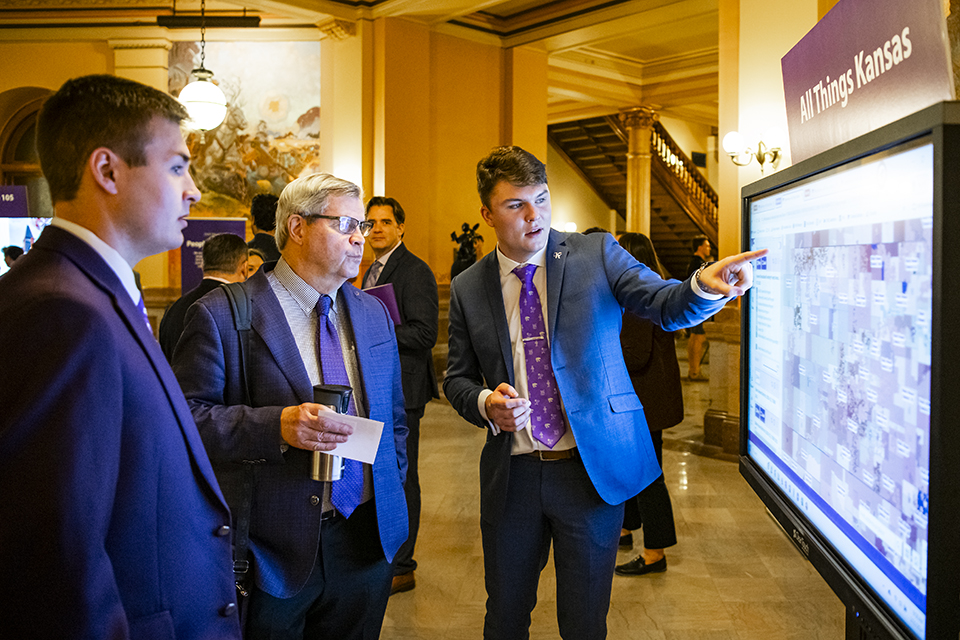
Parker Vulgamore, 2022-23 student body president, discusses All Things Kansas during K-State Impact Day.
A tool built for Kansas
Beyond individual use, All Things Kansas is fostering a sense of connection across Kansas.
When demonstrating the platform across Kansas, Tidball said she has seen it spark moments of community recognition and pride.
“You show a map and people say, ‘Yes, that’s what we’re experiencing,’” she said. “It empowers them to be solution-oriented and connect with other communities doing well in that area.”
And the more Kansans who use it, the more powerful the platform becomes.
“It’s free. It’s current. And it’s built to keep growing,” Tidball said. “Because when Kansans have access to the right information, we all make better decisions.”
Through its many layers of customizable and comparable data, All Things Kansas doesn’t just highlight challenges, Gnad said.
It points to opportunities.
“It confirms the best parts of your community or challenges assumptions,” Gnad said. “It helps Kansans see themselves more clearly and see each other.”
Whether helping a business owner explore new markets, assisting a policymaker in identifying broadband gaps or giving a parent insights into child care supply, All Things Kansas strives to offer a unifying solution across a diverse state.
“This is K-State showing up in those spaces to be agile and responsive to the needs of Kansans,” Gnad said. “We’re creating another tool in our land-grant university toolbox as we bring K-State expertise and resources directly to Kansas communities.” 
◊◊◊
Thermal drone imaging gathers new cattle health insights Nuclear engineering sees resurgence, renewed purpose Plant lab remains vigilant toward protecting food systems

Seek magazine
Seek is Kansas State University’s flagship research magazine and invites readers to “See” “K”-State’s research, scholarly and creative activities, and discoveries.