When Summer is Ruthless, You Don’t Want to Be Rootless
By Megan Kennelly, Ph.D., KSU Plant Pathology
Summertime in Kansas is rough for cool-season turf. It’s hot, and it’s always either too wet or too dry. Maybe there is one random afternoon when it is “just right,” but usually we are off at one extreme or the other. The wide fluctuations and crazy weather stresses out our plants and can make them more prone diseases.
Usually we are looking at the above-ground parts of plants, but a lot of the critical action is underground. Whether you are talking about turf, tomatoes, or trees, we build healthy plants by building healthy roots. Unfortunately, it’s all too easy for a turf rootzone to get out of whack. However, if you keep an eye on things it will be much easier to prevent problems, detect them early, and address them before the turf dives into a tailspin. Buy a small soil probe or trowel, and use it! Take a peek underground and see if the rootzone is trying to tell you a story.
In putting greens, I often see a lot of layering of dark organic matter that looks like this: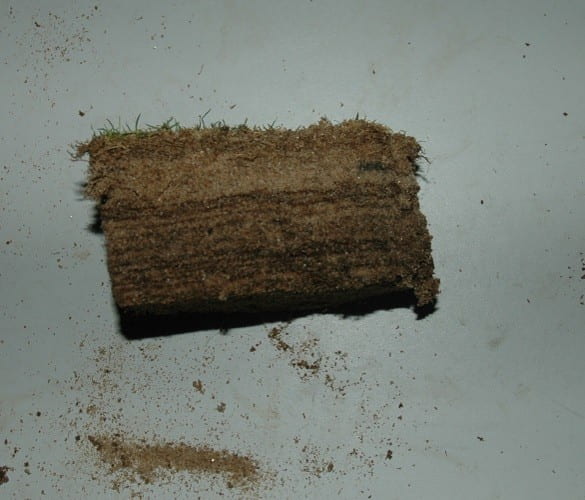
Here is one where you can see an aerification hole:
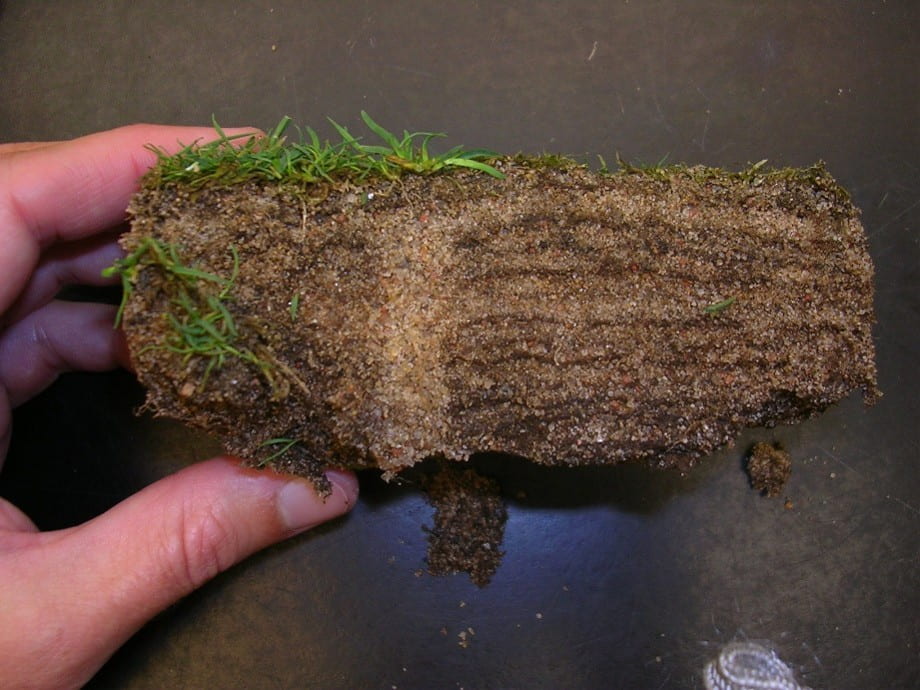
Organic matter holds water, and water holds heat. That means that even if our nighttime lows cool down, the rootzone stays hot. Steam-cooked roots are not happy. They decline physiologically, and they can be prone to Pythium root rot. I’ve seen many cases where steam-cooked roots stressed plants out and leaves them prone to anthracnose as well. A lot of times there is some algae mixed in, taking advantage of the poor drainage and the thinned-out turf.
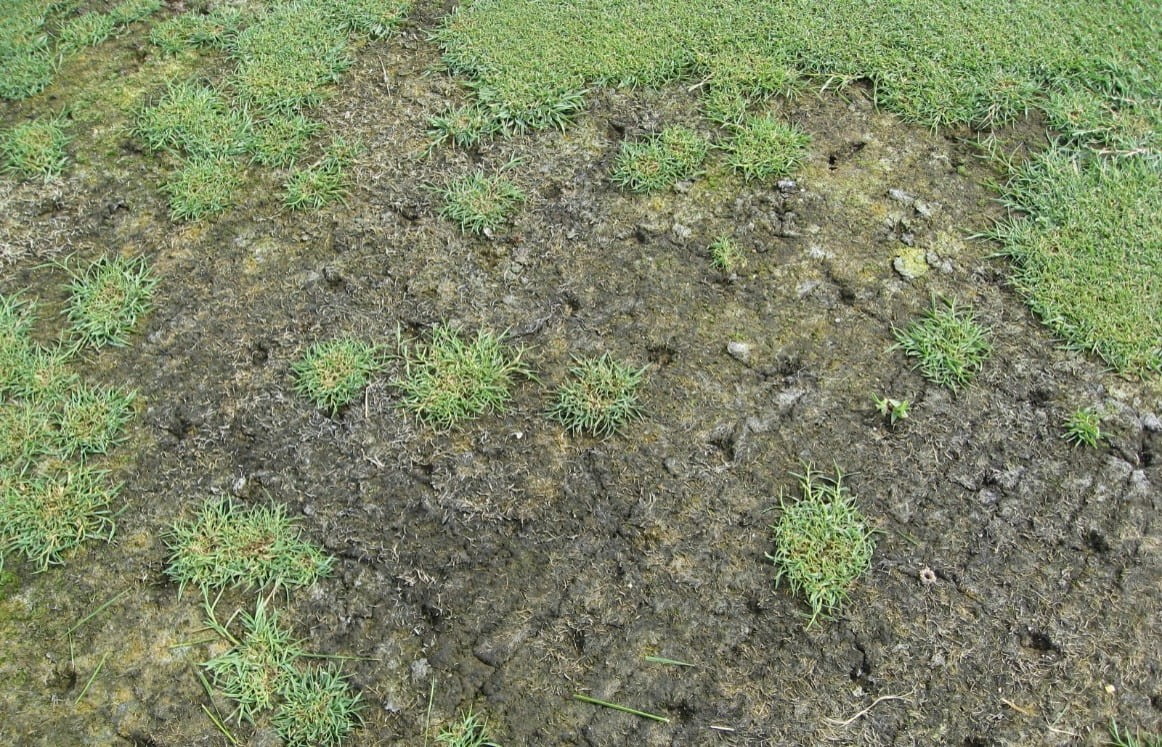
And, here is a photo showing the bentgrass taking hold and growing in the aerification holes:
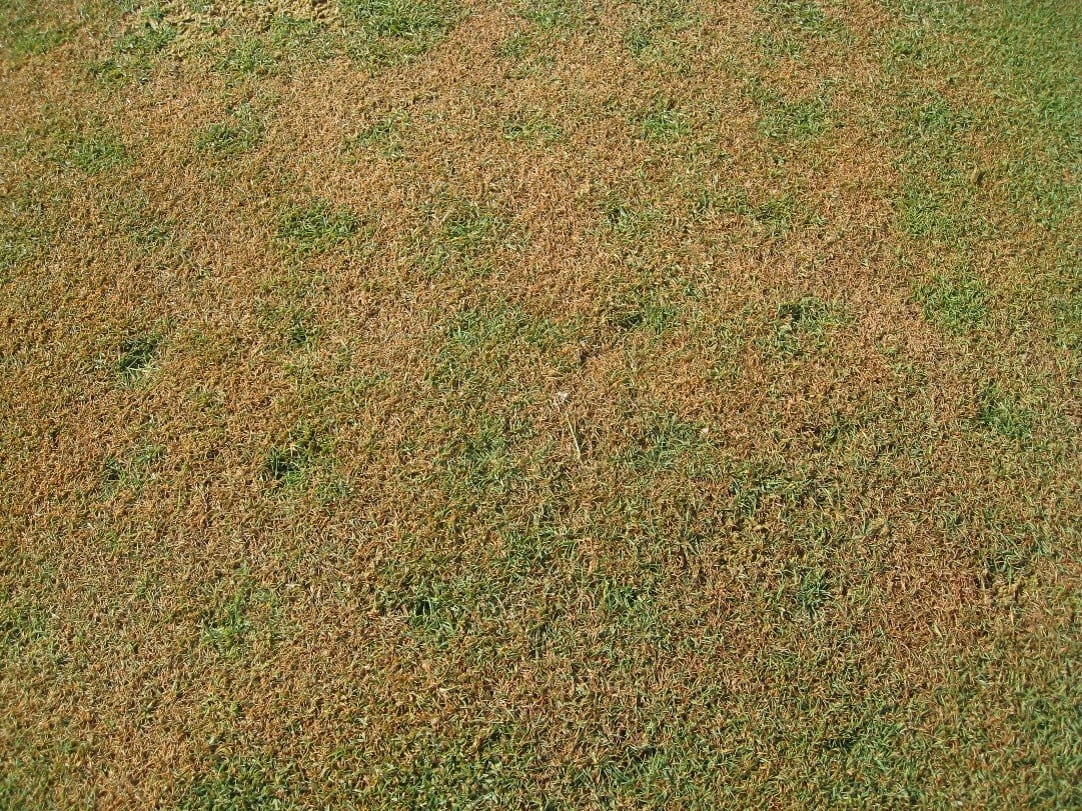
Here is another example of aerification leading to healthy roots, and therefore healthier foliage:
Another rootzone issue I see over and over again is thatch layer buildup in lawns and fairways. The turf declines, people think it is a disease, and they send in a sample. In the photo below, all that stuff between my fingers is thatch:
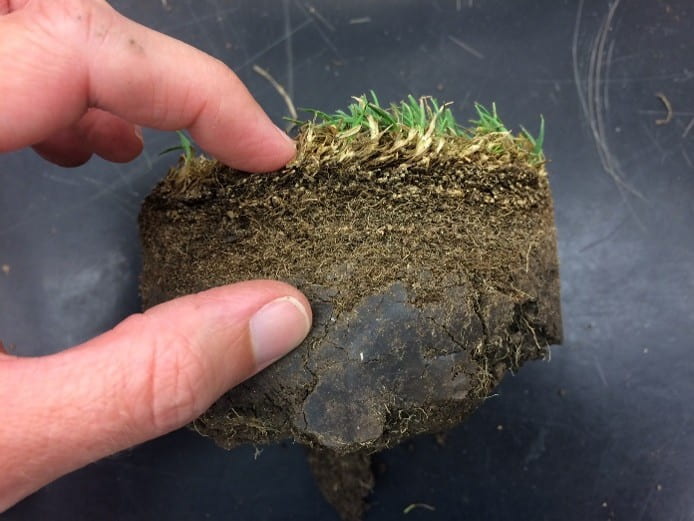
In the photo below of zoysiagrass, everything between the fingers is thatch. (The stuff between the lower finger and thumb is soil).
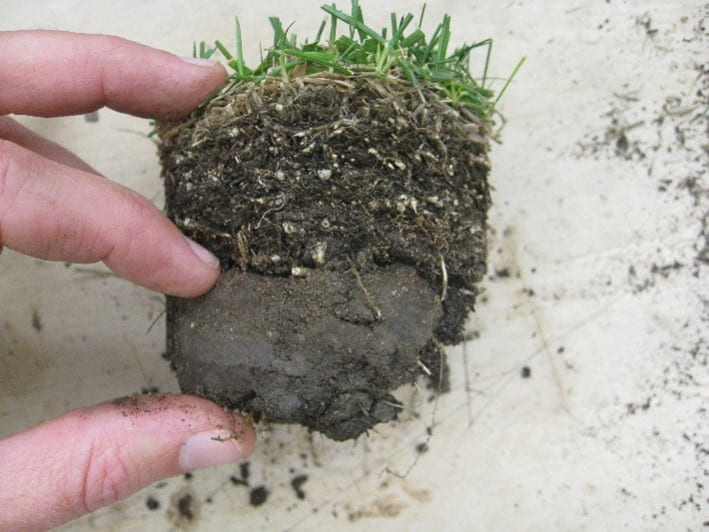
In the photo below the thatch is sandwiched between two soil layers. (Photo courtesy Jacob Weber)
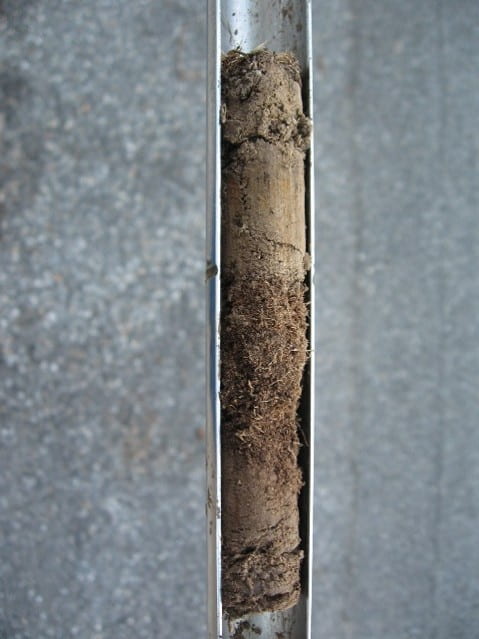
A small amount of thatch is good, but more than ½ inch is problematic. Thatch interferes with water infiltration and rooting, leading to drought stress which people mistake as disease. Thatch is puffy and squishy, leading to scalping while mowing. For more information on thatch, you can check out the publication about Thatch – A Hidden Lawn Concern.
Need help figuring what is going on with your turf? You can always send a sample to the K-State Plant Diagnostic lab. For guidance on how to send a sample, you can visit this website: http://www.plantpath.k-state.edu/extension/documents/turf/Turf_News_sample_submission-2017.pdf
For turf fungicide information, one of my favorite resources is the annual guide from University of Kentucky and Rutgers: http://www2.ca.uky.edu/agc/pubs/ppa/ppa1/ppa1.pdf.