Fall Armyworms Active in Kansas: Intensify Turfgrass Scouting Efforts
By A.J. Lindsey, Ph.D., Kansas State University
July monitoring reports from the Great Lakes and Maritimes Pest Monitoring Network show that fall armyworm moths are active across Kansas, signaling that turfgrass managers should begin or intensify scouting efforts. Moths have been detected in numerous locations throughout the state, with some of the highest captures currently occurring in south-central Kansas. These captures serve as an early warning that egg-laying is occurring and that damaging larval populations may soon develop in turfgrass systems.
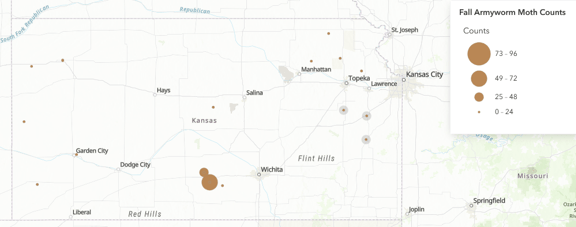
A recent K-State Turf and Landscape Newsletter article discussed identification, scouting techniques, and management options for fall armyworms as part of a broader review of summer insect pests. Rather than repeating that information, this article serves as a timely reminder for golf course superintendents, sports turf managers, lawn care professionals, sod producers, and grounds managers to intensify scouting efforts as we enter a period when outbreaks can develop rapidly. Additional information on fall armyworm identification, scouting methods, and management considerations can be found in the resources listed below.
Fall armyworm does not overwinter in Kansas. Each year, moths migrate northward and establish populations during the growing season. According to a recent K-State Extension
Entomology update, fall armyworm moths began arriving in Kansas during mid-June, and pheromone trap captures have continued to increase. These observations suggest that larval activity may increase throughout late summer, reinforcing the importance of regular scouting in commercial turfgrass systems.
For commercial turfgrass managers, now is the time to routinely scout susceptible turf areas. Increasing moth activity does not guarantee damage at a specific location, but it does indicate that conditions are favorable for infestations to develop.
Additional Resources
- Great Lakes and Maritimes Pest Monitoring Network (track regional fall armyworm activity): https://experience.arcgis.com/experience/7164d23d488246d198dcf7a07d8c9021/page/Home?views=Moth-Counts
- Fall Armyworm is Now Active in Kansas (K-State Extension Entomology): https://blogs.k-state.edu/kansasbugs/2026/06/24/fall-armyworm-is-now-active-in-kansas/
- Summer Turf Wars: Battling Drought, Heat, and Seasonal Pests – Part 2 (Brown Patch and Insect Pests): https://blogs.k-state.edu/turf/summer-turf-wars-battling-drought-heat-and-seasonal-pests-part-2-brown-patch-and-insect-pests/
Have questions? Every Kansas county has a K-State Extension office ready to help with topics just like this. Find your local office at extension.k-state.edu/about/statewide-locations.