Nature’s Highlighter: How to Use Morning Dew to Identify Bermudagrass and Buffalograss
Article by Ross Braun, Ph.D., Kansas State University
Bermudagrass and buffalograss can be excellent turfgrass species options for Kansas for home lawns, golf courses, sports fields, and many other uses. Like zoysiagrass, they have excellent summer performance and can conserve water inputs compared with cool-season grasses. However, like any turfgrass species, they can become weeds when they show up where they were not intentionally planted or where they are not desired. How can you tell if you have some bermudagrass or buffalograss infesting your tall fescue or zoysiagrass on your properties? Well, the first step is to scout on a dewy morning to observe differences in dew on the leaf blades.
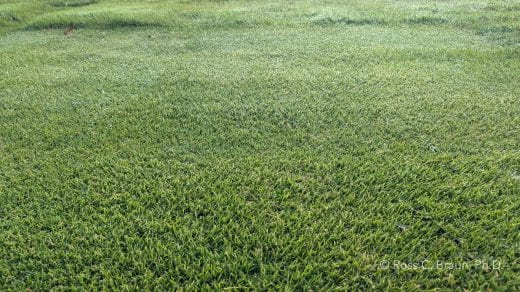
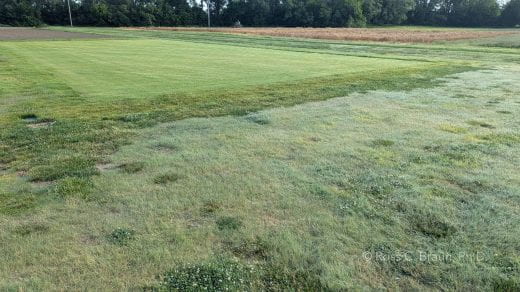
If you walk your property at dawn, you will notice that patches of bermudagrass or buffalograss practically look painted white with moisture, while the surrounding zoysiagrass, Kentucky bluegrass, or tall fescue appears notably drier. This visual contrast is a perfect, built-in scouting tool that relies entirely on the plant’s leaf morphology and canopy architecture.

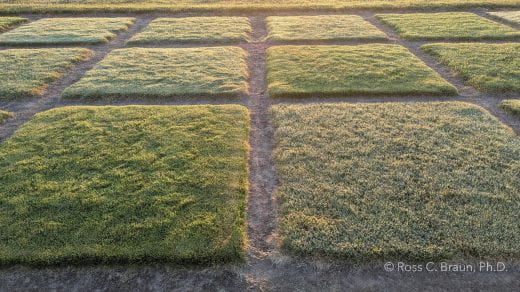
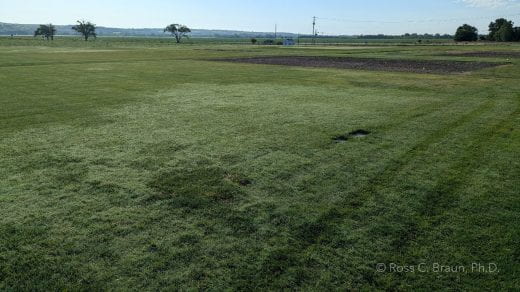
Here is a breakdown of why these grasses interact with morning moisture so differently.
The Dew Catchers: Bermudagrass and Buffalograss
When condensation forms overnight, these two species hold water high and tight at the top of the turf canopy, creating a bright silver-white sheen.
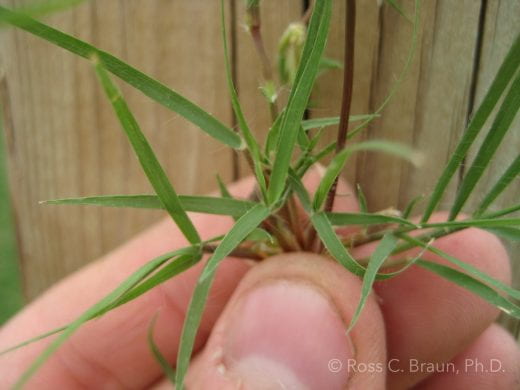
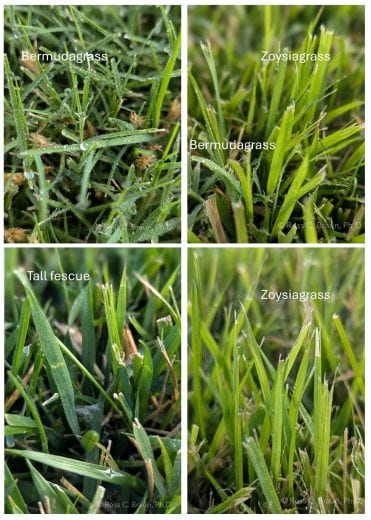
Both buffalograss and bermudagrass have a very specific morphological trait: fine, microscopic hairs (pubescence) along the leaf blades. These hairs are often on both sides of the leaf blades as well. Whereas, zoysiagrass is often less hairy and usually only on the top side of the leaf blade, and most cool-season turfgrasses (tall fescue, Kentucky bluegrass, perennial ryegrass) lack hairs completely. These hairs on bermudagrass and buffalograss act like a net, trapping thousands of tiny water droplets and preventing them from merging into heavier drops. Because the droplets stay small and suspended on the leaf surface, they catch the morning light brilliantly.
The Quick Dew Drainers: Zoysiagrass, Tall Fescue, and Kentucky Bluegrass
On the other side of the spectrum, these grasses have structural traits that actively encourage water to shed rather than sit, making them look darker and drier in the early hours.
Tall fescue is characterized by its much wider, coarser leaf blades. When dew forms, the wide surface area causes the tiny droplets to quickly pool together into larger, heavier drops. Because the leaf lacks the dense hairs of buffalograss and bermudagrass, gravity takes over, and the water simply slides down into the lower canopy. The same happens with Kentucky bluegrass, which has smoother leaf blades (no hairs) like tall fescue and finer (skinnier) leaf texture than tall fescue.
Zoysiagrass has highly rigid leaf blades that stay upright (i.e., more vertical). This stiffness, combined with a smoother leaf surface (less hairs), means it doesn’t cradle small water droplets like bermudagrass or buffalograss. The water runs down the stiff structural veins of the leaf and disappears below the visible canopy line.
Using Dew to Your Advantage!
Once the sun comes up and the morning dew evaporates, a creeping patch of bermudagrass or buffalograss can easily camouflage itself within a tall fescue or zoysiagrass. Trying to scout and spot it in the dry afternoon can be difficult and requires getting down on your hands and knees to inspect collar regions and ligules and leaf blades more closely.
Getting up at dawn on a dewy morning will simplify your scouting efforts. Let the dew do the hard work for you! These dew differences can be observed in both high and lower mowing heights. So you can use this to your advantage in higher heights of cut (i.e., home lawn or golf course rough heights), but also at lower heights of cut (i.e., golf course fairway or sports field heights). Those bright, glistening patches will serve as a glowing map of exactly where your warm-season invaders are spreading, allowing you to accurately target your control efforts before the problem gets out of hand. Flag these areas or use marking paint to outline where you need to control.
Good luck and happy scouting!