Research Update - Pre-Emergent Control of Little Barley (Hordeum pusillum)
Little barley (Hordeum pusillum) populations commonly infest warm season turfgrass systems in Kansas, which result in aesthetically unacceptable turfgrass stands. In addition, little barley is often a concern for pet owners in early summer as the seedheads can become lodged between a dog’s paw pads, causing discomfort or injury.
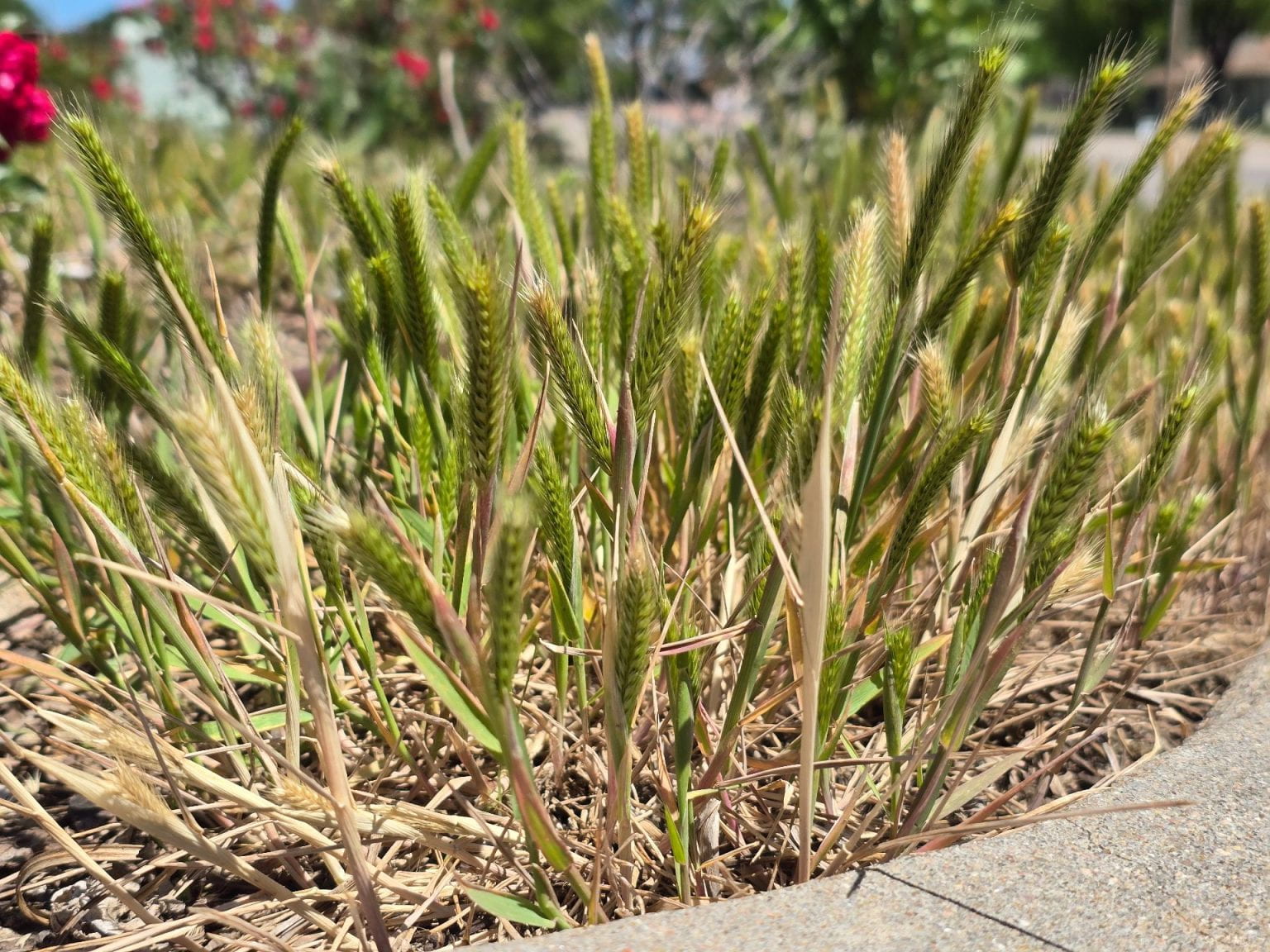 Little barley, highlighting the seedheads as plants mature and begin to brown out at the onset of summer heat.
Little barley is a winter annual, monocot, bunch-type grass spread by seed. Little barley is thought to germinate September to October and spends the winter as a small plant. In the spring, it thrives in cooler temperatures, growing rapidly in size and forming seedheads. Plants often go unnoticed until May and June when they form seedheads, turn brown, and become more visible in lawns. With the onset of summer heat, little barley matures, drops its seed, and disappears.
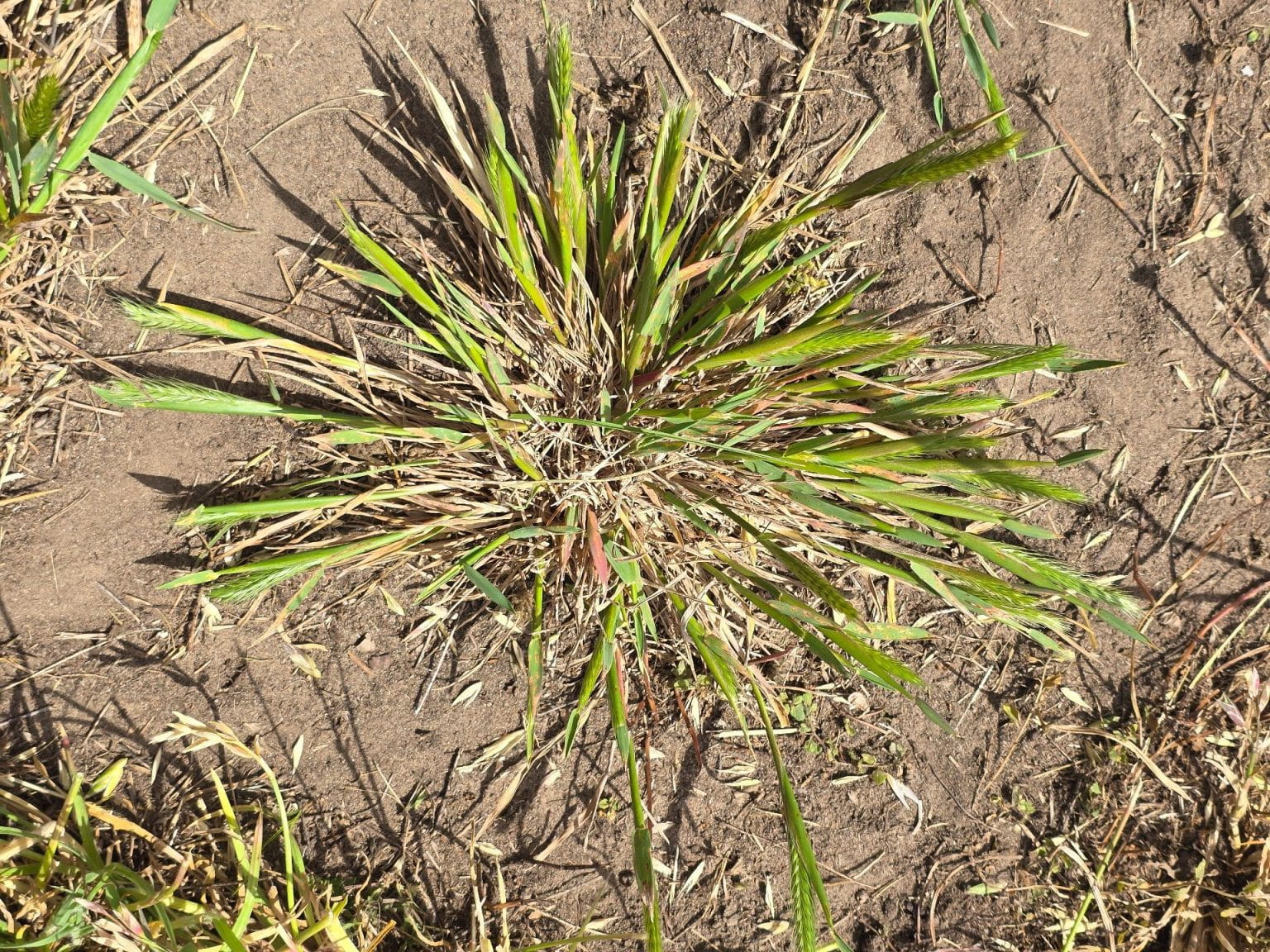 Little barley's overall growth habit
Traditional recommendations for little barley control start with growing a thick and healthy lawn. Additional control can be provided by making a pre-emergent herbicide application in early fall (late August through early September), however, there are very few products labeled for pre-emergent control of little barley.
Little barley is a weed we often experience at the John C. Pair Horticultural Center, and one we receive many questions about. With its abundance in some of our turfgrass demonstration plots, we decided to evaluate the effectiveness of various pre-emergent products against little barley. The goal of this research was to determine which pre-emergent herbicides might provide adequate control of little barley.
The research trial was initiated in late summer 2025 in a buffalograss plot that was heavily infested with little barley the previous spring. Four common preemergent herbicides known for their control of annual grassy weeds were applied as a single, liquid application. A non-treated control was included for comparison, for a total of five individual treatments. All herbicide treatments were applied on August 26, 2025 using a backpack sprayer with a 3-foot-wide boom. All products were watered in to activate them following application. Herbicide treatments consisted of prodiamine, oxadiazon, dithiopyr, and pendimethalin (at labeled rates) in 6 foot wide strips across the buffalograss. Data collection consisted of visual percent little barley cover (0-100%) and were transformed to percent little barley control for presentation purposes.
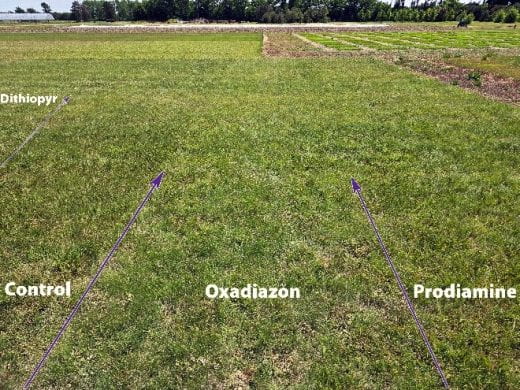 An overview of the buffalograss plot in May 2026, that hosts the little barley pre-emergent trial. Little barley is visible in the picture as the areas of darker green grass in the photograph (as compared to the buffalograss which has a lighter green/blue color). Four of the five treatment areas are visible, with the photograph centered on the six foot wide strip that oxadiazon was applied, with the control plot to the left. The August 26th oxadiazon application provided 90% control of little barley, and provided clearly visible edges of where the application was made.
Much to our surprise, we found that this spring, the buffalograss plot had a significant little barley infestation. The plot treated with oxadiazon (Ronstar) was the only treatment that had significant little barley control (about 90% control).
As with all scientific research, there is always a lesson to be learned. In this case, our understanding of little barley and its growth habit may not be completely accurate. While we felt August 26th was an early enough application date, it is possible that little barley may germinate in south-central Kansas at an even earlier date. It is also possible that some little barley may be able to emerge early in the spring or late in the winter, when the traditional pre-emergence herbicides are losing effectiveness, and a second pre-emergent application may be needed in some winters for adequate control. It is also possible that some of these herbicides do not offer control of little barley. To answer these questions, more research will need to be conducted. This fall we plan to repeat our trial, adjust our application timings, and see what treatments provide the best control of little barley in Kansas lawns.
Table 1. Little Barley (Hordeum pusillum) control after preemergence herbicide applications at John C. Pair Horticultural Center in Wichita, KS; 2026*.
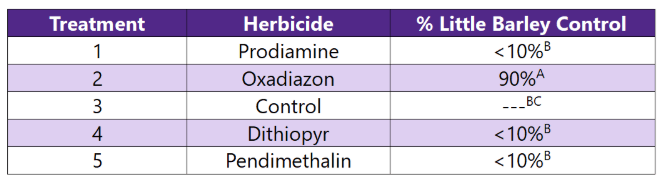
* Ratings were conducted on May 6, 2026.
a Treatments followed by unique capital letters are significantly different.
b Treatment means followed by a common capital letter are not significantly different.
c Non-treated control contained approximately 75% Little Barley cover throughout the research plot.
Regulatory Update & Application Disclaimer: Readers should note that the EPA has recently completed its registration review for oxadiazon (the active ingredient in Ronstar or QualiPro Oxadiazon 2G evaluated in this trial), resulting in significant label changes. All oxadiazon products are now classified as Restricted Use Pesticides (RUP) and may only be purchased and applied by certified professionals. While the liquid application evaluated in this commercial turf trial remains permitted, liquid formulations are now strictly prohibited in residential settings, including landscape and ornamental beds. If adapting this research for residential ornamental weed control, applicators must utilize a granular formulation. As always, oxadiazon across all formulations (liquid or granular) remains strictly prohibited for use on residential home lawns. Current turf use remains strictly limited to golf courses, commercial turf, athletic fields, and sod production. Always consult the most current product label for updated application rate limits and new mandatory requirements, such as immediate post-application irrigation.
Additionally, Oxadiazon is only recommended for warm season turf, and non-desirable damage is more likely to occur in cool-season turf.