Turfgrass and Shade Stress Part 2. Turfgrass Management in Shaded Areas
Into the Shadows: A Guide to Managing Turfgrass in Low Light
Growing healthy, dense turfgrass in the shade of mature trees or buildings is one of the toughest challenges for turfgrass managers and homeowners alike. Shade stress is more than a lack of light; it creates a complex environment in which reduced photosynthesis, altered temperatures, and competition for resources converge. If your turf has been thinning out over the past growing seasons, you need to shift your strategy from standard maintenance to specialized shade management.
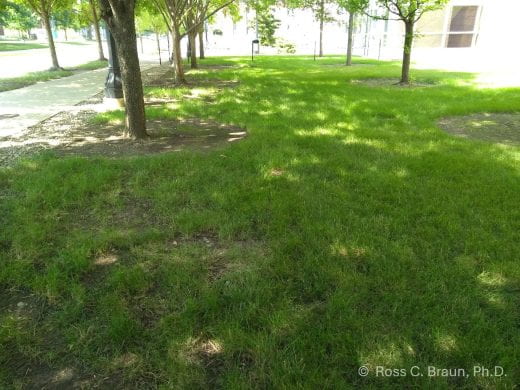
Here are my five top shade tips!
- Prune The Trees
See Part 1 of this 2-part blog post about pruning trees. The turfgrass needs more sunlight, and pruning the trees will promote healthier turf and healthier trees! This will increase sunlight exposure to the turfgrass and improve airflow, reducing fungal disease pressure in summer.
- The Right Plant for the Right Place
The next step in conquering shade is accepting that not all grasses are created equal. If you are struggling with Kentucky bluegrass, bermudagrass, or perennial ryegrass in a shaded area, you are fighting a losing battle, as these species have poor shade tolerance.
Instead, interseeding (overseeding) with shade-adapted species is critical. Fine fescues (such as Chewings, strong creeping red fescue, or hard fescue) are generally the champions of dry shaded environments. For wet-shaded areas, choose tall fescue. Regardless, if the shaded area is dry or wet, fine fescues and/or tall fescue will always be a better option than perennial ryegrass or Kentucky bluegrass. If your bermudagrass is not performing up to your standards in the shade, then use zoysiagrass, which is another warm-season turfgrass but with better shade tolerance than bermudagrass.
Avoid “sun and shade” grass seed mixtures in stores; these often include too much Kentucky bluegrass and perennial ryegrass, which germinate, but then the turf canopy thins over time due to limited shade tolerance. Look for the fescues (fine or tall) for better shade performance. Note: Avoid grass seed that contains ‘Boreal’ strong creeping red fescue (this is an old, very poor performing strong creeping red fescue), instead there are many new excellent strong creeping red fescue, Chewings fescue, or hard fescue cultivars available. Also, avoid ‘K-31’ (Kentucky-31) forage-type tall fescue, instead use turf-type tall fescue cultivars (there are many excellent options).
- Less is More: Fertilization and Mowing
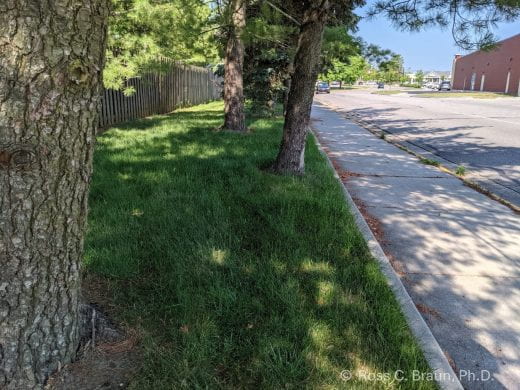
A common mistake is trying to “fertilize” the grass out of a shade problem. How does this happen? Well, the turf canopy looks thin, maybe slightly yellowish, and overall unhealthy. So your instincts kick in, and you want to feed the plants. You shouldn’t! Shaded turf grows more slowly, and it requires significantly fewer nutrients. In fact, you should reduce nitrogen fertilization by approximately 50% in shaded areas compared to full sun areas. Research suggests that applying just 1 lb of nitrogen per 1,000 sq. ft. annually can yield higher-quality turf than higher rates in dense shade.
Mowing practices must also change. Grass under shade stress has thinner leaf cuticles and is more delicate. To compensate, increase your mowing heights to maximize leaf area for photosynthesis and mow less frequently to reduce stress. Think about it: the grass is already growing more slowly compared with the full-sun areas. Does it really need to be cut as often? No. Skip mowing the shaded areas occasionally, and your grass will be healthier because mowing is a stress on the plant and reduces photosynthetic leaf tissue.
- Water and Growth Regulators
Shade often comes with trees, and trees are thirsty competitors. This creates “dry shade,” where tree roots outcompete turf for water and nutrients. While you might intuitively water less in the shade, areas under tree canopies may require more irrigation during summer to combat this root competition. If your shade stress is from structures (e.g., buildings and fences), you are likely to have wet shade because there are no competing plants for water. These wet-shade areas require much less frequent watering than full-sun areas.
For golf course superintendents and turfgrass professionals, consider using plant growth regulators (PGRs) such as Trinexapac-ethyl (sold under various trade names). Plant growth regulators reduce vertical growth while encouraging density and carbohydrate reserves, thereby making the turf more resilient to low-light stress.
- When to Give Up on Grass
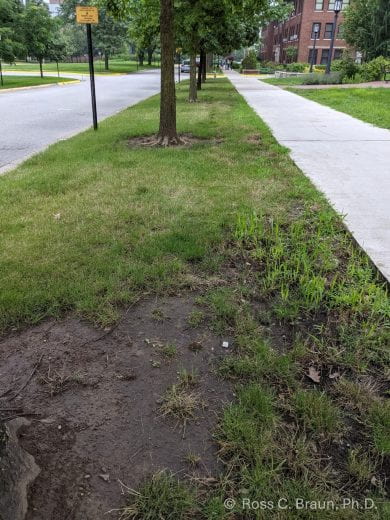
Remember, even the most shade-tolerant grasses typically need at least 4 hours of sunlight to survive. Sometimes, the shade is simply too dense (less than 15% light transmission). If you have pruned trees, improved air movement, and tried the fescues, but the grass still fails, it may be time to switch tactics. Consider alternatives shade-tolerant plants and other ground covers such as pachysandra, hostas, ajuga, or sedges, juncus, Japanese forest grass, vinca minor, ferns to maintain ground cover without the headache of failing turf.
Here is a past K-State Garden Hour episode on “Gardening in the Shade,” which provides a list of many alternatives for shaded areas.
https://youtu.be/LS4HdGUMe6Y?si=eti0Rk4dB9V1briE