Partners in life and science
Through complementary research and collaboration, Ajay and Vaishali Sharda are working to make agriculture more efficient and sustainable.
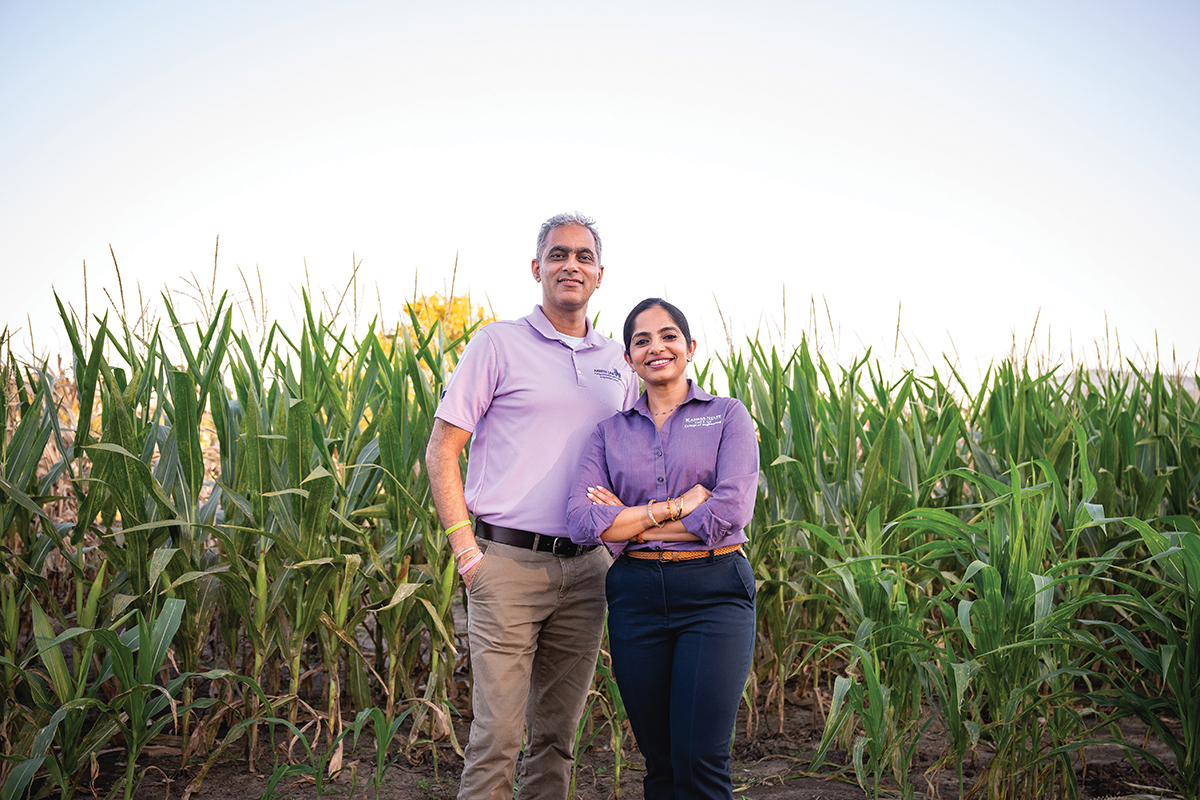
Research collaboration takes on a different meaning for Ajay and Vaishali Sharda, a married couple and Carl R. Ice College of Engineering faculty colleagues whose complementary expertise is helping drive agricultural innovation.
By Grant Guggisberg
Carl R. Ice College of Engineering
Tuesday, Dec. 1, 2026
In the fast-evolving world of agricultural technology, innovation rarely happens in a vacuum. For Ajay and Vaishali Sharda, both faculty in the Carl and Melinda Helwig Department of Biological and Agricultural Engineering at Kansas State University, it can happen almost anywhere, from the kitchen sink to the lab table.
As a married couple working within the same department, the Shardas have navigated the dual-career dynamic while establishing themselves as leading researchers in machine systems, precision agriculture and water resource management.
Their shared journey as undergraduates in India all the way to Manhattan, Kansas, as key figures driving agricultural innovation at K-State is a testament to mutual respect, shared vision and complementary strengths.
From India to Manhattan: A shared trajectory
The couple’s story began during their undergraduate studies in India, where they first met before pursuing master’s degrees and early careers. Their paths eventually led them across the globe to Auburn University for their doctorates. With a 15-month-old daughter in tow, they made a deliberate choice to study together.
"Early on, we decided that doing our doctorates at different schools was not an option," Vaishali said. "That was the plan: get to Auburn, settle down and see what opportunities exist."
After completing their doctorates, the family was once again on the move, this time headed across the country to south central Washington. Both Shardas completed post-doctoral research at Washington State University before reviewing their options. Armed with backup offers from corporate opportunities in the agriculture industry, the two set out looking for an academic destination that would suit both their needs.
Ultimately, Ajay landed a faculty position at K-State in 2013, with Vaishali joining the faculty shortly after. Arriving in Kansas, the Shardas stepped into an environment ripe for growth.
"When I came in, there was no established machine systems program here at K-State," Ajay said. "The more I talked to people, the more I learned that this is a place where people are looking for someone who can come, start and grow these programs."
Divergent expertise, common purpose
While both share a foundational background in agricultural engineering, their individual research portfolios focus on distinct domains aimed at solving real-world challenges for farmers.
Ajay specializes in machine systems, precision agriculture, automation and robotics, with his work primarily focused on smart equipment and sensor networks to optimize field operations. Vaishali’s research centers more on environmental risk assessment for the sustainability of water resources, agrohydrologic modeling and fusing satellite, modeling and field data for scalable water quantity assessment. Her doctoral work involved urban water systems building predictive models to forecast drought six to eight months in advance to aid water managers in critical decision-making.
Despite their distinct technical focuses, both Shardas share a core objective: supporting agricultural producers.
"The bottom line ultimately is to help the producer make better decisions or make their life easier, to get to that endpoint where they can be better stewards of the environment and make better use of technologies," Vaishali said. "To produce the same amount of food or yield, if not more, with the same resources."
Collaborative synergy: The BioWRAP project
While the two have always maintained individual research identities, their expertise naturally intersects on large-scale, cross-disciplinary initiatives.
One prime example is BioWRAP, a collaborative project where Vaishali serves as principal investigator with Ajay collaborating as a co-principal investigator. The initiative integrates robotics, resource management and eco-friendly technologies to advance sustainable weed management and soil stewardship. The goal is to create an all-in-one, sprayable bioplastic system that can serve as a biodegradable protective layer for the soil that would mimic the benefits of plastic sheeting, without the waste that comes with it.
As Vaishali was writing the sprawling grant proposal that ultimately included 15 collaborators across three institutions, she quickly knew Ajay would be a useful contributor.
"When you're writing a proposal, I don't think there's anything wrong when you know that your spouse is probably the best person who can work on a specific research topic," Vaishali said. "Why go look around? You know their strengths, and you know that they can contribute the way you visualize."
Ajay agreed, highlighting Vaishali’s strategic acumen in research design and grant writing.
"She’s a better writer, and she has a closer perspective of how funding agencies like the National Science Foundation see things," Ajay said. "With her, there’s more strategy and finesse."
Commercialization and mentorship
Beyond fundamental research, the Shardas are deeply invested in taking technologies from the laboratory directly to the field. Translating research into market-ready tools remains one of academia’s toughest hurdles, particularly when navigating competitive commercialization pathways like the National Science Foundation's Translation to Practice programs.
"Every new technology is disruptive," Vaishali said. "Farmers have their favorite products already. You want to tell them, 'No, use this product; it’s more promising or better for the environment.' But you need to have enough data to support that."
For Ajay, building a thriving innovation ecosystem at K-State is key to positioning the university as a global destination for agricultural technology. His work as a founding director of K-State’s Institute for Digital Agriculture and Advanced Analytics, or ID3A, is his way of helping build that ecosystem.
Launched as an interdisciplinary collective via K-State’s Next-Gen K-State Strategic Plan, ID3A exists to amplify learning, research and outreach opportunities surrounding digital technologies and advanced analytical methods. It pairs the type of work Ajay does routinely, in fields such as robotics and precision agriculture, with computer scientists skilled at harnessing the emerging power of artificial intelligence.
But it’s not just research that matters to the Shardas. They are both young enough to remember what it was like for struggling young postdocs, and they have also experienced enough to be rock-solid mentors to the next generation of agricultural engineers.
For both Ajay and Vaishali, that vantage point positions them well if they continue to advance within the academic world, whether that’s to a future administrative or leadership position or something else entirely.
"We want students to be the captains of their own ship," Ajay said, recalling advice from an early mentor. "Whatever you are assigned to do, own your work and do your job. We want our students to be leaders in their spaces and know how to ask questions, how to present and how to be respectful in all other things.”
This story originally appeared in the fall 2026 issue of Impact, a magazine published by Kansas State University's Carl R. Ice College of Engineering.