Detection at the nanoscale
Engineering professor awarded patent for phosphate-detecting electrochemical sensor

By Taylor Provine
K-State News and Communications Services
Monday, June 1, 2026
Graphene, the "wonder material," has shaped much of Suprem Das' research career. From nano-manufacturing to advanced printing for applications such as sensing and energy, Das is committed to finding graphene solutions with real-world impact.
As shown in the picture below, Das and his team manufacture graphene in the form of printable ink for various applications.
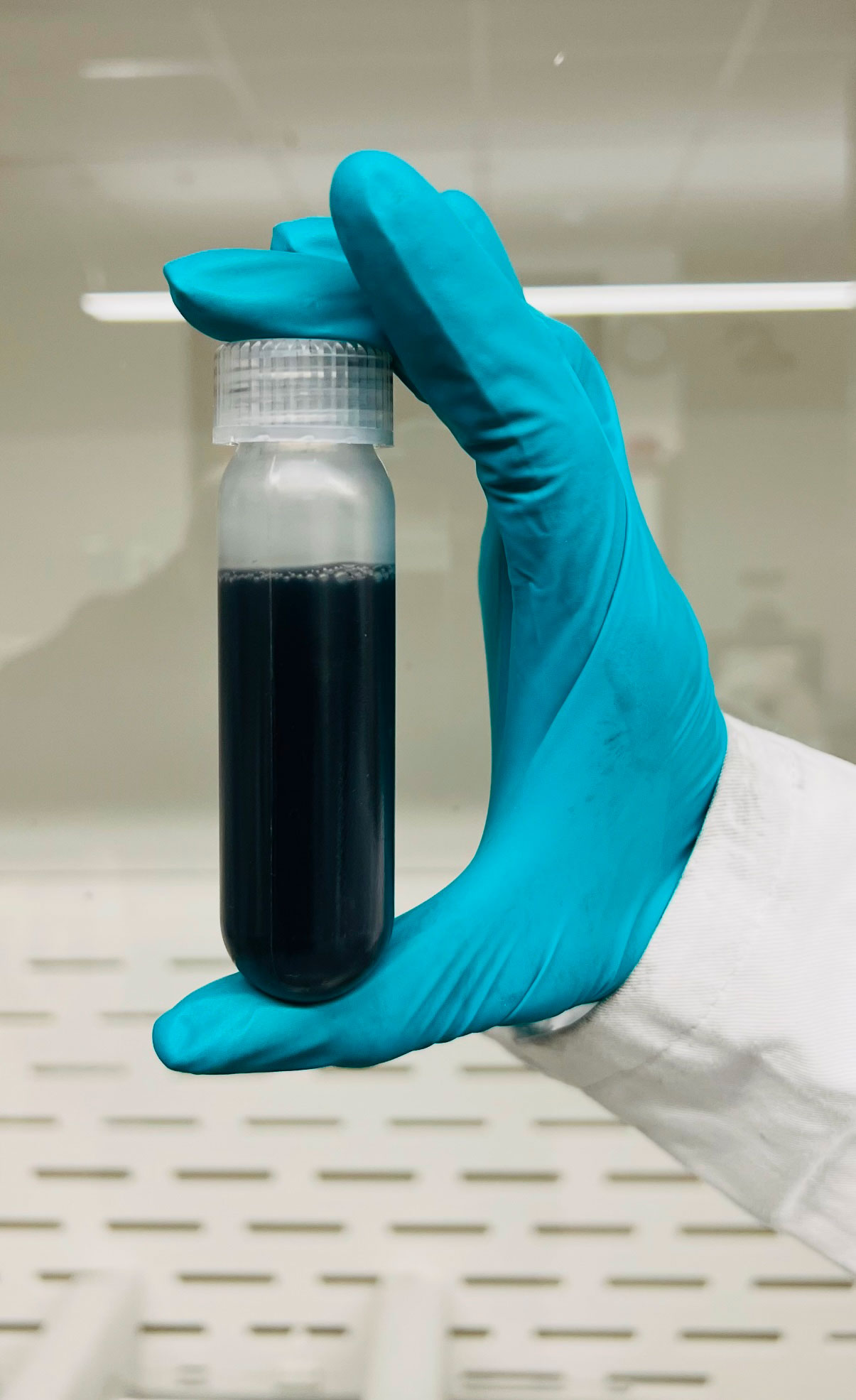
Above: A graphene nano-ink sample manufactured in the laboratory by co-inventors Thiba Nagaraja and Rajavel Krishnamoorthy. The manufacturing process is part of the team's work and a separate patent under review.
Now, his continued work has earned him his fourth patent, further advancing graphene's potential.
Das, an associate professor of industrial and manufacturing systems engineering and an affiliated faculty member in electrical and computer engineering in Kansas State University's Carl R. Ice College of Engineering, leads a research team focused on nanoscale materials, which are ultrathin materials invisible to the human eye, for their various applications in advancing sensing technologies.
"My team is interested in discovering things, such as detecting molecules that are not possible to detect with conventional technology," Das said. "In fact, we try to develop technologies that are not currently available in the market."
His latest project, "Printed Graphene Electrochemical Phosphate Sensors," has done just that. The innovation developed a novel technology using printed graphene to create a stable electrochemical sensor that can detect phosphate molecules in water.
"The sensor is the first printed graphene sensor for phosphate molecular sensing," Das said.
The project was granted a patent by the United States Patent and Trademark Office in March 2026.
Das began this work in 2020 with the interdisciplinary NSF-funded project "Signals in the Soil, SitS." He and former team members Thiba Nagaraja and Rajavel Krishnamoorthy pursued research that led to the graphene sensor, making Nagaraja and Krishnamoorthy co-inventors of the newly patented product.
A 'wonder material' for streamlining testing processes
Graphene is a single-atom-thick sheet of carbon atoms arranged in a hexagonal honeycomb lattice pattern in two dimensions. Discovered in 2004 and awarded a Nobel Prize in Physics in 2010, graphene is the world's thinnest material.
Although there are now a number of 2D atomically thin materials, graphene is still considered a "wonder material" because of its unique physics and associated properties. It is environmentally very stable and doesn’t degrade over time, making it suitable for sensing applications, Das said.
"The sensor not only has to work very well, but it has to work for a prolonged time, and the material has to remain stable," Das said. "That’s why we use graphene."
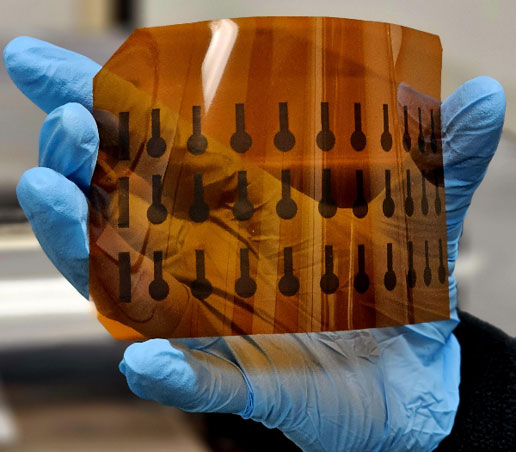
Above: A printed array of graphene phosphate sensors additively manufactured by the team.
The research team has tested samples over several months and received consistent results, Das said.
While there are other types of sensor technologies, Das says electrochemical sensors are unique in their ability to interface with the physical environment, such as water, and generate an electrical signal.
The technology works by applying a small electrical voltage to the sensor surface, enabling the detection and quantification of phosphate molecules. Once there is an electrical signal, it becomes easier to integrate with the existing electronic platforms, including transmitting the data to a data storage unit.
"Electrochemical sensors are very effective sensors for detecting molecules in liquid environments," Das said.
Promising applications now and for the future
The sensors have proven to be important for research in agriculture and the environment, Das said, particularly for measuring phosphate levels in soil and water systems.
"Phosphates are one of the three important macronutrients for healthy plant growth, along with nitrate and potassium, but excessive fertilizer applications in soil can cause runoff and negatively affect nearby surface water quality and ecosystems," Das said. "There has to be a balance, and that can be difficult to determine. This sensor device has the potential to detect phosphate levels in the water."
The sensors could also potentially be used in other areas where phosphate is important, such as physiological sensing in the body, Das said.
"We know that phosphate is an important component of physiological processes," he said. "That is an area we have not explored, but we are open to collaborating with interested biomedical research groups in the future."
The project highlights the collaborative innovation at the Kansas State University Research Foundation, or KSURF, which works with faculty, researchers, students and industry partners to protect, license and launch innovations developed at K‑State.
Das, who worked with KSURF to file the patent, said he appreciates the resources that are available to him and his team, including KSURF team members.
"Working closely with KSURF through meetings, discussions and brainstorming, I am grateful to have this kind of support at K-State," he said.
Related Stories
A farm for the future
At Flickner Innovation Farm, K-State researchers collaborate to develop practical solutions for Kansas agriculture’s biggest challenges.
Next-generation innovation
K-State is one of the nation's top patent-producing universities and has climbed to No. 83 in the Top 100 U.S. universities granted utility patents in 2025,...

K-State leads international collaboration for next-gen global agriculture solutions
K-State researchers are developing an AI-driven system to help soybean farmers worldwide as part of an international project funded by the National Science...