Fighting cancer by building nature's most complex molecule from scratch
Vidya Nadar took first place at the Midwest Association of Graduate Schools's 3MT regional competition

By Julia Hall
Graduate School
Wednesday, April 22, 2026
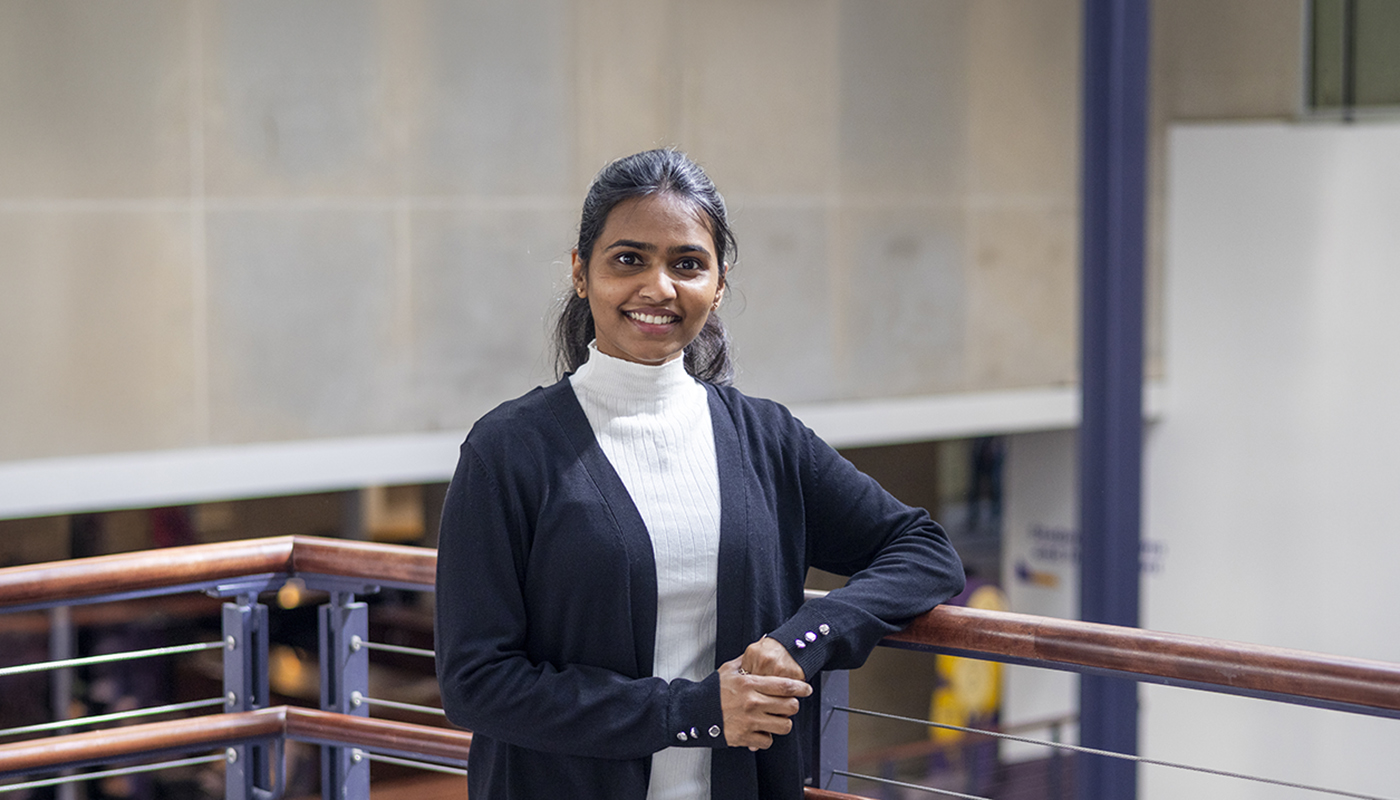
When Vidya Nadar, a doctoral candidate in K‑State's Department of Chemistry, entered the Three Minute Thesis Competition, or 3MT, she wasn’t just developing presentation skills. She was learning how to answer the question that drives all meaningful research: Why does this work matter?
“Cancer patients are susceptible to infection because of their compromised immune systems, and infections are often caused by bacteria that are resistant to antibiotics,” Nadar said. “This highlights a critical need for therapies that can combat both issues simultaneously.”
Under the mentorship of Ryan Rafferty, associate professor of chemistry and interim director of the K-State Johnson Cancer Research Center, Nadar is designing nature-inspired molecules that could serve dual purposes in cancer and drug-resistant bacterial infection treatments.
Nadar studies brocazine, a rare molecule found in mangrove plants that scientists believe is effective in fighting seven deadly cancers.
The challenge is that brocazine naturally occurs in small amounts, so chemists like Nadar are exploring ways to produce it in the lab.
Nadar uses total synthesis to recreate the molecular structure of brocazine from scratch. Synthesizing these compounds in the lab can optimize their structure, improve their drug-like properties, and create new small-molecule libraries for biological testing.
Currently, Nadar and Rafferty are just a few steps away from completing total syntheses, bringing these potential dual-action drug candidates closer to evaluation and development.
Translating complex research to the public
Nadar’s research is incredibly complex. She has been successful not only in her research, but also in communicating her work in a way that is understandable and engaging to non-experts.
This spring, Nadar showcased her research in just three minutes with only a single static slide in the K-State Graduate School’s Three Minute Thesis, or 3MT, competition on February 25th. Her presentation, "From Rare Molecules to Real Medicines,” earned her first-place, the people’s choice award, and a spot in the Midwestern Association of Graduate Schools, or MAGS, 3MT competition, held on March 27 in Kansas City.
Nadar’s success continued with another first-place win in the regional competition, which advances her to represent the Midwest at the national 3MT showcase organized by the Council of Graduate Schools in Los Angeles this December.
“This experience has strengthened my confidence as both a researcher and communicator. Being selected to represent the Midwest at the national showcase is truly an honor,” Nadar said.
For Nadar, the journey from the K-State competition to the regional stage reflects growth not only as a scientist but as a communicator. She described the experience as "coming full circle" — beginning with learning how to share her research effectively on campus and watching that progress be recognized at a larger stage.
Among the most surprising takeaways from the competition, Nadar said, was the power of simplicity.
"Condensing years of research into three minutes challenged me to focus on ‘why my research matters’ rather than the technical details," Nadar said. "I gained confidence in my ability to communicate complex science in an engaging, meaningful and accessible way. And that skill is just as important as the research itself."
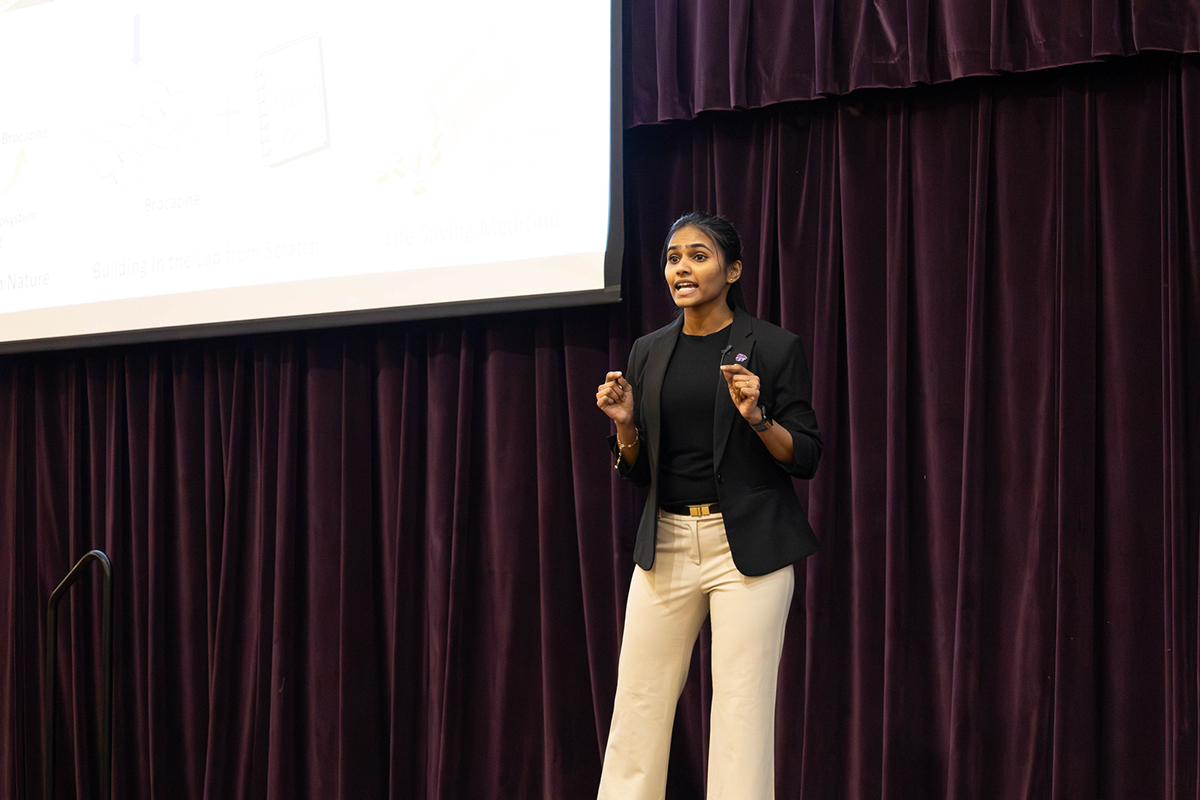
Nadar credited K-State’s graduate research community, and the Graduate School in particular, with preparing her to compete and succeed at the regional level.
“This recognition highlights K-State's strong culture of mentorship, collaboration and support within its graduate research community,” Nadar said.
"K-State’s commitment to professional development and science communication genuinely empowers graduate students to succeed and reach broader platforms," she said. "The Graduate School has definitely played a major role in preparing me to compete and succeed at the regional level."
Three-Minute Thesis showcases the best of K-State graduate research
As Nadar prepares to represent the Midwest at the national 3MT showcase, her win serves as a testament to the strength of K-State’s graduate programs and the university’s dedication to training researchers who can communicate their work with clarity, purpose, and passion.
The K-State Graduate School supports more than 4,000 graduate students across a wide range of disciplines. The Three Minute Thesis competition is one of many initiatives the Graduate School offers to develop communication skills and celebrate the impact of graduate research.
The Three Minute Thesis competition was founded by the University of Queensland in Australia. The competition challenges graduate students to present the significance of their research to a non-specialist audience in just three minutes, using a single static slide.
The competition is designed to develop academic, personal, and professional skills — and to communicate the broader impact of graduate research to the wider world.