K-State research meets the Kansas rotunda
K-State students share research with lawmakers at Kansas Undergraduate Research Day at the Capitol
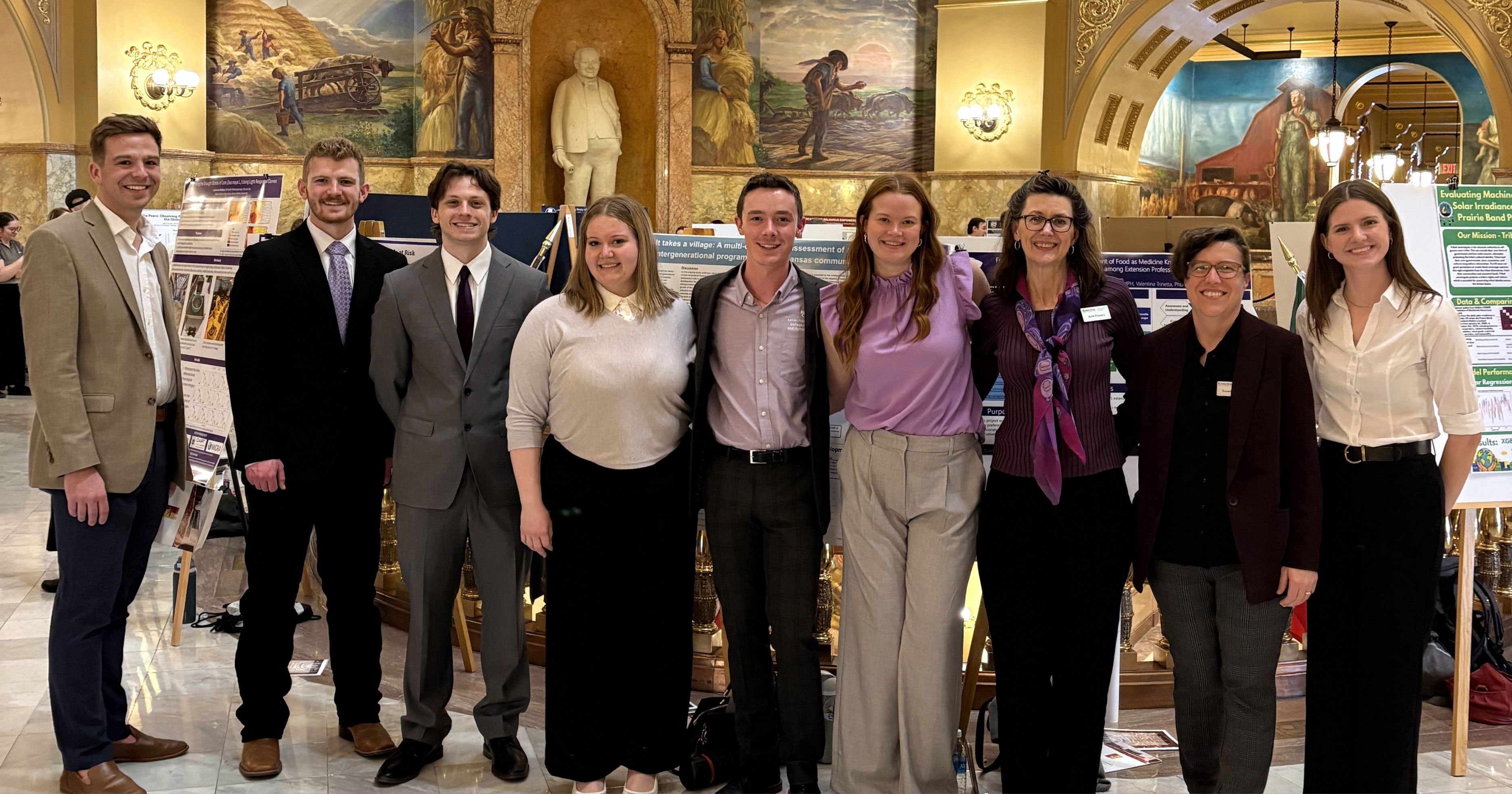
From left: Trase McQueen, Lawrence Settles, Mark Lexow, Madison Cynova, Michael Glenn, Tess Coontz, Beth Powers, Susan Rensing and Madeline Harp

By Susan Rensing
Staley School of Leadership
Wednesday, April 1, 2026
Eight Kansas State University undergraduates presented original research at the state Capitol on Feb. 26 during Kansas Undergraduate Research Day — joining peers from seven other four-year institutions across the state and highlighting how higher education helps prepare thoughtful, skilled graduates ready to support Kansas communities and its economy.
"Undergraduate research is one of the most powerful ways students engage with our university," said Hans Coetzee, vice president for research. "When our students bring their work to the Capitol, they're not just sharing data and results, but demonstrating how K-State research helps solve real challenges facing Kansas communities and industries."
During the event, students presented their work in a poster session, explaining their findings and personal research journeys with state legislators, university administrators and members of the public.
"This year we had a very competitive pool of K-State applicants," said Susan Rensing, associate director of Scholar Development and Undergraduate Research, or SDUR. "The undergraduate researchers that were selected represent the true value and breadth of our land-grant mission."
Selected researchers and research groups
Mark Lexow, senior in geography, Topeka, presented "Threats to the Topeka Shiner." Lexow examined the population decline of the Topeka Shiner, a small minnow species, and the factors driving its decline.
Tess Coontz, junior in sports nutrition and dietetics, Fort Collins, Colorado, presented "From Education to Health: Implementation of Food as Medicine Initiatives in Kansas Communities, Extension Agents and SNAP Educators' Perspectives." Coontz assessed Extension professionals' and SNAP educators' current knowledge, training preferences and resource gaps related to family and consumer sciences education, identifying what is needed to effectively implement Food as Medicine initiatives in Kansas communities.
Lawrence Settles, senior in agricultural technology management, Kansas City, Missouri, presented "Detecting Early Drought Stress in Corn Using Hyperspectral Sensors Under Limited Irrigation." Settles examined whether hyperspectral signatures in corn can be used to detect drought stress.
Madeline Harp, junior in computer science, Lee's Summit, Missouri, presented "Evaluating Machine Learning Models for Solar Irradiance Forecasting in the Prairie Band Potawatomi Nation." Harp evaluated how machine learning can help inform renewable energy practices on Prairie Band Potawatomi Nation land.
Carter Oliver, sophomore in biology, Overland Park; Madison Cynova, senior in interior architecture and industrial design, Junction City; Michael Glenn, junior in public health sciences, Arcadia, Oklahoma; and Grace Toman, senior in psychological sciences, San Antonio, Texas, presented "It takes a village: A multi-disciplinary assessment of an intergenerational program in a rural Kansas community." The group evaluated the Logan Intergenerational Family Education, or LIFE, center in Logan to better understand the effects of intergenerational spaces on social engagement, learning and well-being, particularly in rural communities.
Learning in action
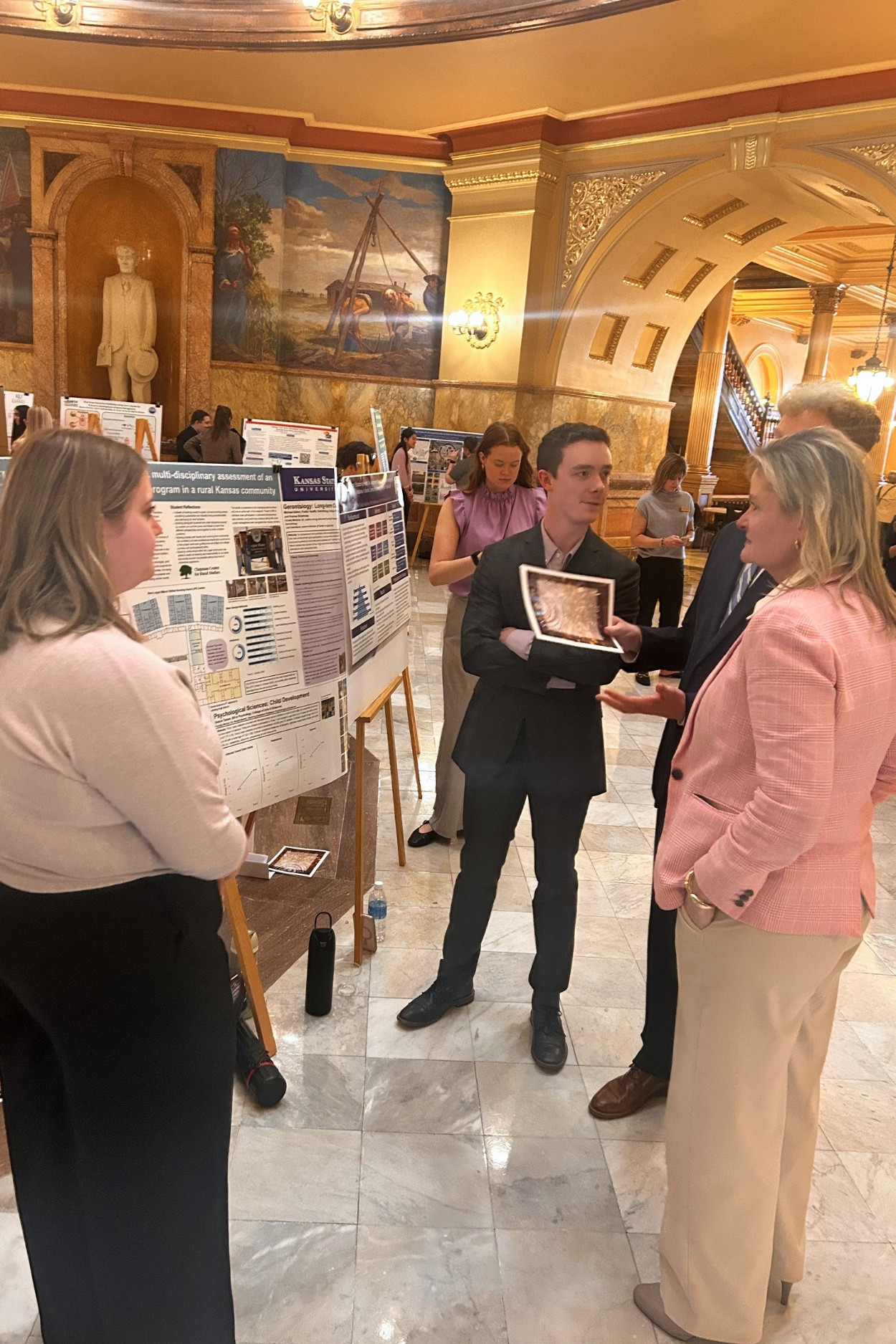
Presenting at the Capitol challenged students to step beyond the classroom, strengthening their confidence in communicating by translating their research into a real-world setting.
"Research as an undergraduate isn't just a resume builder, it's a chance to make a real difference in people's lives," Glenn said.
Trase McQueen, lab manager of the Department of Psychological Sciences' Memory and Aging Lab — which oversees the LIFE center research project — traveled to Topeka alongside the student researchers, noting the positive effect it had on their learning and passion for the project.
"It was great to watch our students translate their research to Kansas legislators," said McQueen. "It pushed them beyond science to consider how their work directly serves Kansans, helping them see how they fit into the land-grant mission."
Applications for the Kansas Undergraduate Research Day open each December. To learn about additional opportunities to present research, apply for funding and explore nationally competitive scholarships, students can visit the SDUR website, follow SDUR on Instagram and Facebook, and subscribe to SDUR's monthly newsletter.
Scholar Development and Undergraduate Research is housed within the Staley School of Leadership. The Staley School also includes undergraduate and graduate leadership studies academic programs, leadership and service co-curricular programs, Applied Learning Experiences, and the University Honors Program. The Staley School develops bold, curious and connected learners to address our world's most complex challenges.