Engineering exploration
K‑State alum Erik Stalcup's work is helping the U.S. send astronauts to the moon today. Next up, Mars.
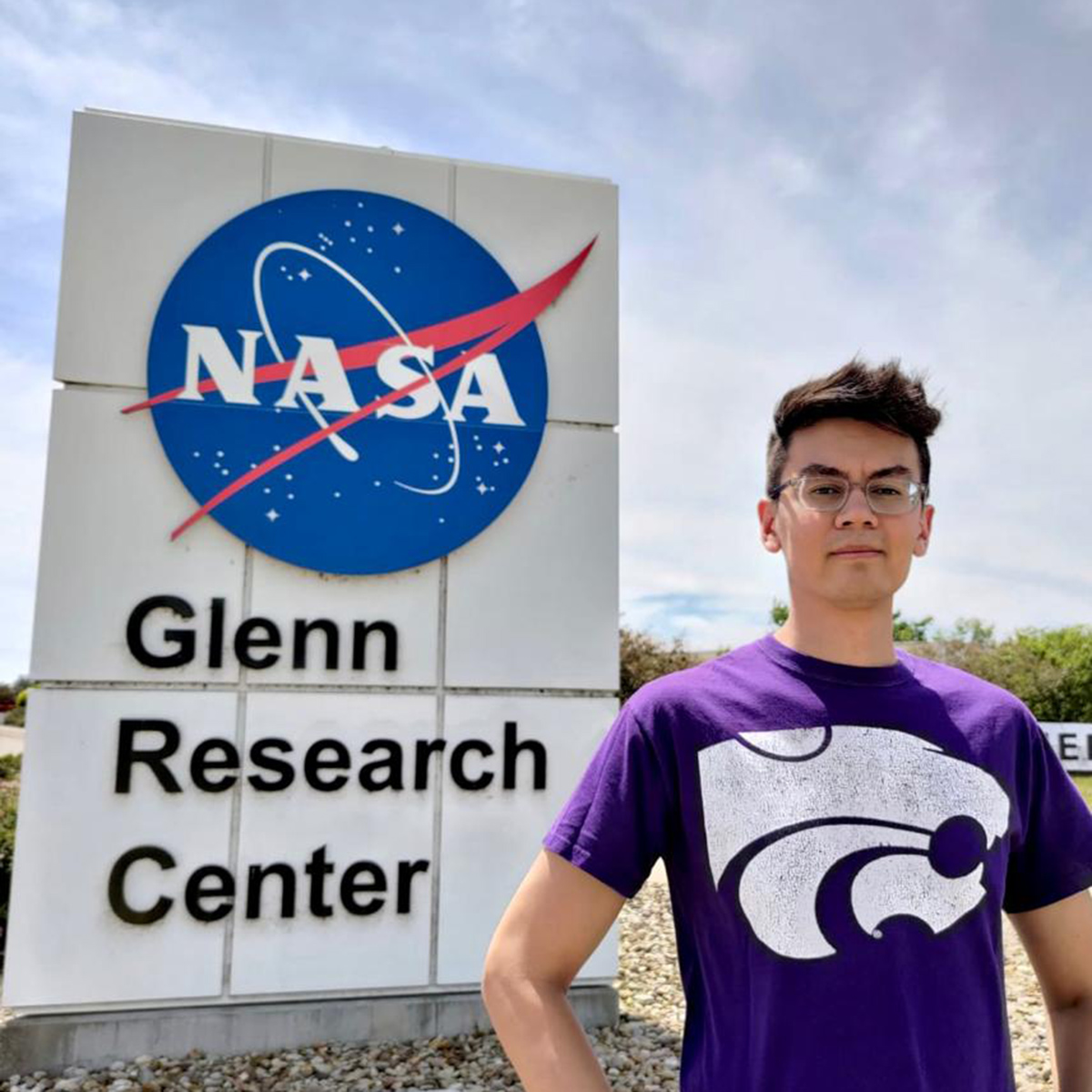
As an aerospace engineer at NASA's Glenn Research Center, Erik Stalcup is supporting the Artemis missions that are taking humans back to the moon for the first time in over half a century.

By Tim Schrag
K-State Alumni Association
Thursday, April 2, 2026
Editor’s note: This story originally appeared in the fall 2022 issue of K-Stater magazine. The K-Stater is delivered quarterly to K-State Alumni Association members. Learn more at the K-Stater's website.
Courses on heat transfer are famously known as some of the most difficult course materials taught at Kansas State University. Perhaps it’s a strange irony that Erik Stalcup ’10 never took them while attending K-State. Stalcup, who works for the thermal systems and transport processes branch at NASA’s Glenn Research Center in Cleveland, Ohio, deals with heat transfers every day.
Stalcup said his role mostly focuses on thermal engineering or as he puts it, “just making sure stuff doesn't get too hot or too cold.”
Through his work he’s helped test the Orion Capsule for the Artemis Program, which is sending humans back to the moon this decade.
In doing so, he helped expose the capsule to extreme temperatures in the world's largest thermal vacuum chamber. He also provided thermal analysis on the project. Ultimately, this research will help NASA build better spacecraft as it prepares to send people back to the moon through the Artemis Program, and then, eventually to Mars.
“Some projects are more research than others,” Stalcup said. “And I do a lot of computer simulations, so a lot of it is spent staring at a computer screen. But it is fun when we get to work with hardware.”
When Artemis I launched in 2022, Stalcup was in Houston, Texas, at the Johnson Space Center, assisting Mission Control in the Mission Evaluation Room, which assists Mission Control with engineering support when called up.
“We're watching the telemetry that's coming back from the vehicle as it's going out to the moon, and we're monitoring stuff,” Stalcup said. “And the main role there is if there's any anomalies that happen, we basically do a deep dive into that, to figure out why it happened, what impact it has, and how you can solve it midflight.”
But that’s just one of many projects he’s working on. One of the many experiments being conducted on board the International Space Station is the Flow Boiling and Condensation Experiment. The project aims to learn more about how liquids boil and how gases condense while they're flowing in microgravity. Stalcup has been working on the project for approximately four years as an aerospace engineer at NASA’s Glenn Research Center.
Prior to the experiment’s launch Stalcup conducted analysis and testing, running computer simulations, exposing prototypes to the extreme temperatures it will experience aboard the space station.
“My job was to help build it, test it and design it, to make sure it's going to do what it was designed to once it gets up there,” Stalcup said. “And once it's up there, it's the science team's job to look at the data and build computer models.”
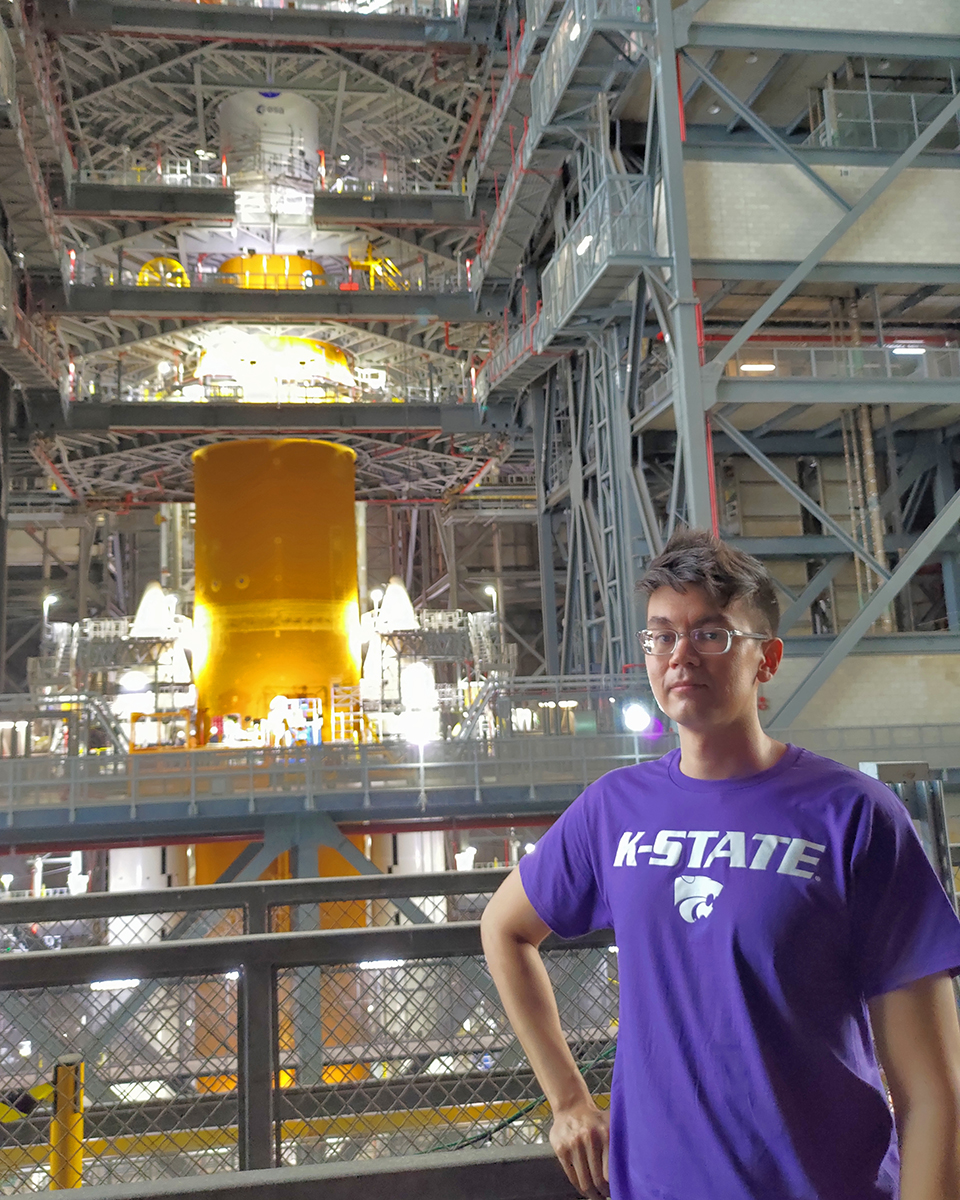 Stalcup said he’s been interested in space from a young age growing up in Wellington, Kansas. His mother gave him a copy of "The Elegant Universe" by Brian Greene; this sparked an interest in physics, quantum mechanics, relativity, astrophysics and astronomy, among other topics.
As an undergraduate at K-State, Stalcup chose to major in physics. While taking cosmology classes, Stalcup said he started to see a potential career path that might lead one day to NASA.
Additionally, he worked as an undergraduate researcher in professor Bruce Law’s lab doing research on ionic liquids and was selected as an honorable mention for the Goldwater Scholarship.
“Erik was one of K-State's talented undergraduates,” Law said. “He worked in my lab as an undergraduate from spring 2007 until he graduated in 2010. His work was funded by a collaborative NSF grant with my German collaborators at the Max Planck Institute for Dynamics and Self-organization in Goettingen, Germany. As part of this collaboration, Erik traveled and worked in the Max Planck Institute in Goettingen for a number of summers which resulted in an academic publication in 2009: ‘Dissipation mechanisms in ionic liquids.’”
Stalcup said K-State prepared him to work in a professional scientific setting.
“I did a lot of the actual experiments over there and then came back here and ended up writing one paper out of that,” he said. “So that was a really good experience for sure, especially writing the paper analyzing the data. That's a lot of what I do right now.”
With stops at Case Western Reserve University to earn a master's degree and work as a contract employee, Stalcup finally achieved his dream of working at NASA officially in 2018.
Stalcup is working on eight different projects for NASA at the moment.
“I just hope that they don't all ask me to do something at the same time,” he said.
When those projects conclude there will be others.
###
Related Stories
Wildcats at Wolf Creek
K-State is preparing tomorrow's nuclear industry leaders to enter the workforce. Between the top-notch education and research opportunities at K-State and the...
Where engineering meets entrepreneurship
Kevin Roy, a senior in computer science at K-State, has discovered his entrepreneurial potential during his time as a Wildcat. Read more about how Roy created...
From Kampala to Kansas Fields
From Kampala to the Kansas prairie, Rayhaan Kabenge— a graduate assistant with the Testing Ag Performance Solutions team at Kansas State University — is...