Selling hope
How Jonathan Maka's sales mindset fuels his mission for education
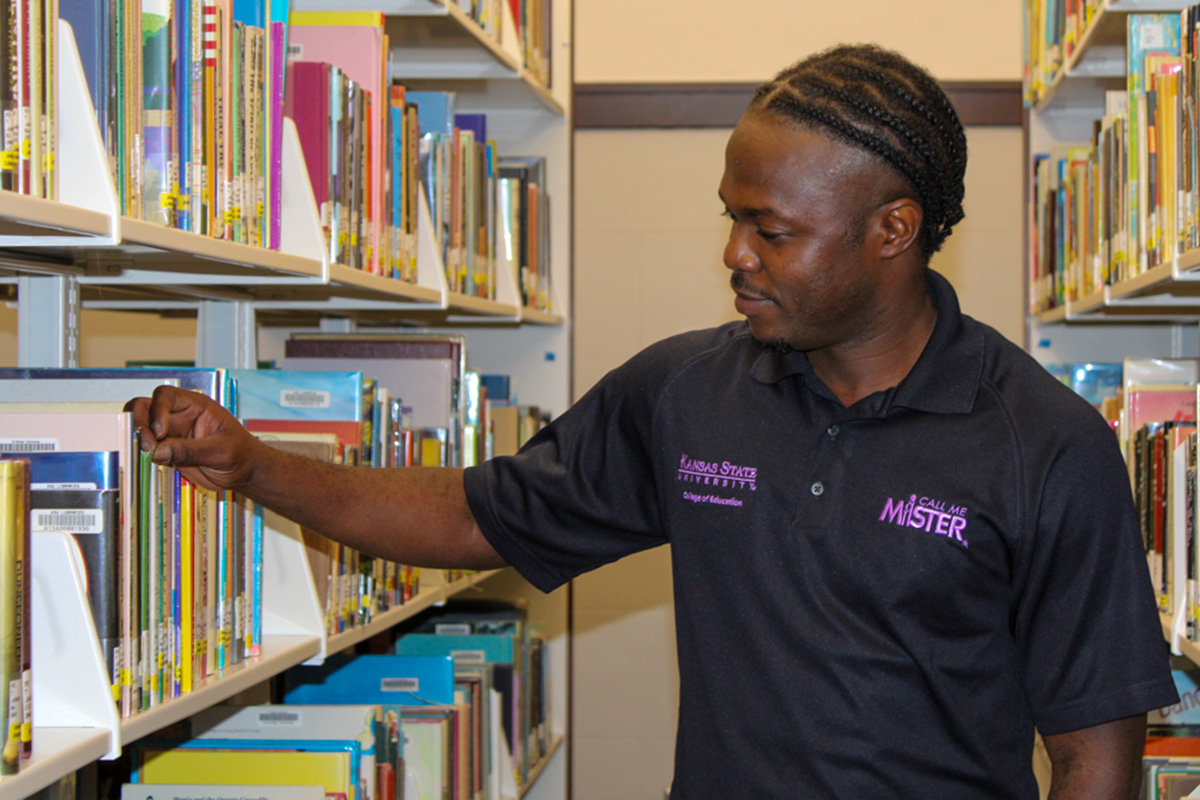
Image courtesy of Mindy Wells.

By Mindy Wells
Kansas State Agriculturist
Monday, March 30, 2026
Being effective in sales starts with believing in what you’re selling,” Jonathan Maka says. “For me, that belief isn’t about products or profit margins; it’s about selling hope.”
Maka, a third-year Kansas State University student, is pursuing a degree in marketing and a minor in agricultural sales. He aims to make a difference through connection and purpose.
“My dream is to build nonprofit schools for orphans and children from low-income families,” Maka says. “As an orphan myself, I know what it means to not have the same opportunities as others. Education changes that.”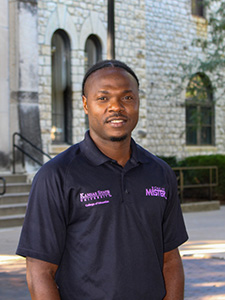
For Maka, paring his degree interests that will teach him how to connect, communicate and inspire others to join in a mission that reaches far beyond Kansas.
Finding purpose
Growing up in the Democratic Republic of Congo, Maka says he didn’t have the kind of structured educational system many American students experience. He shares that his country’s schools were often underfunded and overcrowded, leaving children to face difficult odds from a young age.
“As a child, I saw many kids drop out because their families couldn’t afford school fees or supplies,” he says. “They were smart and talented, but without access to education, their dreams disappeared.”
For Maka, those early memories created a lifelong purpose. Though he couldn’t see it then, he says his path was being shaped by faith, resilience and a determination to give others what he almost lost: the chance to learn.
When he first heard about the Mandela Washington Fellowship, he knew he had to apply. He explains that this is a program that brings emerging African leaders to universities across the U.S. In 2022 Maka was one of 700 selected across the African continent. He was placed at K-State, where he spent six weeks studying civic engagement.
“It was my first time in the United States, and honestly, it was overwhelming,” he says. “But K-State felt different. It was welcoming. I felt like I belonged.”
Connecting across continents
During that first summer, Maka’s journey took an unexpected turn. Through volunteer events and campus gatherings, he met a Manhattan couple named (Karen and Rod Friends), who had both taught at the American School of Kinshasa, the same school where Maka once took his students for athletic competitions.
“When I met them, they greeted me in my native language, Lingala,” he says. “They said ‘Mbuti,’ which means hello. That moment, hearing my language in a foreign country, felt like home.”
The friendship grew quickly. They invited him to dinner, cheered for him at his program graduation, and told him that if he ever came back to Kansas, their home would always be open to him.
At the time, Maka didn’t believe he would return.
“I thought my story in the U.S. was finished,” he says. “But God was already writing my next chapter.”
Planting a seed at home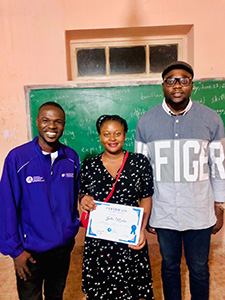
After returning to his homeland, Maka was determined to put his leadership training into practice. His first project, promoting English, offering free English lessons to anyone in his community.
“In the Congo, English is not our first language, we speak French,” Maka says. “But English opens doors to jobs, travel and education. I wanted people in my community to have those opportunities.”
For three months, Maka rented a small building, gathered materials and taught English to dozens of students, all for free.
“It was challenging,” he says. “But when I saw someone learn to introduce themselves or hold a conversation in English, I knew it mattered.”
The success of that program inspired something bigger. Maka began sketching out plans for a nonprofit school dedicated to children who had no access to education, including orphans, kids from low-income families and “shégués,” a term for street children.
“Through this school, I want to offer free, quality education to children who may not have the same opportunities I had,” Maka says. “But, more than that, I want to raise a new generation of young Congolese thinkers.”
While working on his projects in the Congo, Maka continued teaching and coaching sports at the American School of Kinshasa. But, he knew he wasn’t finished learning.
“I told God, ‘If it’s your will for me to continue my education, show me the way.’”
He says that prayer was answered in March 2023. Maka was officially accepted into K-State to get a college education.
“When I got the acceptance letter, I just cried,” he says.
Creating educational opportunities
At first, people were surprised to hear that an education major is studying agricultural sales. But for Maka, it made perfect sense.
“In sales, you learn to build trust, to understand what people need and how to communicate it,” he says. “Those are the same skills I need to grow my nonprofit. I’m learning how to connect with people, share my mission and gain support to make it sustainable.”
Agriculture also holds a practical connection for Maka’s dream. He hopes to integrate agricultural training into his future schools, teaching students not only academics, but also self-reliance through food production and community farming.
“In the Congo, agriculture is life,” he says. “If students learn to farm, they can feed themselves, their families, and their communities. Education and agriculture go hand-in-hand.”
As he continues his studies, Maka keeps his long-term goal in sight: to return to the Congo and build the first of many nonprofit schools.
He knows it won’t be easy. There will be financial challenges, government barriers and logistical hurdles. But he isn’t discouraged.
“I want to use what I’ve learned at K-State, not just in the classroom, but from the people, the culture and the faith to make a difference back home,” Maka says.
Every class he takes and conversation he has feels, he says, is another step toward that dream.
He says, “My hope is that one day a child in my country will say, ‘Because of Jonathan’s school, I learned to read, I learned to dream.’ That’s what keeps me going.”
Mindy Wells is a junior in agricultural and natural resources communications. This editorial originally appeared in the spring 2026 edition of The Agriculturist — the student-produced magazine of the College of Agriculture.
Related Stories
Sunshine to sunflower
For many Wildcats, Kansas State University is known for its feeling of family, but for real-life sisters Reagan and Reese Richards that means more than just...
Getting into the field
For college students, internships can be a step between classroom learning and career preparation. They offer hands-on experience, mentorship and a chance to...
In his natural habitat
Drew Jaime has always felt at home in nature, but it was not until he arrived at K-State that he found the community that matched his passion: the Park Management...