People with Purpose: Kaliramesh Siliveru
From kernel to classroom, Kaliramesh Siliveru is growing the future of grain science innovation at K-State.
By Abbigail Marshall
K-State News and Communications Services
Friday, Jan. 23, 2026
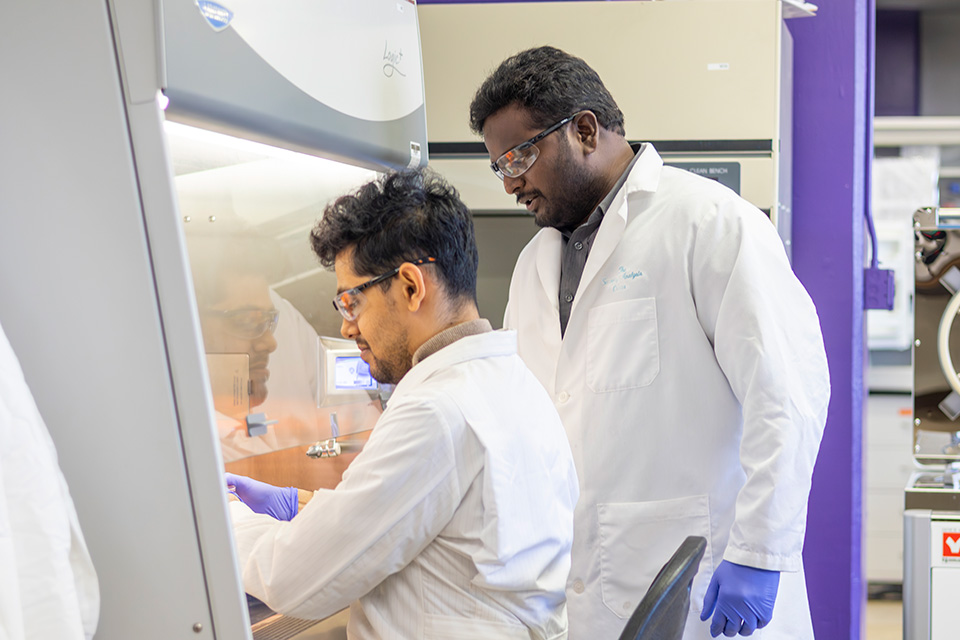
As a University Outstanding Scholar and associate professor of grain science and industry in the College of Agriculture, Kaliramesh "Kali" Siliveru connects his agricultural roots and grain science knowledge with making a real-world impact every day.
An award-winning researcher, Siliveru has served as a trusted mentor to nearly 50 undergraduate students, graduate researchers and postdoctoral scholars in his 12 years at K-State — finding purpose in both advancing his field and growing its future leaders.
Q: How did you decide to pursue education?
Siliveru: Both of my grandparents were farmers, and although they had limited formal education, they deeply believed in the power of learning to transform lives and communities. That belief was reinforced by my father, who is a schoolteacher. Growing up, I saw firsthand how he inspired and shaped his students' lives, leaving a lasting impact on me.
I always knew I wanted to pursue higher education, but for a long time, I wasn't sure which field to choose. A turning point came when my grandfather passed away from a heart attack while working in our rice field. That moment stayed with me, and I felt a strong pull to make a difference in cardiology or in something connected to the world of agriculture I grew up in. Eventually, that path led me to grain science, where I found a way to honor both my roots and my passion for making a positive impact.
Q: What is your teaching style and what's at the heart of it?
Siliveru: My teaching style revolves around three key principles. First, I focus on understanding my students' backgrounds and tailoring my approach to their prior learning experiences. I believe that effective teaching starts with meeting students where they are.
Second, I emphasize a collaborative learning environment where students are encouraged to engage, ask questions and work together to address real-world problems. I want them to see how the concepts they learn apply to current challenges and how they can contribute to solving them in today’s fast-moving world.
Finally, I instill a sense of lifelong learning. We’re living in a time where knowledge and technologies are evolving rapidly, so it’s crucial that students leave not just with content knowledge, but with the mindset and skills to keep learning and adapting throughout their careers.
Q: What's your favorite part of working with students?
Siliveru: My favorite part about working with students is seeing their growth over time. Some of the students I taught in my first cohort back in 2018 are now leaders in the industry, and knowing I played a small role in their journey gives me a deep sense of pride and fulfillment. I also value how much I learn from my students. Many of them have taught me important lessons both in the classroom and on a personal level. The mutual exchange of knowledge and perspective is one of the most enriching parts of being a teacher.
Q: What are your long-term research goals? Where are you in that process?
Siliveru: My long-term research goals focus on developing sustainable technologies and solutions to prevent food safety risks associated with grains, grain-based products and other foods. This includes minimizing contamination risks while maintaining the nutritional and sensory quality of the final product. I believe we’re making strong and steady progress toward this goal through the work our team has done in grain processing and food safety.
Another major goal is to establish a dedicated center for non-thermal food processing technologies. Traditional thermal processing, while effective, can often degrade the sensory and nutritional attributes of food. Non-thermal technologies offer a promising alternative that can enhance food safety without compromising quality. We are currently laying the groundwork for this center through our ongoing research, collaborations and pilot-scale technology evaluations.
Q: What has been your most impactful moment at K-State?
Siliveru: There are two days that stand out as the most impactful for me at K-State. The first was in 2013, when I received my admission letter for the Ph.D. program in the Department of Grain Science. I never imagined at that time how far this journey would take me. That letter marked the beginning of a transformative chapter in my life and shaped me both professionally and personally.
The second most impactful day came years later, when I had the honor of hooding my first Ph.D. student. Standing on the same ground where I once began as a student, now guiding and mentoring the next generation, was a deeply humbling and fulfilling experience. It brought my journey full circle and reminded me of the incredible opportunities K-State has provided me.
###