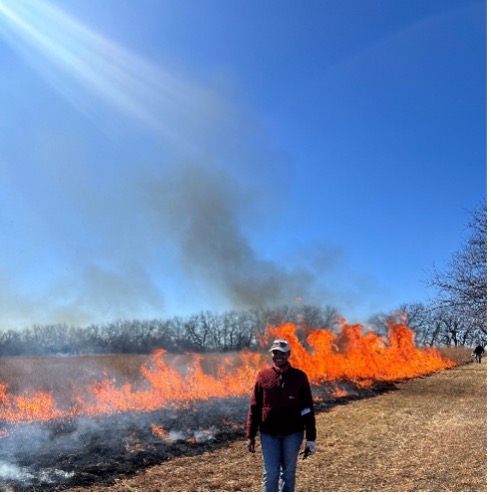
Caroline Ruto
Seaton Hall 1077
PhD Geography
My dissertation examines how Kansas landowners and county officials navigate uncertainty related to prescribed burning and how their decisions shape grassland management practices. Prescribed burning is an important land management tool for maintaining grassland ecosystems, improving forage quality and reducing wildfire severity. Yet its use depends on suitable weather conditions, county rules and support from surrounding communities. Variability in precipitation and weather can shorten the number of days when burning is safe, county burn restrictions can further limit when landowners can burn and social norms and pressures can influence whether landowners are willing to use prescribed fire. These uncertainties can create barriers to prescribed fire use and complicate decisions about when, whether and how to burn. My dissertation examines how these uncertainties shape prescribed fire decisions and practices in Kansas using a mixed methods approach that combines document collection and analysis, spatial analysis, semi-structured interviews, a landowner survey and participant observation. My broad research interests center on how people and institutions respond to environmental change and uncertainty in working landscapes, particularly in relation to rangelands, climate adaptation, environmental governance and human-environment interactions.
Caroline Ruto and Walter Fick "Making Decisions with Caution: Navigating Climate Uncertainty in Kansas Ranching," Transactions of the Kansas Academy of Science 128(3-4), 238-250, (9 December 2025). https://doi.org/10.1660/062.128.0308
Caroline Ruto is a PhD candidate in Geography in the School of Earth and Environment at Kansas State University. Her research examines human-environment interactions in rangeland and agricultural systems, with particular interests in climate adaptation, environmental governance and decision-making. Her doctoral research examines how environmental variability, county burn restrictions and social norms and pressures shape prescribed burning decisions and practices across Kansas grasslands.
Before beginning her PhD, Caroline earned an MSc in Global Food Security and Development from Nottingham Trent University, UK, and a BSc in Dryland Agriculture and Enterprise Development from Kenyatta University, Kenya. Her academic and professional experience includes work on pastoralism, drought, food security and rangeland systems in Africa and internationally, including projects, research and knowledge initiatives with UN organizations. She is motivated by a broad interest in how people and institutions respond to and navigate environmental change and uncertainty in working landscapes, and how research can inform land management decisions, policy and practice.