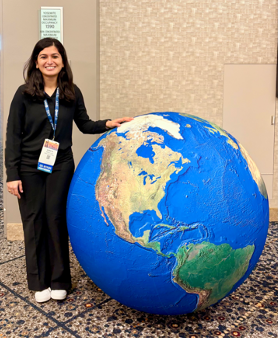
Shreya Ojha
M.A., 2020, University of Delhi
Shreya Ojha’s research broadly focuses on climate adaptation and environmental governance, and contributes to scholarship in human-environment geography, political ecology, and natural resource governance. Her doctoral research in Colorado examines how power, institutional arrangements, and uneven capacities shape the governance of wildfires and water across urban and rural landscapes. In particular, her work investigates how authority and responsibility, is negotiated and contested within polycentric governance systems and how changes in land management practices reshape the socio-environmental relationships of people with land.
2023 Nelson, K. S., Nguyen, T. D., François, J. R., & Ojha, S. (2023). Rural sustainability methods, drivers, and outcomes: A systematic review. Sustainable Development, 31(3), 12261249. DOI: https://doi.org/10.1002/sd.2471
GEOG 100: World Geography & Globalization
GEOG 122: Earth Systems Science Lab
GEOG 302: Cartography and Thematic Mapping Lab
GEOG 508: Geospatial Information System (I) Lab
Shreya Ojha is a PhD candidate in the School of Earth and Environment, specializing in human-environment geography, climate adaptation, and environmental governance. Her research examines how power, institutions, and place shape responses to environmental change, with a particular focus on wildfire and water governance across urban and rural communities. She is currently investigating wildfire adaptation in Colorado using qualitative research, GIS, and mixed methods to understand how governance structures and uneven capacities influence adaptation. She is also interested in collaborative and policy-relevant research that bridges social and environmental dimensions of climate resilience and contributes to sustainable futures.
Ojha’s doctoral research has been supported by the National Science Foundation, and she has presented her research through professional organizations, including the American Association of Geographers. She is actively involved in academic and community service through Gamma Theta Upsilon, Kansas State University’s Graduate Student Council Research Forums Committee, Student Veterans of America Kansas State University Chapter, and on-campus student community engagement.