Bloom's Taxonomy
Overview of Cognitive Skills & Action Verbs
Bloom’s Taxonomy is a well-established framework that categorizes levels of thinking and learning. Originally developed by Benjamin Bloom and later revised by Anderson and Krathwohl, this model organizes cognitive skills into six tiers, from simple recall of facts to the creation of new ideas. The taxonomy serves as a practical tool for designing clear, measurable learning outcomes and for aligning assessments with the complexity of student learning.
|
Level
|
Definition
|
Example
|
|
Remember
|
Recall facts and basic concepts
|
Recall the dates of major historical events.
|
|
Understand
|
Explain ideas or concepts
|
Summarize a scientific article.
|
|
Apply
|
Use information in new situations
|
Use Newton's laws to solve real-world problems.
|
|
Analyze
|
Break down information into parts
|
Identify causes and effects in a historical case.
|
|
Evaluate
|
Justify a decision or stand
|
Critique the methodology of a research study.
|
|
Create
|
Produce new or original work
|
Design a solution for community health issue.
|
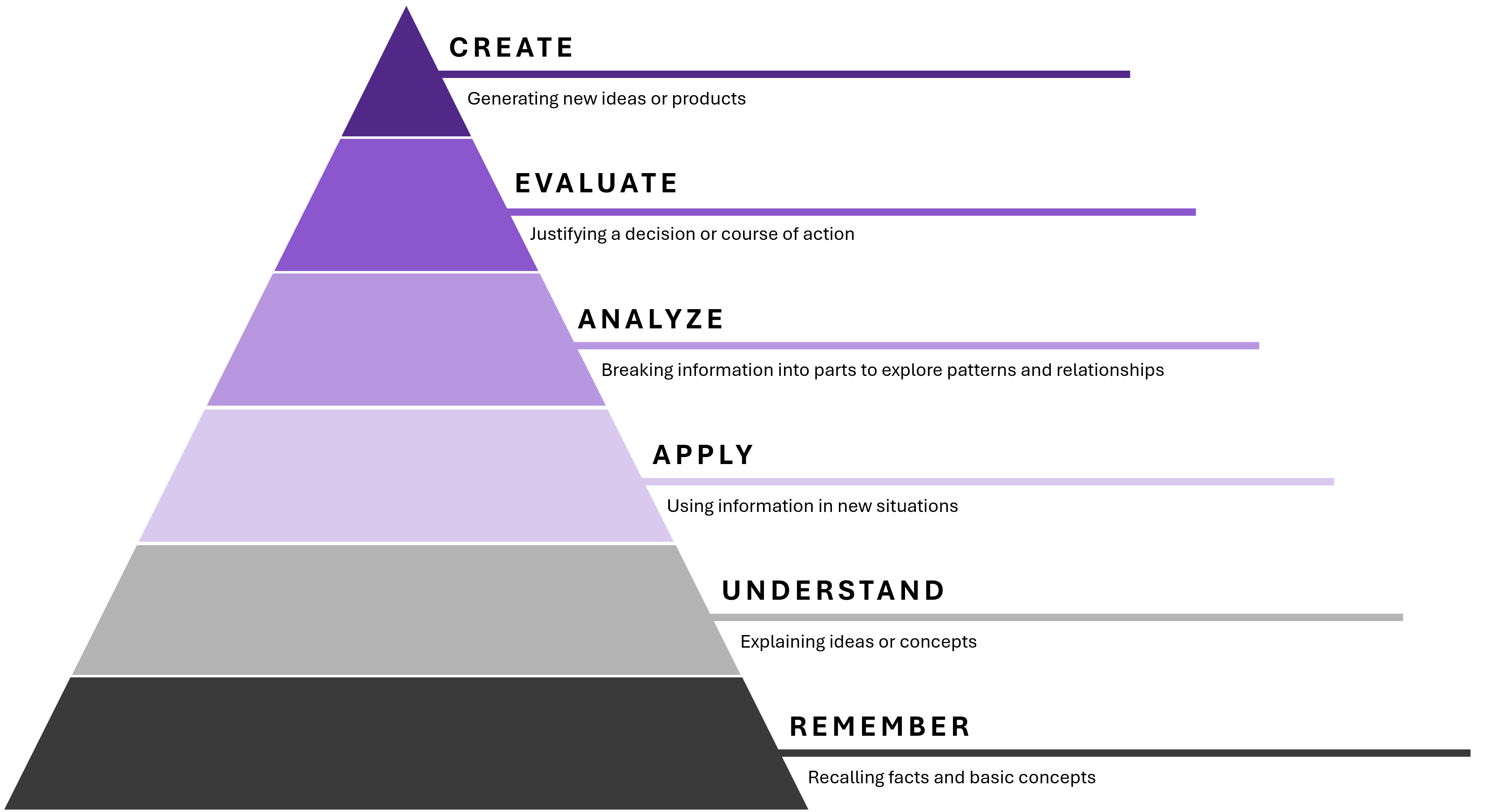
Bloom's Taxonomy pyramid is a tiered model of cognitive skills that progresses from basic recall to complex creation. It organizes learning into six levels: Remember, Understand, Apply, Analyze, Evaluate, and Create.
Action Verbs
Student Learning Outcomes (SLOs) describe what students should be able to do upon completing a course or program. Strong learning outcomes use clear, action-oriented verbs that indicate the level of learning expected.
The table below provides action verbs aligned with different levels of learning, based on Bloom’s Taxonomy. These verbs can help in crafting effective SLO statements.
|
Level of Learning
|
Action Verbs
|
|
Remember (Recall basic facts & concepts)
|
Define, Describe, Identify, Label, List, Name, Recognize, Recall, State
|
|
Understand (Explain ideas & concepts)
|
Classify, Discuss, Explain, Summarize, Interpret, Paraphrase, Summarize, Translate
|
|
Apply (Use knowledge in new situations)
|
Calculate, Construct, Demonstrate, Execute, Solve, Implement, Modify, Sketch, Solve, Use
|
|
Analyze (Break down & examine information)
|
Categorize, Compare, Contrast, Diagram, Differentiate, Examine, Organize, Test
|
|
Evaluate (Justify a stance or decision)
|
Appraise, Assess, Critique, Defend, Judge, Justify, Recommend, Support
|
|
Create (Generate new ideas or products)
|
Compose, Construct, Design, Develop, Formulate, Invent, Plan
|
Source: Adapted from the Eberly Center for Teaching Excellence, Carnegie Mellon University