Building global grain solutions
K-State students help design Senegal research hub for climate-resilient crops

By Thom Jackson
College of Architecture, Planning & Design
Monday, April 13, 2026
The future of food could soon be sitting in your cereal bowl — and two Kansas State University architecture students have helped design a research hub to sustain it.
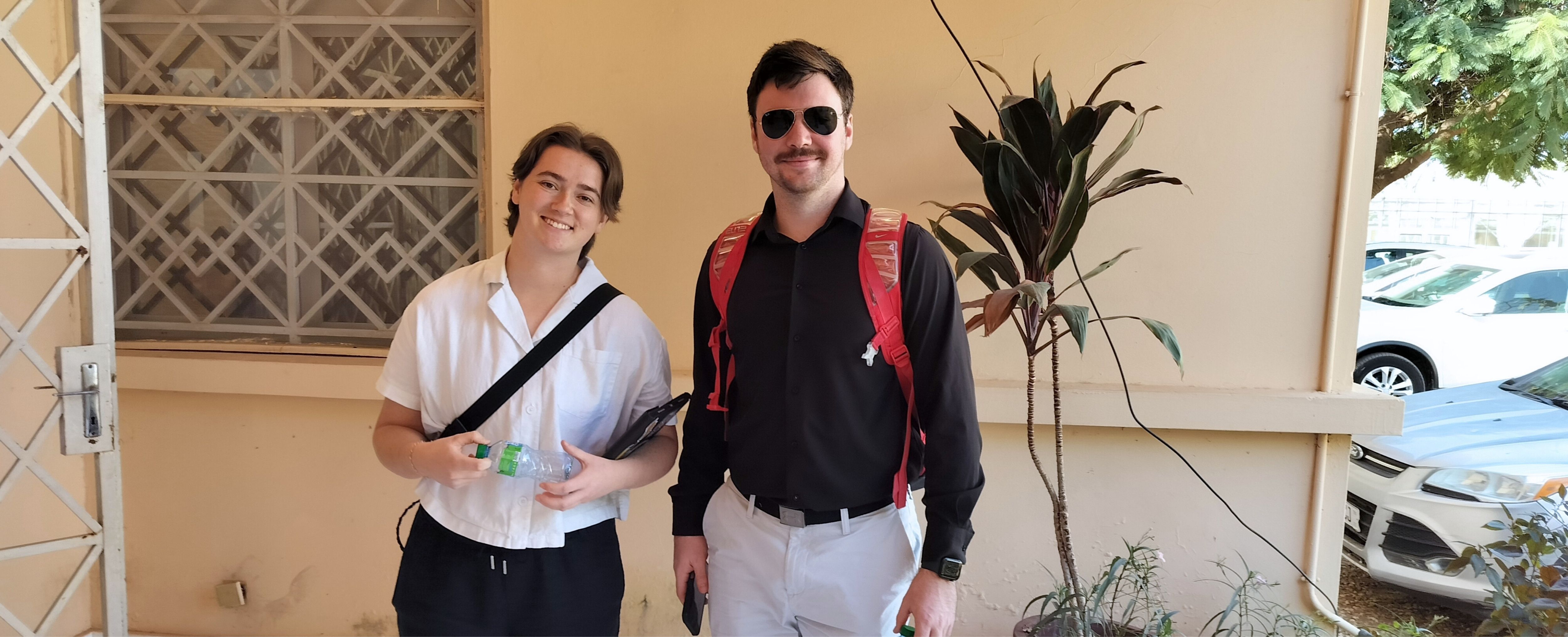
Seth Brooks and Hayden Cochran, fourth-year Master of Architecture students in the College of Architecture, Planning and Design, or APDesign, recently traveled to Senegal to present design proposals for an agricultural research building focused on increasing drought and heat resistance in dryland cereal crops.

From Dec. 12-20, 2025, Brooks and Cochran visited Thiès, Senegal, spending time at the regional headquarters of the Center for the Improvement of Adaptation and Drought, or CERAAS. Accompanied by associate professor of architecture, Todd Gabbard, they shared advanced architectural concepts for a major campus expansion aligning with CERAAS's mission.
"This was an incredible opportunity for students to see how their work can shape a real-world, global initiative," Gabbard said. "We enjoyed learning from our hosts, experiencing Senegalese culture and exploring notable architecture in the region."
During the visit, Brooks, Cochran and Gabbard met with World Bank donors, national agricultural officials and research partners, toured campus facilities and gathered feedback to ensure design and goal alignment.
This trip marked a milestone in a multi-year collaboration between CERAAS, the College of Agriculture's Global Collaboration on Sorghum and Millet, or GCSM, and the Department of Architecture.
In early 2022, CERAAS director Ndjido Kane visited K-State's Manhattan campus, where he connected with Gabbard, Nat Bascom, director of engagement for GSCM and K-State alumnus Ed Thompson to explore architectural visualizations for an expanded research center. That fall, architecture students developed initial concepts for an interdisciplinary space including advanced laboratories, residential accommodations, greenhouses and an event venue — the Mbolo Regional Center — named after the Wolof word meaning "unity" or "coming together."
"The transcontinental bridge between CERAAS and K-State's APDesign helped us secure $2 million in vital funding by transforming the Mbolo Regional Center concept into a visual reality," Kane said. "The project empowered students to design the future of the West African infrastructure for agricultural innovations."
With financial support from the World Bank secured, Kane requested further design development in the summer of 2025. Sixteen architecture students from Gabbard's studio took part, and Brooks' and Cochran's projects were selected to represent K-State in Senegal.
"This collaboration exemplifies the future of design education at K-State — where students engage directly with global challenges and partners," Michael McClure, dean and professor of APDesign, said. "Our students' work demonstrates not only design excellence, but the power architecture has to improve lives through climate resilience, sustainability and creativity."
Travel support for this experience was generously provided by Kane on behalf of CERAAS, along with support from Ed and Sue Thompson and K-State alumni Nat and Marcia Bascom.