Fall Anhydrous Considerations
I recently wrote about the 4R Nutrient Stewardship Principles:
- Right Source
- Right Time
- Right Rate
- Right Place
Few fertilizers are an example of these principles more than Anhydrous Ammonia. Despite our familiarity with it, we use it once a year, so a ‘review’ like this KSU Agronomy eUpdate can be a good idea (check out the link to Kansas Mesonet soil temperatures as well). With the potential a strong El Nino could bring us above normal winter temperatures, a couple of points deserve some extra attention as we consider just how soon we might begin to apply.
For starters, understand how soil temperature affects the potential for increased nitrification (the conversion from a more stable form to a form more susceptible to losses) rates. The 50-degree four-inch soil temperature threshold is a sound one, factoring in declining fall soil temperatures and the initial delay in the nitrification process that occurs because of the properties of anhydrous but nitrification doesn’t stop at 50 degrees. The University of Illinois suggests these soil temperature based nitrification activity levels:
- upper 70s: maximum rates of nitrification
- 60 degrees: rates drop to about 50% of maximum
- 50 degrees: 10% of maximum
- 40 degrees: 5% of maximum at 40 degrees.
In short, we’re really managing for ‘slight losses’ at most soil application temperatures as much as anything. What’s that mean for this winter? If warm weather returns and soil temperatures increase, so, too will nitrification. That doesn’t mean we’ll automatically see N losses, but it does mean we could see increased risk of loss earlier in the season.
Second, a nitrification inhibitor isn’t going to result in increased yields every time and should not be used to compensate for warm soil temperatures in an attempt to apply fertilizer earlier (warmer temperatures accelerate breakdown of the inhibitor and can in a way make them less effective for a shorter time). 4 years of K-State work at 2 EKS sites showed a significant response to the inhibitor in 3 of 8 site years…
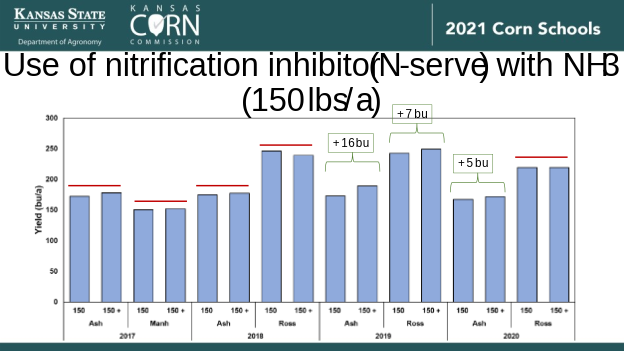
…but an average response during those three site years of 9+ bu/A or 3+ bu/A averaged over all 8 site years). The inhibitor also resulted in slightly increased nitrogen use efficiencies at one site as well. They may not be a slam dunk all the time, but when used in conjunction with appropriate soil temperatures, they can help offset some loss risks.
What this winter brings is anyone’s guess, but an understanding of the challenges our nitrogen programs might face is an important first step towards managing it as efficiently and economically this fall and next season. If you’re concerned about the potential for losses, consider a N-rich strip. It can be as simple as a single strip with 30-40 pounds of added nitrogen you can compare to during the growing season. Sometimes differences will be visible. Other times it may take specialized tools or a tissue sample, but they can be valuable comparisons to ‘test out’ our nitrogen management programs. Drop me a line if you want to know more about what those strips might entail.