Measuring Soybean Harvest Losses
Soybean finishing weather is fun. Adequate moisture, then hot and dry. Good drying weather, then rain…and more rain. These conditions can end up causing problems even beyond dodging rains and mud holes. Issues like the Green Stem Syndrome I referenced last week plus lodging and shattering can cause issues with harvest that add up before we ever have a chance to get the crop out of the field.
How much loss? Studies vary, but estimates suggest harvest losses under good conditions at 1-2 bu/A (4 soybeans/sq. ft. is approximately 1 bu/A). If you start to add any of the above factors, it can climb much higher. Most of those losses (90 percent) fall under what’s considered gathering losses, but there are pre-harvest and separating/cleaning losses to consider as well. Measuring them doesn’t have to be complicated:
- Pre-harvest losses are the first check. Do so by counting seeds (including seeds remaining in pods) in several 10-foot square samples in front of the combine.
- Gathering losses are most easily counted by harvesting an area then backing up. The area in front of the combine that is free of chaff is where you evaluate the gathering losses.
- Separating and cleaning losses happen inside the machine and are best measured in the area behind the combine keeping in mind the pre-harvest and gathering losses already measured.
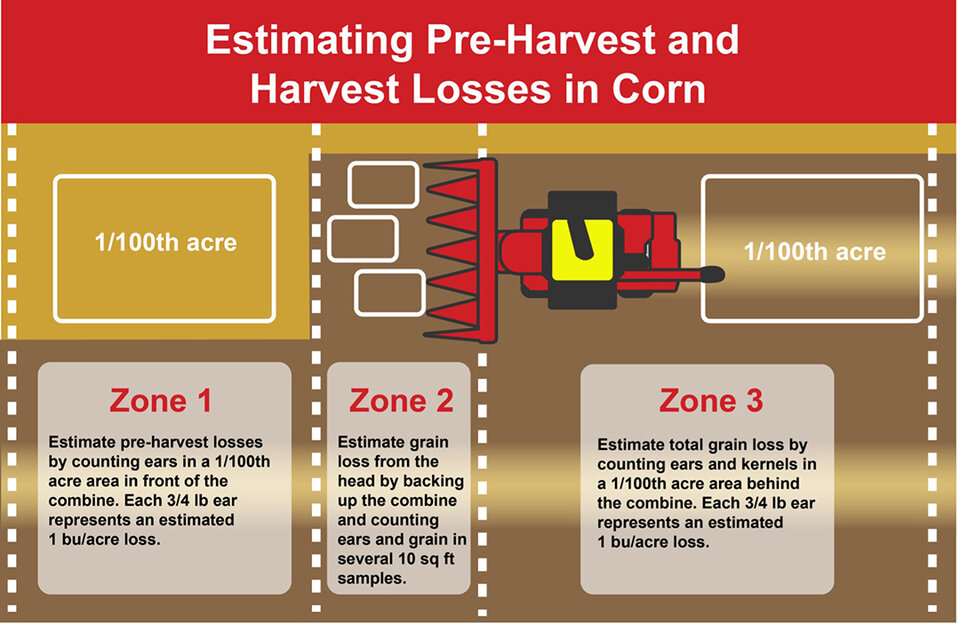
Image from How to Estimate Harvest Losses in Soybean and Corn Fields (UNL Cropwatch, October 2023)
Once you have an idea where losses are occurring, you can start to determine how to reduce them. For example: if the gathering number starts to approach two bushels per acre, consider reel or cutter bar speed or even harvest speed. Separating/cleaning losses are often related to machine capacity or operator management. You can’t do much about pre-harvest losses, but knowing loss levels can help you determine whether weather or harvest moisture, or other factors are at play.
While it’s not always encouraging to note the amount of lost crop on the ground, it can be helpful to reduce losses when things can be adjusted. It won’t be a one-time analysis. Harvest conditions change quickly so check settings regularly. Allow machine automation to do its thing but use operator knowledge to fine tune settings. You’re never going to reach zero loss, but maybe you can get to tolerable loss levels. For harvest lost calculation references, drop me a line at dhallaue@ksu.edu .