Soybean Seedling Diseases
When was the last time you recall much stand loss from a soybean seedling disease? Crop Protection Network estimates put Kansas losses at just .25% and while that’s almost $5M in value across the state, for individual growers, it might be a non-issue – until its concentrated in one area of one field.
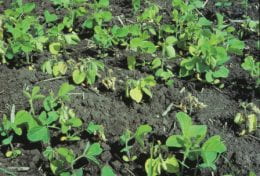
Seedlings affected by Phytophthora root rot appear scattered in a field, and symptoms resemble other seedling blight diseases. (Craig Grau, University of Wisconsin-Madison – https://cropprotectionnetwork.org/publications/an-overview-of-soybean-seedling-diseases
We often think about seedling diseases in cooler soils, and while some diseases prefer them, others (like the Phytophthora above) thrive in warmer soils. With much of the area experiencing ample moisture and a number of soybean acres planted in April, it might be a year to keep soybean seedling diseases on your radar during emergence evaluations.
The most common pathogens are the aforementioned Phytophthora plus Pythium, Fusarium, and Rhizoctonia. While disease causing conditions may differ, the result is often the same: post-emergence damping off with the base of the plant and root system often showing everything from discoloration and lesions to collapsed stems and poorly developed root systems.
Seed treatments are effective – so long as they include an appropriate active ingredient to combat the disease(s) in question. For example, Phytophthora and Pythium require active ingredients like mefenoxam, metalaxyl, or ethoboxam. Those don’t touch Fusarium, however, so knowing what your seed treatment includes can help you understand what you might be seeing in the field (see the Crop Protection Network’s 2026 Soybean Seedling Disease Fungicide Efficacy reference for product efficacy ratings)
Keep in mind as well: even with the right active ingredients, seed applied fungicide protection does have a limited protection period. If the crop emerges slowly, fungicide protection can wane. That’s why strategies like variety selection, crop rotation and proper drainage should also be a part of an integrated disease management program.
Seedling diseases are a concern, but other issues can also arise during establishment. Herbicide injury, soil compaction, high residue, flooding, cold stress, drought, planting depth, and seed quality can be problems as well. To ID, consider submitting samples to the KSU Plant Disease Diagnostic Lab (contact me or a District Office). You can also check out Soybean Seedling Diseases, available at: https://crop-protection-network.s3.amazonaws.com/publications/cpn-1008-soybean-seedling-diseases.pdf .