Poison Hemlock - Control Options
This is poison hemlock:
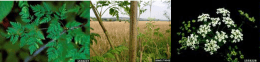 (Poison hemlock leaves (left); stems with purple spots (center); c) umbrella shaped inflorescence (right). Images from John Cardina, Jan Samanek, and Jeff Stachler, Bugwood.org)
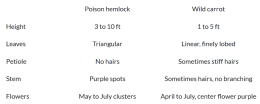
Similar in appearance to a carrot plant, it’s triangular leaves consist of multiple smaller lance looking leaflets. A first year rosette can become a 10′ tall plant by year two with erect flowering stems that are hollow, hairless, and distinctly purple spotted. Flowers/flower clusters will be an inch and a half plus in size and while appearing similar to wild carrot, the purple, hairless stems distinguish it as poison hemlock (check out the differences in the chart below, courtesy of K-State Weed Science Graduate Student Tyler Meyeres and Extension Weed Management Specialist Dr. Sarah Lancaster-Ganske)
 Control is most consistently achieved with chemicals, but timely mowing can help reduce seed production (plant elimination is unlikely), particularly if plants get too large for chemical control. If you have only a few plants, mechanical removal is an option as well. The University of Missouri has experimented with electrocution, and while not a viable option for most producers, it was relatively effective as well.
Chemical control options are numerous. A cross reference of pasture products with hemlock on the label in Kansas include:
- 2,4-D
- dicamba
- picloram
- triclopyr
- metsulfuron and
- aminopyralid
– or combinations thereof. University of Missouri research suggest picloram plus 2,4-D/aminopyralid plus triclopyr are most effective, with efforts focused on the rosette stage of the plant prior to bolting or stem elongation. University of Tennessee research suggests aminopyralid may have some efficacy at the early bloom stage as well. Bottom line: we have options, but early treatment is better than later and control windows can close quickly.
As the name implies, Poison Hemlock is toxic! For toxicity details, check out a companion article by District Livestock and Natural Resources Agent Ross Mosteller on the Meadowlark Extension District Livestock and Natural Resources page: https://www.meadowlark.k-state.edu/livestock-natresource/ .
Prior to herbicide application, thoroughly read and understand the herbicide label, following all application directions and precautions. Even products containing the same active ingredients can vary in allowable crop uses/rates.