Another Contributor to Brome Decline?
For most, Easter 2007 doesn’t ring many bells. If you were a wheat grower, however, it was a weekend of plummeting temperatures and injury to wheat lasting the rest of the growing season.
What was not so widely observed – but WAS evident – was damage to bromegrass. It was noticeable mostly in low lying areas of fields and was considered nothing to worry about…or so we thought at the time. Fast forward to 2026 and another short cold snap made notable mostly because it has been such a mild winter. Interestingly, that might be when we need to worry most.
It’s dated, but in 1993 Dr. Leslie J. Klebesadel, Emeritus Professor of Agronomy at the University of Alaska Fairbanks published a paper entitled Bromegrass in Alaska. III Effects of Planting Dates, Time of Seeding-Year Harvest on Seeding-Year Forage Yields and Quality, Winter Survival, and Second-Year Spring Forage Yield. It’s a good paper, but I want to focus on 2 excerpts from the section on Winter Survival:
Excerpt I:
Comparing two winters, the team found less damage in one year than they did in the next, with more damage in the warmer year than the colder one. Why?
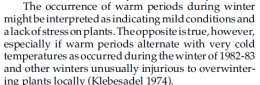
The paper went on to say:
Smith (1964) stated “Air temperatures that alternate from above to below freezing can be very damaging, especially when there is little or no insulation on the soil surface.”
Sounds a LITTLE like 2026…and it gets better…(highlights added by me…):
Dexter (1941) reported that warm periods during winter cause dehardening (loss of freeze tolerance) in plants, and that rehardening was dependent upon high levels of carbohydrate food reserves as a source of energy. This rationale explains why bromegrass plants entering the winter period with low levels of stored food reserves may be especially susceptible to winter stresses that involve several periods of alternating freeze and thaw periods as occurred during 1982-83.
Sounds a little like most falls/winters in the past 5 years!
Two thoughts:
- as cold tolerant as brome is (tolerating temperatures reaching -17 to -25 F in the Alaskan winter of 1983-1984), it doesn’t mean it’s bulletproof against it, particularly when we have up and down temperature swings.
- plants need good carbohydrate reserves going into winter for lots of reasons – and cold tolerance is one of them
Who knows what the rest of the spring/summer will bring. Maybe it will be stress free – but if it’s not, growers might want to keep this mid-March freeze in their memory bank. It might have made for a rough start to the season.