Soybean SDS - Planting Time Options
The best approach to managing any disease is an integrated approach and SDS is no different. While management factors can vary in their level of efficacy, combining them will give you the best chance for success.
Variety Selection
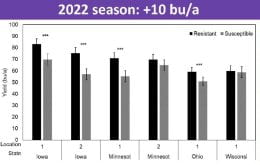
A multi-state (IA, MN, OH, WI) trial showed almost a 10 bu/A bump when using a resistant variety vs. a susceptible one:
Work below from K-State Extension Row Crops Pathologist Rodrigo Onofre shows similar results:
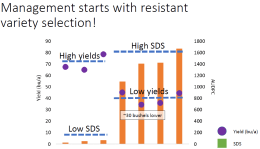
The varieties (3) on the left had some level of SDS resistance. The right (4) had lower resistance. The purple dots show relative yield levels while the orange bars represent differences in leaf area showing disease.
Row Spacing X Population
Preliminary row spacing X population work by Dr. Onofre indicated slight trends in increased foliar symptoms as populations increased while comparisons between 15- and 30-inch rows were less conclusive. Research continues to find out how consistent these initial findings are.
Soil Fertility
A Kansas Soybean Commission funded study by Dr. Onofre’s team showed potential P fertility effects as well. Not only were yield boosts consistent as P rates increased (zero to 30 to 60#/A), but foliar SDS severity declined as P rates increased as well. While more research is needed, appropriate fertility levels can hep mitigate plant stress levels in turn keeping SDS levels in check.
Planting Conditions
Multiple research trials have shown increased SDS infection risk when we experience high soil moisture levels within a few days of planting. With work still ongoing to evaluate the yield consistency of early planted soybeans, we know there are general trends towards declining yields when planting is delayed past an optimum date for an area. As such, delayed planting is likely a practice most effective on 1) our worst SDS or 2) when we can strategically delay planting to avoid high soil moisture after planting.
The Tie to SCN
While Soybean Cyst Nematode (SCN) is a different issue, high populations of SCN have been tied to increased SDS severity. Any practice to reduce SCN (crop rotation, resistant varieties, etc…) could help for SDS levels as well.
Seed Treatments
Most are familiar with the demonstrated efficacy of seed treatments (fluopyram or pydiflumetofen) against SDS over ‘base’ seed treatments. If you want to know more about seed treatment ratings – against SDS or other seedling diseases-, check out the Fungicide Efficacy for Control of Soybean Seedling Diseases reference available online or upon request.
Prediction Tools
SDS work has included disease prediction tools as well. While too soon to know their accuracy level, a knowledge of the most important SDS contributing factors can give you a pretty good idea of whether disease might be an issue later on – or not.