Integrated Weed Management (Dr. Kevin Bradley, University of Missouri Extension Weed Scientist)
University of Missouri Extension Weed Scientist Dr. Kevin Bradley often shares a word of caution at the end of his Midwest Crops Conference weed management update. Whether raising concerns about product resistance to sharing research on alternative weed control methods, his approach to weed management is always done on an integrated scale vs. based on herbicide programs alone. This week, he shared research on two additional ‘tools’ for the weed management tool box.
Research summary #1 centered on the value of cover crops for weed control, showing work by weed scientists from 11 states (19 site-years; 2021 & 2022 growing seasons) underscoring the value of a cereal rye cover crop:
- Terminating cereal rye 2 weeks before planting resulted in a 16% reduction in pigweed density when compared with no-till.
- If cereal rye termination was delayed and soybeans were planted green, there was a 44% reduction in pigweed density as compared with no-till.
The second study took a look at research in to row spacing as it relates to weed seed production. Note the 49% reduction in weed seed produced in 15″ rows vs. 30″ rows (7″ and 15″ rows were not significantly different). 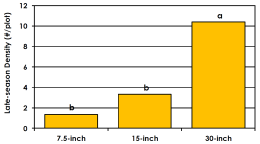
*Results summarized across herbicide programs, tillage types, and planting populations.
**Means followed by the same letter are not different, P≤0.05
Source: Source: Schultz, J. and K.W. Bradley, 2015. Weed Technol. 29:169-176.
Lots of factors beyond weed control factor in to whether to change row spacing or implement a cover crop ahead of soybeans, but if changes are in store, consider the weed management – and herbicide program – benefits as well.