Soybean Drydown
One day they’re green – the next they’re not: soybean drydown. It happens faster than you might think, often even faster than corn.
Depending on weather, we might see corn drydown rates ranging from 1% in late August to <.5% as we get into October. In contrast, soybean drydown rates can reach as much as 3%/day. Iowa State work noted almost flat moisture levels (60% during the de-greening period) that dropped rapidly as pods turned to a mature color at the beginning of R7 (full maturity).
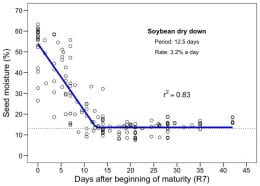
Average seed moisture dry down (blue line) across four soybean varieties representing a range of maturity groups at four planting dates from 2014 through 2016 near Ames, IA. Horizontal dashed line represents 13% grain moisture, open circles are actual data. Source: How Fast do Soybeans Dry Down in the Field? September 19, 2017 Content Author: Rafael Martinez-Feria, Sotirios Archontoulis, Mark Licht
At this point, dry matter accumulation is complete and seed moisture decreases rapidly – 3%+/day in the first 12 days after maturity in the ISU study. Former KSU Agronomist Dr. Ignacio Ciampitti saw much the same with drydown starting at 58% moisture decreasing to 12% in just 15 days. Even with lots of variables at play: it happens fast!
What difference does it make?
In many cases, maybe it doesn’t. If moisture drops to 13% and stays there, maybe it’s not worth thinking about, but what if it goes still lower?
Work from the University of Nebraska quantified the economic effect of moisture losses in a study where moisture samples were collected from 115 truckloads of soybeans at elevator delivery. Their work found close to 20% percent were below 10% moisture and almost 40% were below 11%. Two percentage points doesn’t seem like much until you find out those two percentage points (11 vs. 13) represent a 3%+ yield loss.
What can we do?
While there is value in harvesting at higher moisture, it’s impossible to harvest every acre at optimum moisture. That’s when a few little things may help:
- Harvest at higher moisture levels – Soybeans are fully mature when 95% of the pods are a mature tan color, likely with leaves still on the plant and maybe sitting at a 14-15% moisture. It may require harvest equipment adjustments (even throughout the day as conditions change) and slower harvest speeds, but if adjustments can be implemented without causing other economic losses, they could be a consideration.
- Coordinate harvest to capture overnight moisture – This also helps reduce shattering losses we see when warm windy afternoons drop soybean moisture levels to 8 or 9%. The losses can add up. 4-5 beans/square foot on the ground equals almost a bushel per acre in losses.
There’s a lot to think about during harvest. Soybean harvest moisture may not be high on your list, but if we can minimize moisture (and shattering) losses, it might deserve at least a little greater consideration.