Fall Armyworm Fallout - Next Steps?
No – this not a Fall Armyworm (FAW) only blog! Unfortunately, another generation of FAW continue to be of concern causing additional injury to stressed stands and complicating the recovery process. If you’re ready to ‘move on’ from feeding injury sooner than later, keep a few things in mind.
Did they kill the stand?
FAW don’t feed on roots or release toxins causing stand decline. It’s more likely the feeding results in loss of leaf area (the plant’s photosynthetic capacity) preventing plants from the process of growing foliage while replenishing root mass. This happens in the spring when plants begin growth and again when we harvest (graze/hay) then again if FAW feeding occurs. Grass plants do a great job of responding, but can’t continue to do so without some ability for root restoration and can eventually get weak enough they die.
Unfortunately, its difficult to know if the plant is dead or not. The obvious sign is no regrowth – but we may have to allow time for that to occur. This graph depicts what can happen when we graze short:
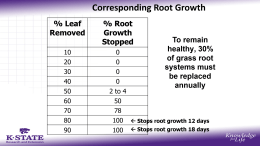
After significant feeding injury a few years ago, the K-State Plant Disease Diagnostic Lab and Frontier Extension District Agents Rod and Ryan Schaub evaluated roots from damaged stands. You can see their findings at: https://youtu.be/VKXFPK3lX1k . In short, if the roots held soil, they likely still had some life in them. If not, there was cause for concern. NOTE: evaluations were done post dormancy so time will be needed before we can apply these findings to our stands but it’s a good reference for later evaluations.
Plant Back Interval Concerns?
Consider previous herbicide applications and any required plant back intervals prior to reseeding. Whether applied with spring fertilizer or insecticide this summer, plant back intervals are important. This KSU eUpdate article is a good reference and includes potential application damage and plant back intervals.
Should I Replant This Fall?
That really depends the planting window for your intended forage, but the window for planting cool season grasses typically closes in mid-September:
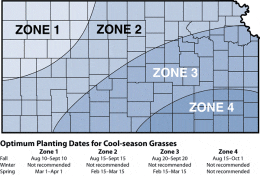 This doesn’t mean later planting won’t work, but the establishment risk increases. The intent of a planting ‘window’ is to provide the forage time to germinate and grow enough leaf area via photosynthesis before dormancy to replenish root reserves. If it doesn’t reach that leaf area threshold (3-4 leaves minimum), it may lack ample root energy for winter survival and early spring growth. Knowing yields will be lowered if we wait to plant until spring, it may be tempting to seed this fall. While possible, it does come with increased risk. For more planting dates, see the Kansas Crop Planting Guide: https://bookstore.ksre.ksu.edu/download/kansas-crop-planting-guide_L818 .
NOTE: monitor any reseeding done this fall for late FAW feeding during establishment. With any luck, this round will complete their feeding season in NEK – but there are no guarantees.
Longer Term: What Needs to Be Considered?
This might be the toughest question of all and requires looks back and ahead:
Looking back, consider the factors potentially contributing to damage:
- Timing of utilization (haying OR grazing timing has had an impact)
- Forage type (definitely a factor)
- Harvest height (maybe?).
Looking ahead provides the opportunity to determine what we might need more or less of in our forage system.
- There may be good reason you’re heavy on cool season forages, but there may be reasons to add in warm season forages as well.
- Do you need as much hay or would grazing allow us to better manage future FAW infestations?
There are no easy answers and no one size fits all solution. In the short term, continue to evaluate stands, shooting for a goal of 4-6″ of regrowth prior to fall dormancy. Longer term, let’s hope this isn’t a regular issue requiring forage system changes while at the same time keeping our options open as well.