After(?) the Armyworm…
When moth numbers like these show up in your Fall Armyworm pheremone trap, you might be in trouble…
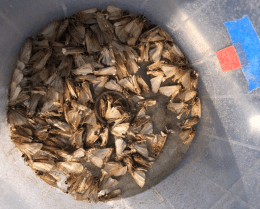
…and trouble is what many growers experienced the last two weeks as Fall Armyworm (FAW) larvae feeding damage hit many brome and alfalfa stands.
Right now, we’re observing multiple stages of the pest’s (+/-) 2 week feeding cycle and scouting should continue! It’s easier to attack FAW early than late.
Unfortunately, we can’t get to every infestation early, leaving many asking ‘what’s next’? There aren’t any definitive answers – just more questions…
- What is current status of the feeding population? If you have high (4-5/sq. ft.) numbers of small (3/4″ or less) larvae, are open to applying an insecticide, and you can do so in a timely manner, you might reduce feeding damage. Larger (1″+) larvae are less likely to be adequately controlled with an insecticide application.
- What was the state of the stand before feeding? How did the stand respond post-harvest? If it was able to take advantage of July moisture and regrowth was good, it can likely withstand greater feeding injury than stands that had not. A perennial grass plant regrows from root reserves requiring adequate foliage regrowth to a) put out new leaves and b) ‘refill’ it’s root system. If plants didn’t return to a 4-6″ height (4/5 leaves) prior to feeding, root energy levels may be reduced – with recovery slowed. Weed pressure, fertility issues, etc… contribute to stand health as well.
- What is the outlook ahead? If soil moisture is good and there’s time for regrowth prior to winter dormancy (early November…) and we don’t see additional feeding without good recovery and there aren’t other issues to contend with (that’s a lot of ands…), a grass stand in good health will likely recover. That doesn’t mean it will return immediately to optimum production levels, but it will survive to produce another season.
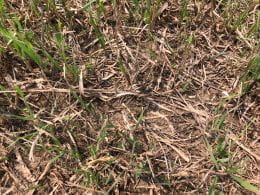
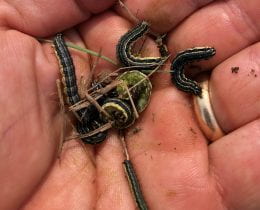
Ultimately, there’s no way to predict with certainty what might result from heavy feeding or insecticide vs. no insecticide applications. It’s a dynamic system. What we can do is be vigilant for the remainder of the season:
Additional Generations: The life cycle of the FAW is +/- 30 days, meaning there’s a chance we could see one or more cycles prior to fall dormancy. They may move on during the moth cycle – but they may not (or high moth numbers elsewhere could decide to lay eggs here for another generation)!
Insecticide Applications: Scouting every week (if not more…) is suggested. When isecticide applications are made, always read and follow label directions, applying appropriate rates of insecticide AND carrier volume. Check out these KSU Agronomy eUpdate articles with product information:
- Product cross reference by crop: https://eupdate.agronomy.ksu.edu/article/late-summer-insect-update-fall-armyworms-654-4
- Efficacy trial data (2021): https://eupdate.agronomy.ksu.edu/article/update-on-fall-armyworms-and-armyworms-608-7
NOTE: Always read and follow label directions for product efficacy as well as human/animal safety. Many labels include Pre-Harvest (PHI) and Pre-Entry (PEI) intervals that should be considered prior to application. Some reports of animal discomfort following applications to pasture have been reported. If in doubt, err on the side of longer than shorter animal removal time frames. For a great reference on PHI and grazing restrictions check out Management of Insect Pest in Rangeland and Pasture (Oklahoma State University).
Harvest Management: Monitor grazing pressure. Continual removal of new regrowth could stress root systems already asked to support a grazed (by livestock) plant and one fed on by FAW. Avoid a second cutting (or grazing) of grass hays and watch regrowth in the alfalfa crop for feeding pressure as well.
Weed Pressure: Stands thinned by feeding are susceptible to invasive broadleaf and grass weed species, particularly if stressed by additional factors above. Herbicide use when grass is under stress should be done with care (always read and follow label directions!), but thinking ahead to the need for potential weed control applications as warranted is suggested.
Keep scouting! While there is a stage of FAW spent underground, this pest does not cause significant injury to root systems. New regrowth is an entirely different story. So while young larvae may be difficult to find (and not much fun to look for…), it is important to stay on top of scouting to catch them early. A stand evaluated last week averaged less than 7 larvae/sq. ft. (40% 1″+) in the first 7 stops – but the next 3 jumped to over 30/sq. ft. – many 3/4″ and less. Numbers – and injury – can vary greatly across short distances.
Drop me a line (dhallaue@ksu.edu) if you have questions and check back here for updates as the season progresses!