Looking Ahead to Fungicide Applications
If the confirmation June 11th of Tar Spot in NEK caused you to think more about fungicide applications, current input costs + corn price + weather outlook may have caused you to pause a bit. Maximizing the value of inputs is important and there are things we can do to maximize fungicide ROI as well:
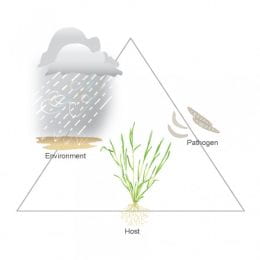
- Know the disease: Plant Pathologists often start disease discussions with the disease triangle below from Iowa State University Integrated Pest Management. The host is planted. Tar Spot is confirmed as a nearby pathogen, but other diseases (Southern Rust, Gray Leaf Spot, etc…) may also be of interest even if we haven’t seen/heard about them yet. Understanding what we are up against now and in the future is key. Take soybean diseases for example. There are fungal diseases in soybeans, but they tend to be yield limiting less often than corn diseases. Understanding disease potential can help us make economical and environmentally sensible fungicide application decisions.
- Select an appropriate fungicide: Not all fungicides work equally against all diseases. University Plant Pathologists annually update fungicide efficacy ratings for various crops (see corn here). For Tar Spot, 26 products are listed but just 3 are rated Very Good. 8 are Good to Very Good. 9 are not labeled or efficacy is unknown. For Gray Leaf Spot, however, 15 products are rated Very Good to Excellent. Selecting the right product has to begin by determining what we’re trying to combat.
- Timing is key: In the eUpdate article above, Dr. Onofre outlines fungicide guidelines directly related to Tar Spot with some variability based on when you find the disease, crop growth stage, etc… Scouting is an important aspect of determining when to apply, not only for knowing what disease(s) might be present, but also to determine crop growth stage. Most fungicide products will have a period of activity extending from 14-21 days post application. Apply too early, and there may not be enough AI remaining in the plant to combat disease. Apply too late and there will be some diseases the product may not be able to get ahead of.
- Small details matter: Product rates may vary based on what we’re trying to control. Mix order can be important and nozzles do make a difference. Environmental conditions are important: small droplets can evaporate after leaving the spray nozzle if humidity is less than 50 percent and temperatures are more than 92 degrees after application.
When a fungicide doesn’t work as expected, we look back at one or more of these factors to find the culprit. With a little planning, we can avoid that step and help the product achieve success the first time.
For a list of product ratings or more information on Tar Spot, drop me a line via any Meadowlark Extension District Office or e-mail dhallaue@ksu.edu .