Fungicide Applications - The Importance of Scouting…
Current Situation:
The Kansas section of the Crop Protection Network Tar Spot of Corn map added another yellow county this week.
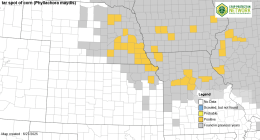
The addition of JF Co. this week brings KS to 3 counties in 2 weeks. Thus far, most reports have been of fairly low disease levels lower in the canopy.
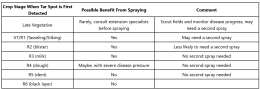
The lack of a rapid increase of confirmed counties is a positive. Hopefully, disease incidence and severity will remain low, even as vigilant scouting is a key to staying ahead of progression. As we approach VT, the front end of the optimum fungicide application window is approaching according to this KSU eUpdate article from Extension Row Crops Pathologist Dr. Rodrigo Onofre. This reference from the Crop Protection Network provides a visual representation:
Now What?
Knowing it’s nearby and knowing our optimum application timing, is there any reason not to just quit scouting and apply early? YES! Multiple ones…
For starters, a lot can happen in a few days, particularly with Tar Spot and Southern Rust. In the last 3 days, Southern Rust has moved N & W in SE Arkansas amid concerns recent wind events have spread it further N (see map here). An application effective against multiple diseases simultaneously is something to keep in mind, but can only be accomplished with good scouting.
Second: fungicides have a limited life span. Most will provide 14-21 days of activity, but all are NOT created equally (single vs. multiple MOAs/etc…)! See the fungicide efficacy reference below for product rankings against multiple diseases keeping in mind we won’t get to dough (R4) – the growth stage when fungicide application efficacy becomes more variable – for 30 days after R1 (silking). If we apply early, particularly if we do so based wholly on timing and not disease factors, we run the risk of running out of product activity before the potential for damage from disease has concluded. As with herbicides, appropriate use of fungicide products is an important stewardship practice.
Keep Scouting!
Scouting can be a lot of work, but particularly with Tar Spot, it can be an important practice, as outlined by Purdue Plant Pathologist Darcy Telenko in her 10 Tips & Tools to Prepare for Tar Spot in Corn . #2 says:
Scouting is critical – I would start keeping an eye out once corn reaches V7/V8 looking in the lower canopy to see if you can find any small stroma . You want to catch the disease before severity ramps up. If it’s 5% or more in the upper canopy it’s too late to spray to slow it down.
With that in mind, a couple of scouting thoughts:
- 5% is more than you think – but it isn’t much! It’s best to catch it early!
- Tar Spot lesions often show up in the lower canopy. Southern Rust will likely be in the upper canopy. Check out plants from top to bottom.
- Check multiple spots. University of Nebraska work has shown significant disease differences from the pivot pad to the outer pivot span based on the length time the canopy stays wet.
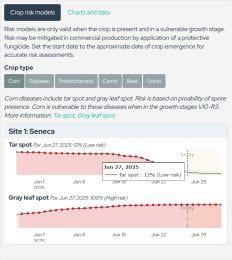
- Consider digital tools to direct scouting. The Crop Protection Network Crop Disease Forecasting Tool developed by the University of Wisconsin predicts the likelihood of increasing tar spot (& gray leaf spot), using models developed with research from multiple University partners in combination with field location and recent weather data. It won’t tell you if you have tar spot, but it can help guide you where to look. This is a screenshot of the result from a site in the NW part of the District today:
If you think you have Tar Spot or Southern Rust and your location (county) doesn’t yet show up on the map, we’d love to hear from you! Knowing continued disease pressure and movement are keys to making appropriate fungicide application decision.
To Learn More:
- Corn Fungicide Efficacy Ratings
- June 13 Purdue Pest & Crop Newsletter article by Plant Pathologist Darcy Telenko. It looks at some interesting research from 2024. Good read!
- Corn Disease Resource Center – a collaboration between Kansas Corn and K-State Research & Extension Row Crops Pathologist Dr. Rodrigo Onofre.