Considerations for Early Planted Soybeans
There’s been a lot of recent work evaluating the merits of early planted soybeans (KSU summary: https://eupdate.agronomy.ksu.edu/article/soybean-planting-date-and-maturity-group-selection-635-4 – graph below…). This effort to attain quicker canopy closure and potentially adding more nodes/plant then retaining the pods that are set has come with somewhat mixed results – and the need for greater attention to other planting practices as well.
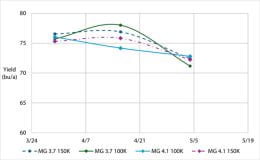
The effect of planting date on irrigated soybean yield at the Kansas River Valley Experiment Field in 2021-2024. Each line represents a maturity group (MG 3.7 or MG 4.1) and seeding rate (100K or 150K).
Take soil temperature at seeding for example. It’s a focus when planting corn but is typically less concerning for soybean planting with soil temperatures seldom below the ‘optimum’ 60-degree level we aim for to get quick (and uniform) soybean emergence during our ‘typical’ planting window. Don’t want to wait? If you can tolerate the potential for reduced emergence and/or uniformity, plus maybe a little corkscrewing as plants emerge, it might not be an issue. Soybeans compensate for numerous issues during the growing season, and (minor?) uniformity issues may not be a big deal. Soybeans absorb water in the first 12-24 hours. Cold soil water temperatures (under 45 degrees F) can result in injury. If possible, concentrate soybean planting when soil temperatures will be greatest (late morning/early afternoon). Varieties with higher early season vigor or cold tolerance scores are also recommended.

A second consideration is the potential for increased early season disease/ insect pressure. When we delay emergence in cool/wet soils, disease (fusarium, pythium, etc…) concerns increase. Sudden Death Syndrome (SDS) infection potential increases when seedling development is slowed by cool/wet soil conditions with irreversible results as well. Variety selection can help overcome some of these pathogens, but be sure early planted soybeans have appropriate seed treatments applied as well.
Don’t forget bean leaf beetles! If early planted soybeans are the only beans around, the potential for these damaging beetles to cause problems increases.
If early planted soybeans are a fit for you, give it a shot. You can help increase your chances of success by considering some of these practices as well.