The Effect of Pasture Fertility on Weed Pressure
Some of our pasture/hay fertilizer is on. Some is a work in progress. With the time/money spent to make it happen, have you ever wondered if it’s worth it?
The value of fertilizer for cool season forages has long been a promoted best management practice (with application rates based on tons of forage produced or animal units grazed). In fact, they’ve worked so well we’ve attempted (with mixed results) to make it work in warm season forage systems as well.
Yield response isn’t the only benefit of a balanced fertility program, however. According to a 3 year, 63 pasture (fescue) study from the University of Missouri (Bradley, Bunton, Trower), fertility plays a role in weed/brush pressure as well. In their work, pastures were sampled every 14 days looking at weed species/density in a given area. Soil test levels, forage density, groundcover, and stocking rate were also evaluated (fertility results below…)
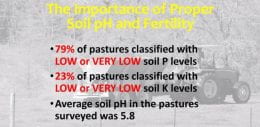
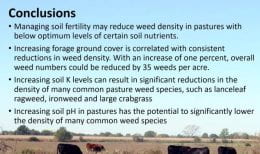
While results varied between broadleaf weeds, brush, and grassy weeds (and within each category as well), soil fertility was confirmed as an important facet of weed/brush management. Soil pH was the biggest influencer, reducing the density of both brush and broadleaf species. Phosphorous (P) levels were also a factor, with each increase in soil test P reducing biennial and perennial weed pressure levels. Positive reductions of ragweed, ironweed and large crabgrass were noted from increasing soil test K (Potassium) levels as well.
Some of the reduction was directly attributed to plant density. The study found each 1% increase in ground cover having the potential to reduce weed pressure by 35 weeds/acre (Bradley’s conclusion slide below).
Good fertility programs aren’t cheap – but constantly fighting weed pressure isn’t inexpensive, either. Making sure you have a balanced fertility program may be your best bet at least attempting to get the best of both worlds.
Interested in fine tuning your fertility management program for 2026 and beyond? Contact me via any of our District Offices or dhallaue@ksu.edu .