A Way Too Early Confirmation of Tar Spot
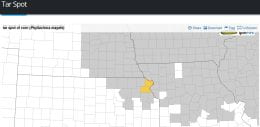
This is not a map you want to be first on – but here we are. On June 5, 2024, K-State Research & Extension Row Crops Pathologist Dr. Rodrigo Onofre confirmed the first Tar Spot finding of 2024 in corn fields in Doniphan and Atchison County Kansas. This is 3-4 weeks earlier than confirmation in 2023.
Interspersed below are Tar Spot resources to answer some common questions you might have about this challenging disease.
Is this early finding a surprise?
Maybe…but not totally… While this disease continues it’s spread south and west into Kansas, for NEK, even as the timing is earlier than preferred, it’s not completely unexpected. The Corn Belt area affected by Tar Spot has been increasing since 2018 (https://corn.ipmpipe.org/tarspot/historical-end-of-season-maps/) and in Kansas since confirmation in 2022. We now have established pathogen sources in corn residue across much of the NE part of the state allowing this disease to get a start as soon as conditions allow.
What are those conditions:
- 60-75 degree F temperatures
- > 7 hours of leaf wetness
- Irrigation
For some areas of the state, those were certainly the conditions in May…
What were the conditions surrounding THIS confirmation?
See more details in this afternoon’s KSU Agronomy eUpdate, but fields have had a history of Tar Spot. Previous crops were both corn and soybeans.
Should spray applications begin?
Scouting is always a best first option. While I do expect this to be an increasingly common corn pathogen, every field will be different (hybrid susceptibility + previous crop management both affect pressure…). Consider this advice from University of Wisconsin Field Crops Pathologist Damon Smith:
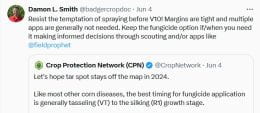 Confirmed levels right now are low. Unless scouting dictates otherwise, fungicide applications are not warranted at this time. Be aware of disease presence. Scout to determine levels in your fields. Plan ahead for fungicide applications should the need arise.
What products work – which don’t?
There are lots of good products available. One good reference is this report summarizing efficacy research from the Corn Disease Working Group, a consortium of Plant Pathologists from across the country. This excerpt shows ratings for specific diseases (a few Tar Spot ratings outlined in the vertical gray box at right). Efficacy ratings are outlined in the purple box at the top.
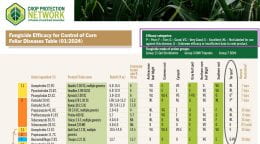
NOTE: four years of data from Darcy Telenko (Purdue) and others shows definite efficacy differences among products as well as multiple mode of action products vs. single mode of action products.
Where can I get additional information:
- Fungicide Selection: Fungicide Efficacy for Control of Corn Foliar Diseases [PDF]
- For a deeper look into the disease: Crop Protection Network publication solely dedicated to Tar Spot: https://cropprotectionnetwork.s3.amazonaws.com/tar-spot-filename-2020-05-12-175731.pdf
- Regular Kansas based updates: the KSU Agronomy eUpdate includes a ton of information on numerous topics, and will be a great source of regular updates on the current conditions surrounding Tar Spot for us, including Kansas research results and observations from K-State Research & Extension Row Crops Pathologist Dr. Rodrigo Onofre. Find it here.
- Disease confirmation: suspicious about what you might have? samples are always welcome in the K-State Plant Disease Diagnostic Lab. Information on sampling and submission can be found at: https://www.plantpath.k-state.edu/extension/plant-disease-diagnostic-lab/
Feel free to drop me a line as well via any of our Meadowlark Extension District Offices (contact information at left) or e-mail to dhallaue@ksu.edu. I’ll be posting regular updates and additional information here as might be useful. Best of luck!