Yellow Garden Spider

By Dr. Raymond A. Cloyd
Professor and Extension Specialist in Horticultural Entomology/Plant Protection
Thursday, Sept. 3, 2026
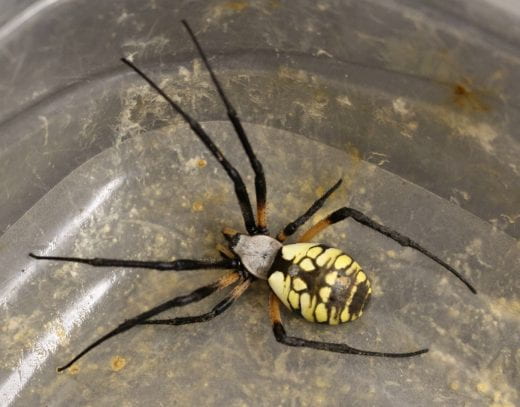
We are at that time of year when people start noticing the yellow garden spider, Argiope aurantia, an orb-weaving spider, in landscapes, gardens, unmanaged areas in grasslands, and along roadsides and fencerows. Yellow garden spider females are 1/2 to 1.0 inch (1.2 to 2.5 centimeters) long, with black and yellow markings on the abdomen, and a silvery cephalothorax (Figure 1), which is the fusion of the head and thorax associated with spiders.
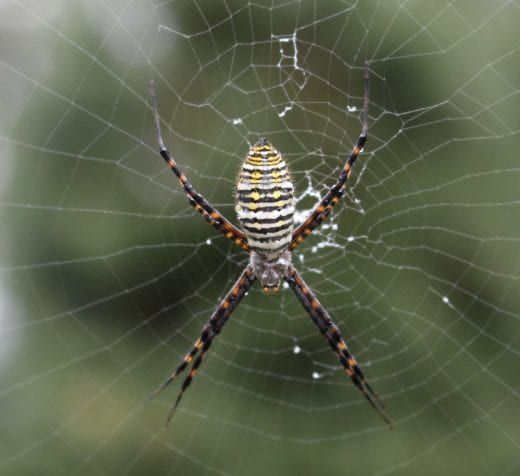
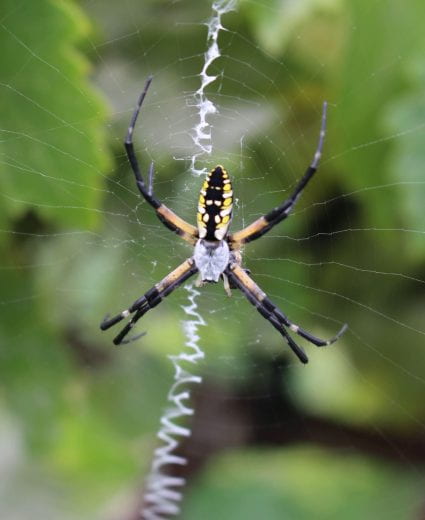
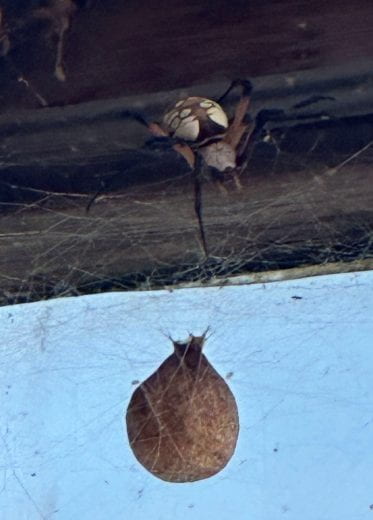
Another species in Kansas is the banded garden spider, Argiope trifasciata (Figure 2), which does not have markings on the abdomen, but black transverse lines are typically present. A yellow garden spider female is usually suspended with the head pointed downward in the center of the web that has vertically crossed zig-zag bands (Figure 3). A female produces an egg sac in the fall that may contain between 400 and 1,200 eggs. The egg sac is brown and usually suspended within the web (Figure 4), which protects the eggs inside from predators and temperature extremes. The female dies after producing the egg sac. Spiderlings overwinter in the egg sac and then emerge (eclose) from the egg sac in the spring.
Yellow garden spiders are active in the morning and at night, creating webs that are attached to trees, shrubs, or weeds. They generally build webs in open areas with tall weeds or herbaceous plants, instead of inside the canopy of trees and shrubs or inside shelters. Yellow garden spiders detect prey on their webs by sensing vibrations as prey attempt to escape. Prey may include annual or dog day cicada (Tibicen pruinosa) and June beetle (Phyllophaga spp.) adults. However, grasshopper adults are the primary food source captured on webs. After an adult grasshopper is captured on the web, a yellow garden spider will wrap the grasshopper in fine silk (Figure 5), a process called walking or rotational swath.
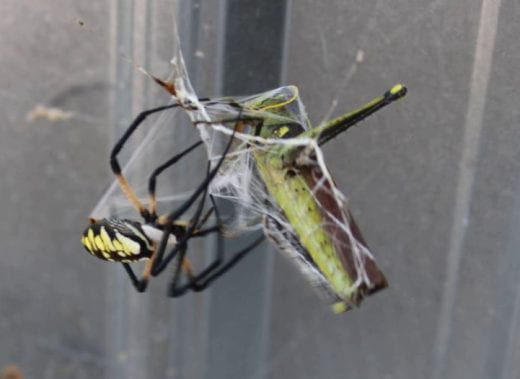
Once the grasshopper is secured, the yellow garden spider will bite and inject a toxic venom that kills the grasshopper. The injected venom liquifies the internal organs, which allows the yellow garden spider to easily consume the grasshopper.
Raymond Cloyd – Horticultural Entomology/Plant Protection